0° Cancer. The cardinal water gate. The longest day of the year.
Every June, astrology says the Sun enters Cancer and the year turns inward. Science class says Earth tilts toward the Sun, the Northern Hemisphere receives its maximum daylight, and summer officially begins.
Both stories are true. Neither story is complete.
Because the Solstice is not only a peak in sunlight. It is a change in circuit state.
At the same moment the thermal circuit opens wide, Earth's electromagnetic coupling to the solar wind drops toward its seasonal minimum. The day of maximum light is also the day the magnetic door begins to close.
That is the Solstice Paradox. And it may be the physical reason Cancer has always been the sign of the shell.
Two Separate Systems
The relationship between the Earth and the Sun is not one circuit. It is two.
Thermal Circuit
Light, heat, angle of incidence, seasons, agriculture, weather. This is the Solstice everyone learns first.
Electromagnetic Circuit
Solar wind, IMF polarity, magnetic coupling, geomagnetic storms, flux transfer events. This is the Solstice most people never see.
The first circuit is thermal. It tracks radiation — the angle of sunlight hitting the atmosphere, the density of energy per square meter, the heat that drives seasons, agriculture, and weather. This is the circuit everyone learns. At the June Solstice, the Northern Hemisphere is angled directly toward the source. The thermal input is at its annual maximum. If you imagine Earth's axis as a rheostat — a variable resistor controlling how much solar energy the atmosphere absorbs — the Solstice is the moment the knob is turned all the way up.
The second circuit is electromagnetic. It tracks the magnetic coupling between Earth and the solar wind — the continuous stream of charged plasma the Sun fires outward at a million miles per hour. This circuit has its own switching schedule. And it runs on completely different logic.
Understanding the difference between these two circuits is the foundation of Electric Astrology. It is also where the standard story about the Solstice starts to break.
The Rheostat Is Wide Open. The Main Breaker Is Off.
In 1973, two geophysicists — C.T. Russell and R.L. McPherron — published a paper in the Journal of Geophysical Research that should have rewritten the popular understanding of astrology. Instead, it was filed away and read almost exclusively by space weather forecasters and satellite operators.
What they found was a pattern so precise it is unsettling.
Earth's magnetosphere — the invisible electromagnetic shield that protects us from the solar wind — does not hold steady year-round. It has a switching schedule. And that schedule maps directly onto the structure of the Tropical Zodiac.
Here is how the switch works.
The Sun's magnetic field (called the Interplanetary Magnetic Field, or IMF) travels outward with the solar wind. When that field arrives at Earth, what happens next depends entirely on the geometry of the encounter — specifically, on the orientation of Earth's magnetic field relative to the incoming solar field.
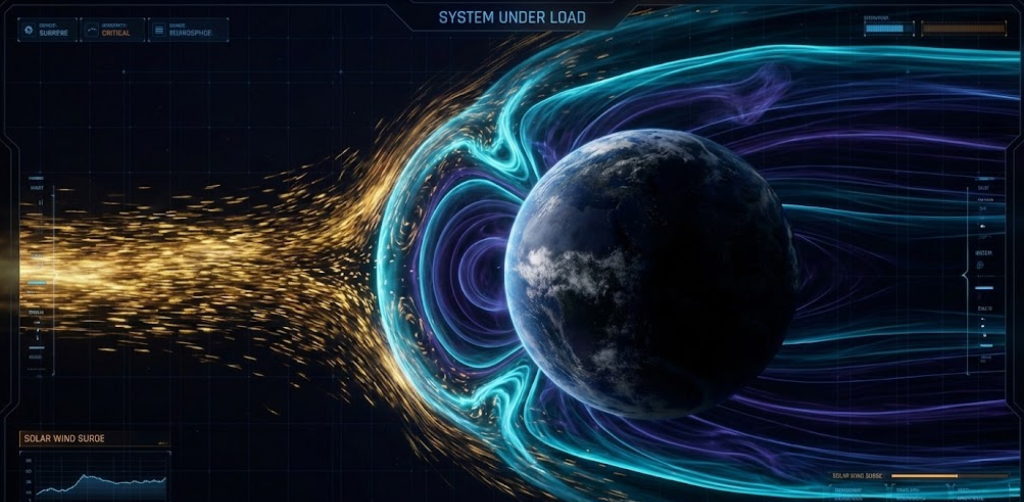
During the Equinoxes — Spring and Fall — the tilt of the Earth aligns perfectly with the Parker Spiral of the solar wind. The fields line up with correct polarity. In electrical terms, the connection is made. The resistance drops to zero. What happens next is not a metaphor: NASA has confirmed the formation of Flux Transfer Events — magnetic portals, Earth-sized, that open approximately every eight minutes when the alignment is right. Through these portals, high-voltage solar plasma pours directly into Earth's atmosphere, bypassing the shield entirely.
The Main Breaker is closed. The portals are open. The current is flowing.
Now look at the Solstices.
In June and December, the Earth is tilted at its maximum angle relative to the solar wind. The magnetic fields are misaligned. They are perpendicular. The fields do not splice together — they push apart. The magnetosphere thickens. Becomes impermeable. The Flux Transfer Events stop. The portals close.
Maximum thermal input from the Sun. Minimum electromagnetic coupling to the Sun.
The Rheostat is wide open. The Main Breaker is open.
This is the Solstice Paradox. You are bathed in more sunlight than any other day of the year, and your planet's electromagnetic door is sealed shut.
Maximum light. Minimum coupling. The sign of the shell begins when the planet itself goes into Shield Mode.

Why This Is Not a Small Difference
At this point a reasonable skeptic leans forward and says: Okay, so a little more energy gets in during the Equinox. Does that actually matter?
This is where the math ends the argument.
In electrical engineering, power does not scale linearly with voltage. It follows the Square Law:
P = V² / R
If you double the voltage, you do not double the power. You quadruple it.
When the Russell-McPherron effect kicks in — when those magnetic portals open during the Equinox windows — the geomagnetic activity does not just tick up slightly. It spikes. And the power delivered to the system does not just increase proportionally. It surges by the square.
The difference between the Equinox and Solstice electromagnetic environments is not subtle. It is the difference between working on a live transformer during a thunderstorm and working in a properly grounded, isolated panel room.
This is why the Cardinal signs — Aries, Cancer, Libra, Capricorn — feel categorically different from one another despite all being called “Cardinal.” Aries and Libra are commissioned during Open Breaker conditions. Cancer and Capricorn are commissioned during Shield Mode. They are not the same quality of Cardinal. They are different operating environments.
The Zodiac is not a personality quiz. It is a commissioning report. And the Russell-McPherron effect is the smoking gun in the data that proves the Quality of Time is not a mystical feeling.
It is a switching schedule for the local distribution grid.
The Crab Has a Shell for a Reason
None of this is news to the people who wrote the mythology.
Astrologers have called Cancer — the sign that begins at the Summer Solstice — the sign of the Crab for thousands of years. A creature that carries a hard shell. That retreats inside when threatened. That protects what is inside from what is outside.
They were describing the magnetosphere.
At the Solstice, the shield is at maximum thickness. The portals are sealed. The Earth itself is in insulated, self-contained mode. High thermal input from the radiation. Maximum resistance to electromagnetic penetration. If you were commissioned — born — during this window, your biological machine was built for that operating environment. You are designed to be self-contained. You carry the shell.
Aries batters down the door because during Aries, the door is physically open. Cancer retreats inside because during Cancer, the door is physically locked.
The myth is not decorative. It is documentation.
The Solar Wind Is Not Just Energy. It Is Data.
This is where the framework goes deeper than heliophysics alone.
A steady DC current on a bare wire is just power. But if you modulate that current — if you vibrate its frequency or pulse its amplitude — that wire becomes a communication line. A carrier wave. This is how your Wi-Fi works. It is how your cell phone receives a text. And according to the Electric Universe framework, it is how the Sun communicates with Earth.
The solar wind is not just a stream of charged particles. It is a multi-million-ampere stream of high-frequency data, flowing through the conductive plasma of the solar system. Because space is 99.9% plasma, it does not behave like a void — it behaves like a fiber-optic cable. The solar wind touches the magnetosphere and creates a handshake between the Sun's output and Earth's receiver.
When that signal hits the magnetosphere, it rings the Earth like a tuning fork. That vibration creates the Schumann Resonance — the 7.83 Hz electromagnetic heartbeat of the planet, oscillating in the cavity between the ground and the ionosphere.
And it does not stop at the surface.
Inside the human heart and brain, there are microscopic crystals of biogenic magnetite — biological compass needles, documented by researchers at Caltech. When the Sun shifts its output or the solar wind pulses with a new data set, those magnetite crystals feel the torque. Your heart generates the strongest electromagnetic field in your body, producing a toroidal field that acts as your personal local area network.
You are not just warmed by the Sun. You are tuned to it.

What This Means for the Solstice Right Now
We are currently in the maximum phase of Solar Cycle 25. NASA and NOAA confirmed the Sun entered its activity peak in late 2024. Throughout 2025 and into 2026, the solar circuit has been running at elevated current — X-class flares, coronal mass ejections, auroras visible at latitudes that haven't seen them in decades.
Right now, the Heliosphere — the Sun's massive magnetic pressure bubble around the entire solar system — is thick and strong. The clean room is pressurized. Galactic Cosmic Rays, the high-energy interstellar shrapnel generated by exploding stars and galactic cores, are being pushed back by the elevated solar output. The shield is doing its job.

That is the good news.
Here is the part nobody is talking about.
The 11-year solar cycle always turns. It peaked. It will decline. And history has a pattern during the decline that is worth paying close attention to.
2009: A deep Solar Minimum. Record high Galactic Cosmic Ray flux. The H1N1 pandemic.
2020: The deepest Solar Minimum in over a century. All-time record cosmic ray levels. COVID-19.
When the Sun goes quiet, the Heliosphere deflates. The positive pressure that holds the galactic static at bay drops. The cosmic ray shrapnel floods the grid. And the research is not ambiguous about what high-energy cosmic radiation does to viral cells — it causes viral mutagenesis. It scrambles DNA. It accelerates species jumps.
The correlation between solar floor cycles and pandemic events is not a fringe claim. It is in the data. The maintenance logs of history.
But there is a layer beneath that correlation that I was not prepared to find when I started writing this book — and that I spent a long time deciding whether to include.
It appears that not everyone is equally exposed when the minimum hits.
Your vulnerability during a Solar Minimum may be partially determined by the solar environment you were born into.
If you were commissioned during a Solar Maximum — built in a high-voltage, low-radiation environment — your biological system has no natural hardening against galactic cosmic ray shrapnel. You were rated for heat, not static. When the cycle inverts and the GCRs flood in, you are running in an environment you were never designed for.
The machine doesn't fail because it's broken. It fails because it's out of spec.
I found this pattern while auditing my own near-fatal cardiac event in October 2020 — at the floor of the deepest solar minimum in a century. I was born in 1983, during Solar Maximum. The hereditary condition was the loaded gun. The Solar Minimum was the ammunition. That specific autumn was the trigger.
The data made my stomach turn. I checked it three times before I wrote it down.
If this holds — and the evidence is building that it does — we are not just talking about astrology anymore. We are talking about a missing variable in medical risk assessment. We are talking about a commissioning environment that your birth certificate records but your doctor never reads.
I do not have all the answers. This is a frontier, not a finished map. But the question itself is no longer one I am willing to ignore.
How to Read This Astrologically
In Tropical astrology, the Summer Solstice is not simply “the first day of summer.” It is the Sun's ingress into 0° Cancer, one of the four cardinal hinges of the year.
That matters because the cardinal signs are not interchangeable. Aries and Libra are born at the Equinoxes, when Earth's magnetic geometry favors open coupling with the solar wind. Cancer and Capricorn are born at the Solstices, when that coupling is reduced and the planetary shield is more closed. All four are cardinal. All four initiate. But they do not initiate under the same electrical conditions.
Cancer begins when the light is strongest and the door is most sealed. That is the key. Cancer is not “emotional” because ancient people randomly assigned it feelings. Cancer is the sign of the protected interior: the home, the body, the mother, the shell, the private chamber, the living circuit that must be insulated before it can grow.
The Map Is Not the Stars
One more thing worth saying directly, because the skeptic always brings it up.
The standard argument against astrology goes like this: the constellations have drifted over two thousand years due to the precession of the equinoxes. Therefore your Sun sign is wrong and the whole system is broken.
This argument is aimed at the wallpaper. Tropical astrology — the system this framework is built on — has nothing to do with distant star clusters. The Tropical Zodiac is anchored entirely to the four turning points of the Sun-Earth geometry: the two Equinoxes and the two Solstices. Those turning points have not moved. The axial tilt is still 23.5 degrees. The magnetospheric switching schedule described by Russell and McPherron still runs on the same seasonal geometry it followed in ancient Babylon.
The skeptic is looking at the stars. The Journeyman is looking at the wiring.
The wallpaper has shifted. The wiring has not changed.
The Zodiac is not a star map. It is a specification sheet for the local distribution grid.
The Longer Work
This article covers the surface layer of a framework that goes considerably further.
Electric Astrology: A Journeyman's Guide to Planetary Logic Controls is the full technical and symbolic breakdown — written from the perspective of a working Journeyman Electrician who spent years cross-referencing the electrical trade, plasma cosmology, and the architecture of the sky. It covers the planetary machine shop, the commissioning logic, the PLC Input Scan, the Solar Cycle vulnerability theory, and the full account of what the data looked like on October 2, 2020.
Chapter 14 is where the Solar Minimum pattern and the Cosmic Commissioning theory live in full. It is the chapter I was most hesitant to write and most certain needed to be written.
If anything in this piece stopped you — the portals, the Square Law, the pandemic correlation, the idea that your birth date might define your radiation hardening — there is considerably more in the book.
The next Solar Minimum is coming. The cycle always turns.