Most arguments about astrology are dead on arrival because both sides think they already know what astrology is.
One side defends it as belief. The other attacks it as superstition.
One side points to tradition, intuition, experience, and symbolic meaning. The other side points to physics, evidence, mechanism, and measurement. The debate usually collapses into the same exhausted question:
Is astrology real or fake?
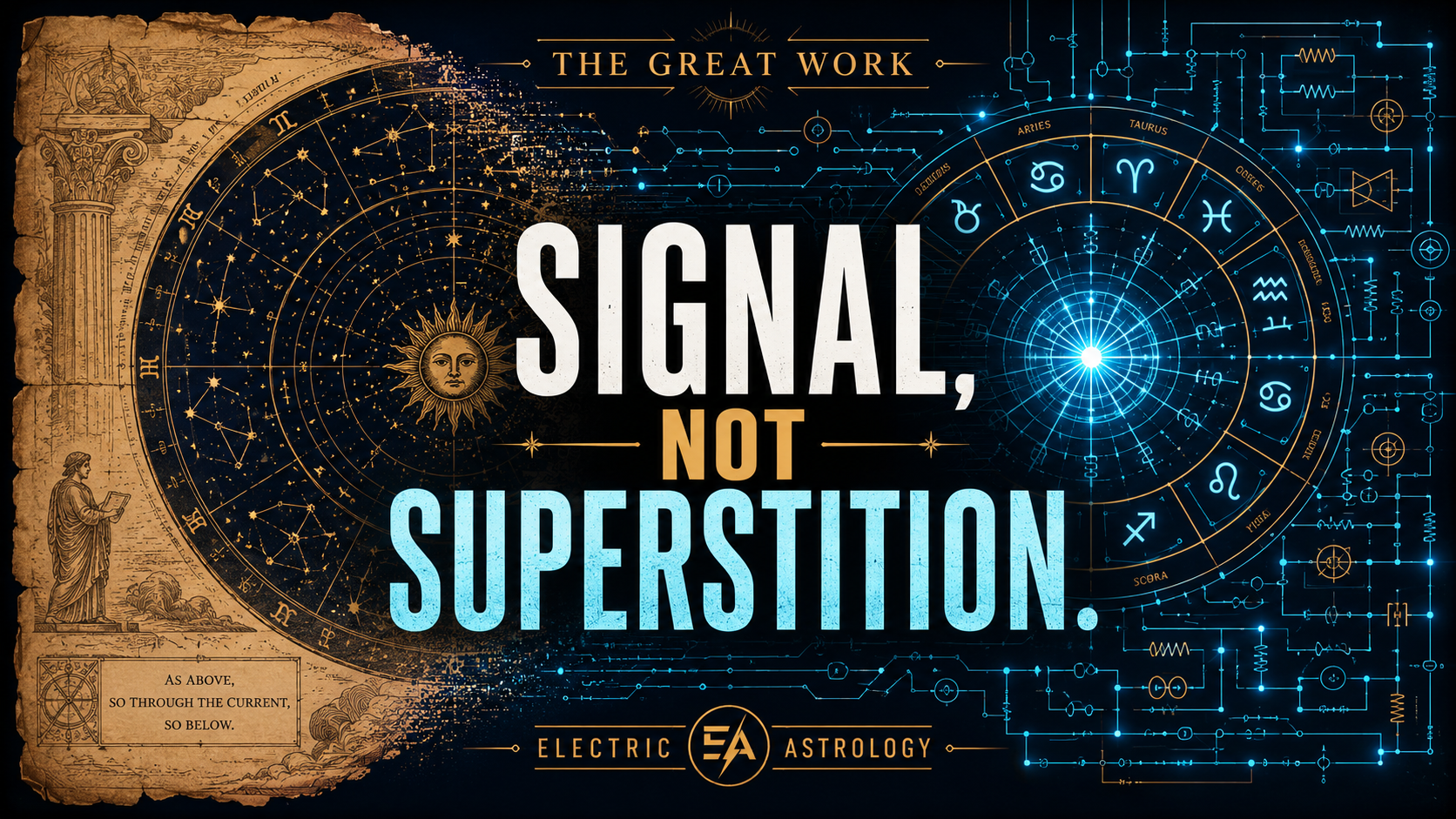
Electric Astrology begins somewhere else.
It does not ask anyone to accept every astrological claim ever made. It does not pretend that newspaper horoscopes are science. It does not claim that the planets magically control human life.
Instead, it asks a better question:
What exactly did ancient observers notice, how did they encode it, and could modern electrical, solar, and biological knowledge help us reinterpret it?
That question does not settle the debate. It makes the debate worth having.
The Wrong Target
Skeptics often attack the easiest version of astrology.
- Daily horoscopes.
- Personality memes.
- Vague predictions.
- Generic descriptions that could apply to almost anyone.
- Claims that sound mystical, unfalsifiable, or detached from any physical mechanism.
In many cases, that criticism is fair.
If astrology is reduced to entertainment content written for millions of strangers at once, skepticism is not the enemy. It is necessary. A serious framework should not be afraid of weak claims being challenged.
But the weakest version of a tradition is not always the whole tradition.
Electric Astrology does not defend astrology by pretending that every popular expression of it is profound. It starts by removing the easy target from the center of the argument.
The real question is not whether a vague horoscope can predict your day.
The real question is whether ancient astrology preserved a symbolic map of timing, pattern, and relationship that modern culture has not yet properly understood.
That is a very different target. And it requires a different kind of critique.
The Wrong Defense
Believers can make the opposite mistake.
They may defend astrology only because it is ancient, meaningful, intuitive, or personally resonant. Those things matter, but they are not enough.
A tradition can be old and still incomplete. A symbol can be meaningful and still misunderstood. A pattern can be real to experience and still need a better explanation.
Electric Astrology respects the ancient symbolic inheritance of astrology, but it does not treat tradition as the final argument. The fact that astrology survived for thousands of years is not proof that every claim is correct.
But it is evidence that human beings kept seeing something worth preserving.
That deserves curiosity.
- Why did so many cultures watch the sky?
- Why did they connect planetary timing with human affairs?
- Why did planets become gods, archetypes, rulers, messengers, warriors, teachers, and judges?
- Why did the birth moment become important?
- Why did symbolic systems endure even when the mechanism was unclear?
Electric Astrology does not answer those questions with blind belief. It answers them with a proposal:
Maybe the symbols survived because they were tracking something real, but not yet technically understood.
The Third Path
Electric Astrology takes a third path between belief and dismissal.
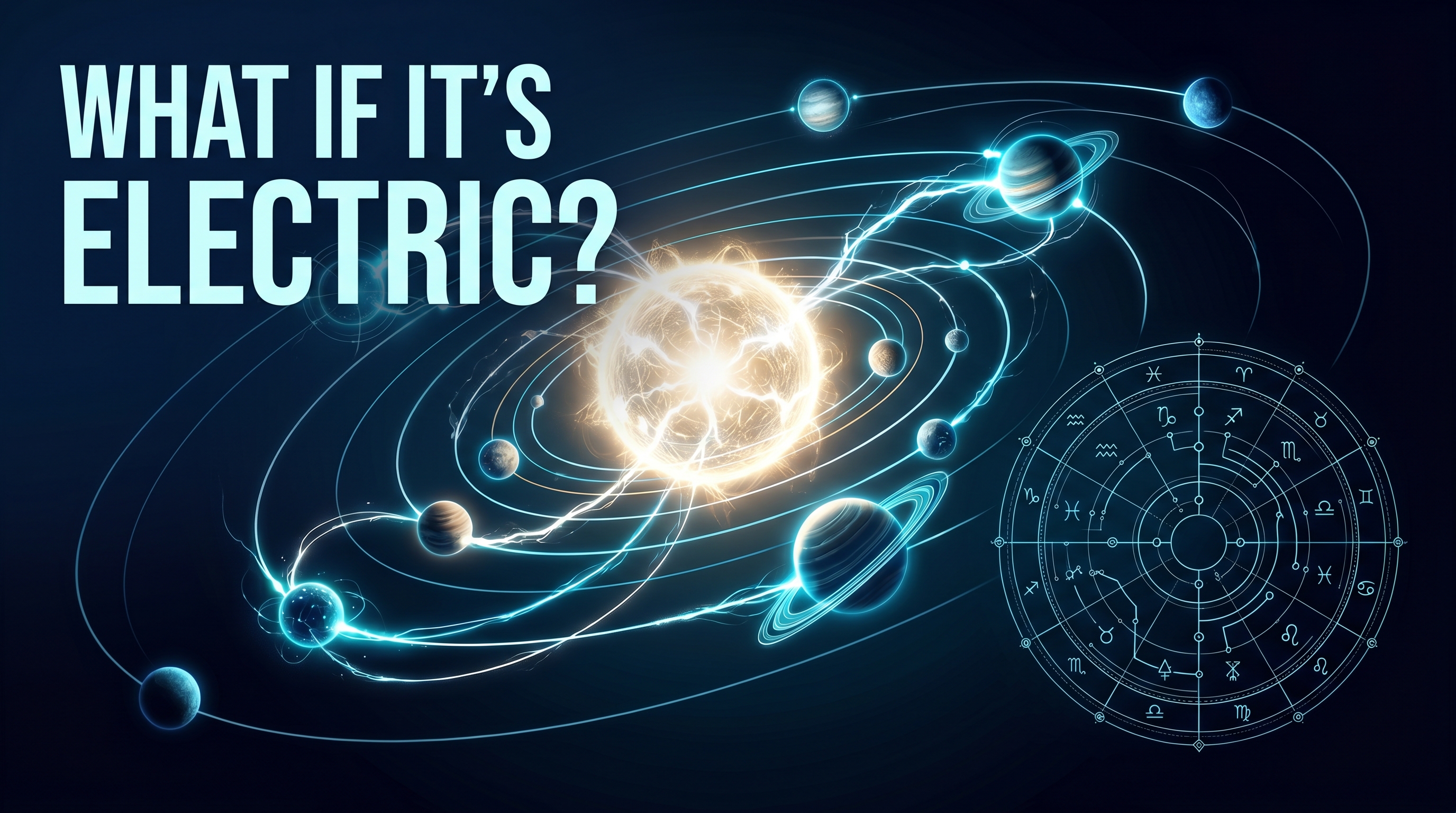
It treats astrology as a symbolic framework that may be informed by electrical systems, solar activity, resonance, timing, biological sensitivity, and the human body's participation in a larger environment.
That does not mean the planets control you. It does not mean every event has an astrological cause. It does not mean ancient astrologers had modern science.
It means astrology may be worth reexamining through a different operating language.
- The sun is active.
- The Earth is magnetically shielded and electrically responsive.
- The human body runs through electrical processes.
- The nervous system conducts signal.
- The heart pulses rhythmically.
- The brain produces waves.
- Life is not separate from light, season, timing, field, and environment.
None of those facts prove astrology. But together, they make the old cultural picture feel too simple.
The human being is not sealed off from the cosmos. The solar system is not a dead backdrop. Space is not empty in the way ordinary language imagines it.
Electric Astrology proposes that the old astrological map may be a symbolic interface with this larger field of relationship.
Not proof. Not dogma. A framework.
What Modern Instruments Changed
Ancient observers did not have satellites, magnetometers, solar observatories, oscilloscopes, biomedical sensors, electrical theory, or plasma physics.
They had the sky. They had bodies. They had seasons. They had ritual. They had memory. They had myth.
They watched the heavens and encoded recurring patterns in symbolic language. That does not mean they understood the mechanism. It means they may have preserved observations before they had the tools to explain them.
Modern instruments changed the situation.
We now know the sun is dynamic rather than static. Earth exists inside a changing space-weather environment. Biological life is deeply responsive to light and timing. The body is electrical at every meaningful level of operation. Communication itself has become invisible, wireless, networked, and field-like.
Again, none of this proves that astrology works in the conventional sense.
But it does challenge the lazy assumption that the sky is irrelevant because it is far away.
Distance is not the only question.
Relationship matters. Medium matters. Timing matters. Fields matter. Sensitivity matters.
Electric Astrology asks whether astrology may have been using symbolic language to describe relationships that only now can be approached with better technical imagination.
A Framework, Not a Verdict
This point matters.
Electric Astrology is not presented as settled laboratory science. It is not a claim that the ancient system has been proven. It is not an attempt to force spirituality into a lab coat.
It is a model, a language, and a proposition:
The ancient astrological map may be describing a relationship between human life and the solar system that modern culture has not yet properly named.
That is the boundary.
Electric Astrology lives at the edge between symbol and system. It does not ask science to abandon rigor. It does not ask spirituality to abandon meaning. It asks whether the separation between the two may have become too rigid to notice what sits between them.
The old argument says: astrology is either real or fake.
Electric Astrology asks: what if that binary is too crude for the thing being described?
Maybe astrology is not a finished science. Maybe it is not mere superstition. Maybe it is a symbolic technology developed before the mechanism was understood. Maybe it is a map of timing and relationship waiting for a better language.
Maybe the better language is electrical.
Decide Where the Old Debate Fails
The purpose of Electric Astrology is not to end the conversation. It is to reopen it.
Not by defending every claim. Not by dismissing every symbol. Not by pretending uncertainty does not exist.
But by refusing to let the weakest versions of astrology and the shallowest versions of skepticism define the entire field of possibility.
The question is not simply: Is astrology real or fake?
The better question is: What kind of relationship exists between the human organism and the solar system, and did ancient astrology preserve a symbolic way of reading it?
That is where Electric Astrology begins.
Read the framework. Test the language. Decide where the old debate fails.