Research · Circuit Analysis
Does the Schumann Resonance Affect Us?
What is measured, what is suggested, what is still unknown, and how to look for yourself.
By William Edwards, Founder of Electric Astrology ·
The resonance is real. Its effect on people is not proven. Global lightning makes the space between Earth's surface and the ionosphere ring like a bell, at about 7.83 Hz plus a ladder of higher tones. Physicists predicted it in 1952 and have measured it continuously since 1960.
Whether it affects your health, mood or sleep is an open question. A handful of small studies report links to blood pressure, heart-rate variability and circadian rhythm. None has been independently replicated at scale, and the natural field is extremely weak: around a picotesla, tens of millions of times weaker than Earth's steady magnetic field.
That is exactly why we think it is worth testing, openly, with real data. Below is the evidence as it stands, the popular myths to ignore, and how to look for yourself.
The fundamental. Set by the size of the planet and the height of the ionosphere.
Lightning flashes worldwide, from about 2,000 storms at any moment.
Field strength. Tens of millions of times weaker than Earth’s steady field.
First clean measurement, by Balser and Wagner. Predicted in 1952.
01 · The physics
What is the Schumann resonance?
Picture two conducting shells, one inside the other: the ground beneath you, and the ionosphere 60 to 100 km overhead. The air between them is a poor conductor, so the gap works as a giant waveguide wrapped around the planet. Every lightning strike injects a burst of energy into it. The waves that fit Earth's circumference exactly reinforce each other. Those are the Schumann resonances[1].
Pick a mode below to watch it ring. Each one fits one more ring of nodes around the globe.
Mode 1: one wavelength fits around the planet. The field swings up on one side of the Earth while it swings down on the other, with a single node ring between them. This is the famous ~7.8 Hz.
- Central Africa
- South America
- Maritime Continent
Modeled from lightning climatology: land storms peak around 15:00–17:00 local time. Not a live lightning feed.
Mode shapes are exact for an ideal spherical cavity driven from one point (Legendre polynomials Pn), shown here from the African centre. The day/night line follows the real position of the Sun. A perfect, lossless cavity the size of Earth (6,371 km radius) would ring at 10.6 Hz. The real one rings lower, and the reason is the ionosphere itself.
02 · The record
From a prediction to a measurement to a question
- 1905
Tesla imagines a ringing Earth
Nikola Tesla writes about the planet resonating electrically.[1]
- 1952
Schumann predicts it
Winfried Otto Schumann works out the physics of the Earth–ionosphere cavity.[1]
- 1954
The first attempt fails
Schumann and Herbert König try to measure it. The signal stays buried in noise.[1]
- 1960
Measured
Balser and Wagner pull the resonance cleanly out of the noise.[1]
- 1964–89
The bunker experiments
Rütger Wever studies circadian rhythms in a shielded bunker at Andechs, Germany.[2]
- 2005
The Hokkaido blood-pressure study
56 adults, seven days of monitoring, lower systolic pressure on higher-Schumann days for about a third of them.[5]
- 2017
Heart-rate variability
A small HeartMath group finds heart-rhythm correlations with Schumann power and geomagnetic activity.[6]
- 2020
Life evolved inside it?
Atmospheric physicists propose the resonance was the background field for the evolution of biological electrical activity.[7]
03 · The myth
Is the Schumann frequency rising?
Earth's frequency is rising toward 40 Hz and beyond.
So why 7.83 and not some rounder number? A perfect, lossless cavity the size of Earth would ring higher. The real ionosphere leaks, and a leaky cavity rings lower. You can see the whole calculation here:
Cyan: modeled spectrum for storms spread over the whole globe. Dashed amber: where a perfect, lossless cavity would ring.
Smaller worlds ring higher, like a smaller bell. This is the upper limit for a perfect cavity; a real one always rings lower, by an amount set by its ionosphere. Measured continuously since 1960. Mode 1 near 7.8 Hz.
04 · The evidence
Does the Schumann resonance affect human health?
The honest state of the evidence: suggestive, small and unreplicated. These are the studies most often quoted, including by us, each with its catch.
Wever, Andechs bunker[2]
1960s–70sIn a room shielded from outside fields, circadian rhythms ran longer and could desynchronize. A weak 10 Hz, 2.5 V/m square-wave field shortened circadian periods by about 1.3 hours.
Never repeated elsewhere, and the field was roughly a thousand times stronger than the natural Schumann electric field.[3]
König[4]
1974Reaction times differed when subjects were exposed to artificial 10 Hz versus 3 Hz fields.
Small laboratory samples of the era, and no modern replication we can point to.
Mitsutake et al.[5]
200556 adults in Urausu, Hokkaido, wore blood-pressure monitors for seven days. On higher-Schumann days, 32% had significantly lower systolic pressure; 4% had higher.
One week, one town. It can show an association, not a cause.
McCraty et al. (HeartMath)[6]
2017Heart-rate variability over 31 days correlated with Schumann power, Kp, solar wind and cosmic rays. The group’s rhythms appeared to synchronize on a ~2.5-day cycle.
The authors name the small sample as the main limitation, and the correlations reversed during a magnetic storm.
Taken together, these studies do not prove an effect. They are also not nothing. They are the kind of faint, repeated signal that deserves a bigger, better-designed look, which is not the same as a conclusion.
05 · The coincidence
Does 7.83 Hz match human brainwaves?
The first mode sits on the theta–alpha border. The overlap is real. It is also not evidence that one drives the other.
Close. The fundamental sits near the border between the theta and alpha bands of the human EEG, and that overlap has fascinated researchers for decades. But brain rhythms are generated inside the brain, and the natural Schumann field is far weaker than the body's own electrical activity.
The more serious version of the idea runs the other way. In 2020 a team of atmospheric physicists, including Colin Price and Earle Williams, proposed that life evolved inside this constant electromagnetic background, which may be why so much biological electrical activity sits below 50 Hz[7]. They present it as a hypothesis, not a finding, and so do we.
06 · Why we care
“We do not think the answer is to believe it or dismiss it. We think the answer is to measure it.”
Our working hypothesis is that the body is a receiver in an electrically active environment: the Sun modulates the ionosphere, the ionosphere shapes the cavity, and at least some people may register those changes. That is a hypothesis, not an established result. Some of the wider framework we explore is openly contested; the proposal that planetary alignments pace the roughly 11-year solar cycle, for example, is a minority view in solar physics[8].
07 · The instrument
How can you look for yourself?
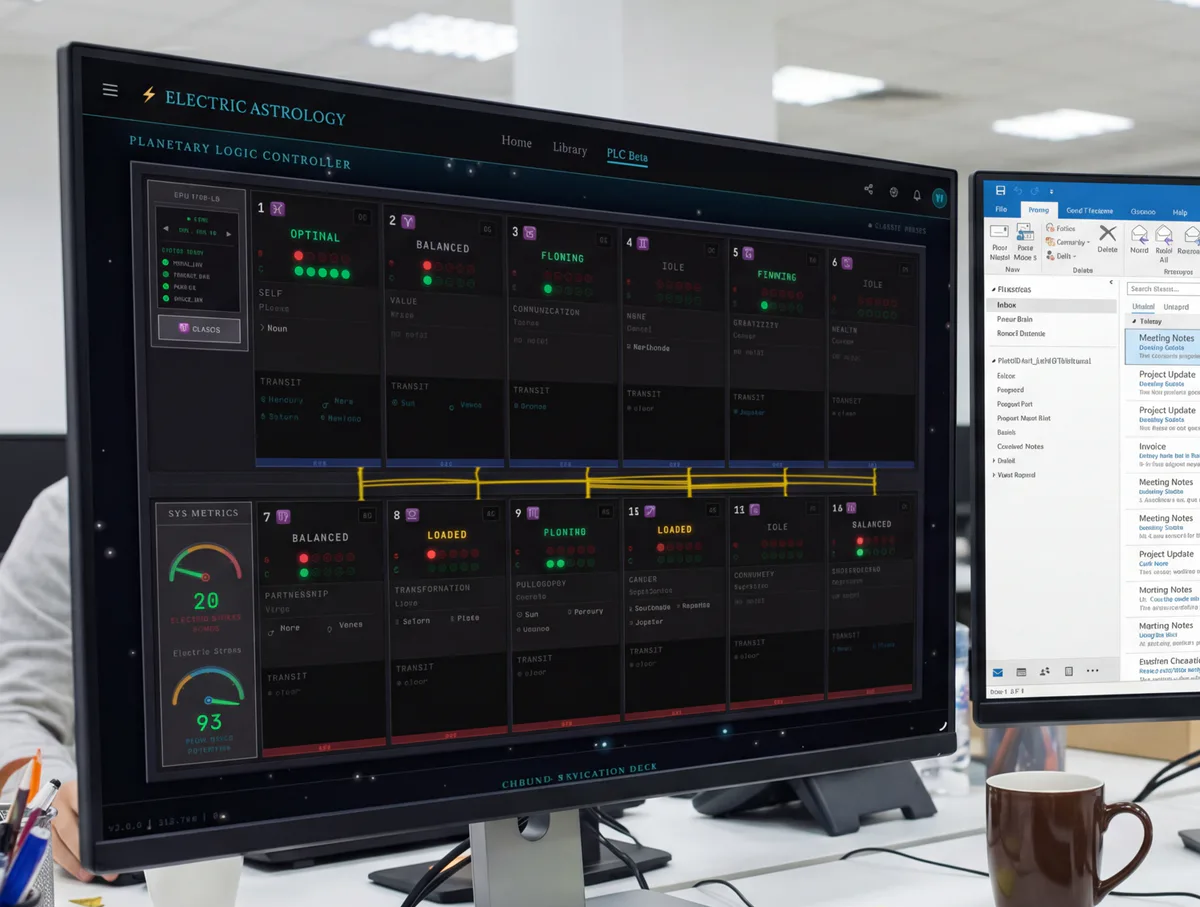
There is no reliable free real-time Schumann feed; most "live" sites re-post images from one Russian observatory. So we built our own rendition from the physics above: the cavity model, the three lightning centres on the real clock, and live NOAA X-ray flux. It is modeled, and labelled that way. The same model now drives the Schumann gauge on every Electric Astrology dashboard and app. Press play to hear the cavity ring.
Horizontal magnetic power at Tomsk, Siberia, relative units. Computed from the Ishaq & Jones cavity model driven by three tropical lightning centres at today's UTC time.
Lightning clicks at the real global rate ringing the modeled modes, shifted up four octaves (×16) so 7.8 Hz becomes about 124 Hz. Headphones help.
The full instrument, with a 24-hour spectrogram, lives at Schumann Resonance Today.
08 · Quick answers
Frequently asked questions
Is the Schumann resonance real?
Yes. It is a standing electromagnetic wave in the cavity between Earth's surface and the ionosphere, excited by roughly 50 lightning flashes per second worldwide. It was predicted by Winfried Otto Schumann in 1952 and first clearly measured by Balser and Wagner in 1960. Its main modes sit near 7.8, 14.3, 20.8, 27.3 and 33.8 Hz.
Is the Schumann resonance frequency rising?
No. The fundamental has stayed near 7.8 Hz for as long as it has been measured. What changes day to day is its amplitude (power), which follows global thunderstorm activity. Solar flares, solar proton events and the 11-year solar cycle cause small frequency shifts, but nothing like the "rising to 40 Hz" claims that circulate online.
Can the Schumann resonance cause headaches, fatigue or anxiety?
There is no reliable evidence that it does. A few small studies report associations between Schumann or geomagnetic activity and blood pressure or heart-rate variability, but they are correlational and unreplicated at scale. If you have persistent symptoms, see a doctor; do not attribute them to the Schumann resonance.
Do 7.83 Hz generators or Schumann devices work?
We know of no controlled evidence that consumer 7.83 Hz devices improve health. The closest historical experiment, Rütger Wever's shielded-bunker work, used a 10 Hz field of 2.5 V/m, roughly a thousand times stronger than the natural Schumann electric field, and it has never been repeated elsewhere.
Where can I see the Schumann resonance live?
A few research stations publish spectrogram images, but there is no reliable free real-time data feed. Electric Astrology computes its own rendition at electricastrology.com/space-weather/schumann-resonance: a live physics model of the spectrum driven by the real clock and NOAA X-ray flux, clearly labelled MODELED, with the cavity in 3D and a version you can hear.
09 · Receipts
Sources
- Price, C. (2016). ELF Electromagnetic Waves from Lightning: The Schumann Resonances. Atmosphere, 7(9), 116. doi.org/10.3390/atmos7090116
- Wever, R. (1970). The effects of electric fields on circadian rhythmicity in men. Life Sciences and Space Research, 8, 177–187. pubmed.ncbi.nlm.nih.gov/11826883/
- National Research Council (1993). Assessment of the Possible Health Effects of Ground Wave Emergency Network. National Academies Press. www.nationalacademies.org/read/2046/chapter/10
- König, H. L. (1974). Behavioural Changes in Human Subjects Associated with ELF Electric Fields. In M. A. Persinger (Ed.), ELF and VLF Electromagnetic Field Effects. Plenum. link.springer.com/chapter/10.1007/978-1-4684-9004-6_4
- Mitsutake, G., Otsuka, K., et al. (2005). Does Schumann resonance affect our blood pressure? Biomedicine & Pharmacotherapy, 59(Suppl 1), S10–S14. pubmed.ncbi.nlm.nih.gov/16275477
- McCraty, R., Atkinson, M., Stolc, V., Alabdulgader, A. A., Vainoras, A., & Ragulskis, M. (2017). Synchronization of Human Autonomic Nervous System Rhythms with Geomagnetic Activity in Human Subjects. IJERPH, 14(7), 770. pmc.ncbi.nlm.nih.gov/articles/PMC5551208/
- Price, C., Williams, E., Elhalel, G., & Sentman, D. (2021). Natural ELF fields in the atmosphere and in living organisms. International Journal of Biometeorology, 65, 85–92. link.springer.com/article/10.1007/s00484-020-01864-6
- Scafetta, N. (2012). Does the Sun work as a nuclear fusion amplifier of planetary tidal forcing? Journal of Atmospheric and Solar-Terrestrial Physics, 81, 27–40. arxiv.org/abs/1205.4061