Electric charge travelled through 34 nanometres of DNA, and one wrong base pair cut it to less than half
Jacqueline Barton’s group at Caltech showed that DNA carries electric charge along its stacked bases over 100 base pairs, a distance that surpasses most molecular wires.
The short version
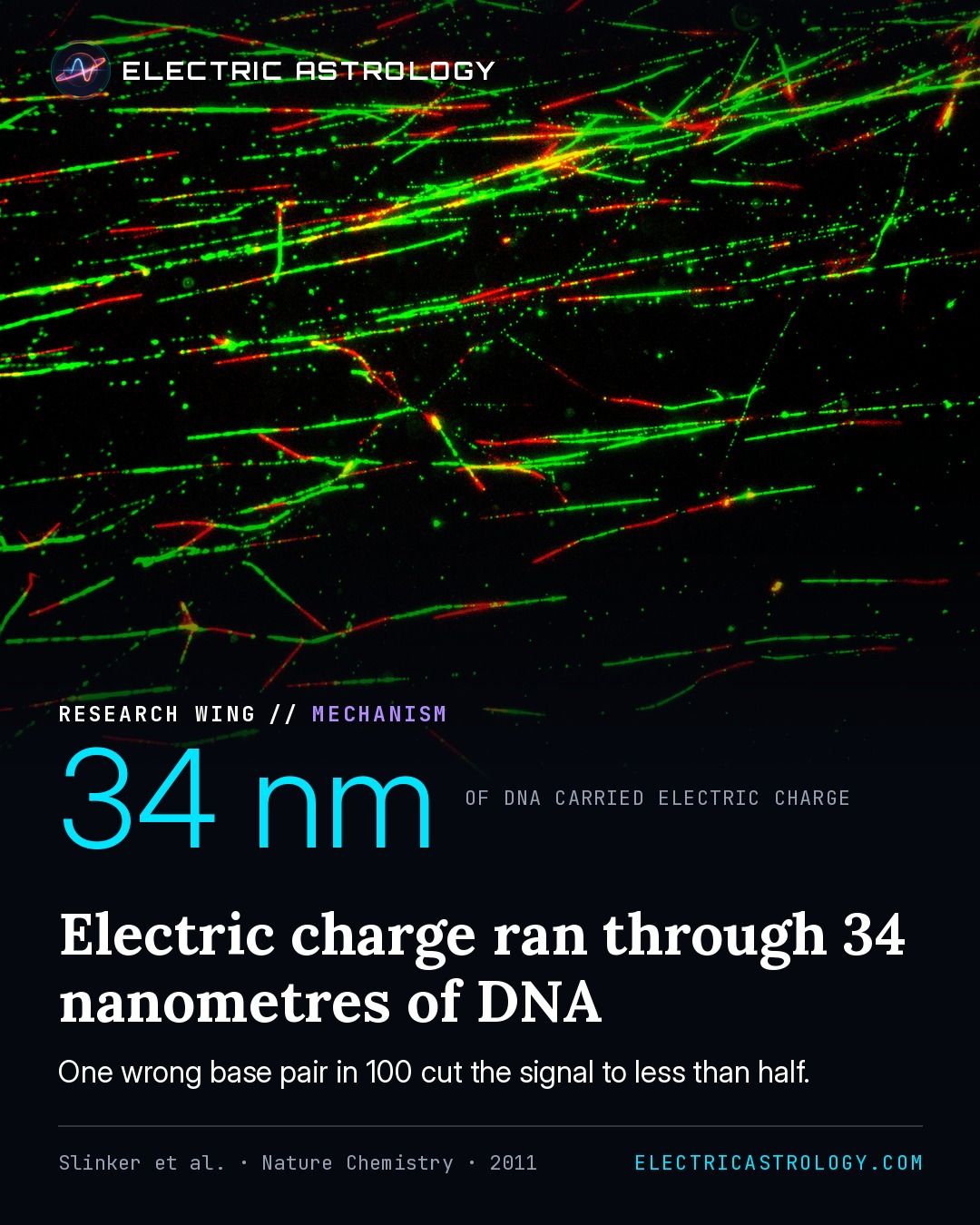
A Caltech team built a 100-base-pair DNA double helix on gold electrodes and sent electric charge along it, 34 nanometres end to end. The charge travelled through the stacked bases, and the signal was lower than, but comparable to, that through a strand one-sixth the length.
A single mismatched base pair cut the signal to less than half. The authors call it a transient and fragile wire: it works in solution, and is extraordinarily sensitive to its structure.
34 nm
Distance charge travelled through the DNA double helix: 100 base pairs, close to the length over which the helix stays stiff in solution.
The paper
DNA charge transport over 34 nm
Slinker, J. D., Muren, N. B., Renfrew, S. E., Barton, J. K. (2011). DNA charge transport over 34 nm. Nature Chemistry, 3(3), 228–233.
Checked against the paper’s full text on November 13, 2026.
What they measured
The team assembled a 100-base-pair DNA double helix, 34 nm long, from five shorter strands and anchored it on gold electrodes, sixteen to a silicon chip, with a Nile Blue redox probe attached to the far end. The charge reaching that probe from the electrode was measured electrochemically.
Well-matched helices were compared side by side with helices carrying a single mismatched base pair, across 6 chips and more than 40 electrodes of each type. An enzyme that cuts the DNA at one sequence tested whether the signal needed an intact helix.
What they found
Charge reached the probe through the full 34 nm. The signal was lower than, but comparable to, that through a 17-base-pair helix, so the long DNA was, in the authors’ words, comparably effective as a bridge.
A single mismatched base pair lowered the signal by a factor of 2.3 ± 0.4 (p = 0.0005).
Cutting the helix with the enzyme RsaI reduced the 100-base-pair signal by 90%, while the comparison electrodes on the same chip were essentially unchanged.
The authors conclude that DNA can efficiently carry charge over 100 base pairs, or 34 nm, a distance that surpasses most reports of molecular wires. The charge travels through the stacked bases, not the backbone.
How it bears on the hypothesis
MechanismShows a working part of the circuit: a receiver in the body, a current in space, a field that couples them.
The molecule that carries heredity is also an electrical conductor at this scale, and its conduction is sensitive to a single error in the sequence: the authors note the 34 nm helix could serve as a sensor.
This was DNA on a gold electrode in buffered solution, not inside a cell.
The authors’ own caution: The authors call it “a transient and fragile wire”: it must be kept in buffered solution, its conduction is extraordinarily sensitive to subtle changes in structure, and the full mechanism is still elusive.