
Planetary Logic Controls — Technical Reference Archive
RESEARCH WING
The papers under the hypothesis: peer-reviewed studies on the Sun, Earth’s field and the living body, summarized in plain words.
The papers behind the circuit
Inspect the evidence yourself.
Electric Astrology proposes that the body is part of a circuit that runs from the Sun through Earth’s magnetic field to the nervous system. This wing collects the published research that measures pieces of that circuit: storms and the heart, magnetic sensing in the brain and in birds, the body’s own currents and voltages, the planet’s ringing cavity, and the currents that join bodies in space.
Each paper has its own page: the full citation, what the researchers measured, the number that matters, and how it bears on the hypothesis. Follow the DOI and read the paper for yourself.
Measures the body (or a living thing) changing with the Sun, the sky or Earth’s field.
Shows a working part of the circuit: a receiver in the body, a current in space, a field that couples them.
Points the same way, from a smaller study or a proposed mechanism still being tested.
Do geomagnetic storms affect the heart and circulation?
Large population studies say they move the numbers. Across 11,453 strokes in five countries, stroke risk was 19% higher with geomagnetic storms; across 44 million deaths in 263 U.S. cities, cardiovascular and heart-attack deaths rose with the Kp index. Studies that record heart rhythms around the clock find the autonomic nervous system tracking solar and geomagnetic activity.
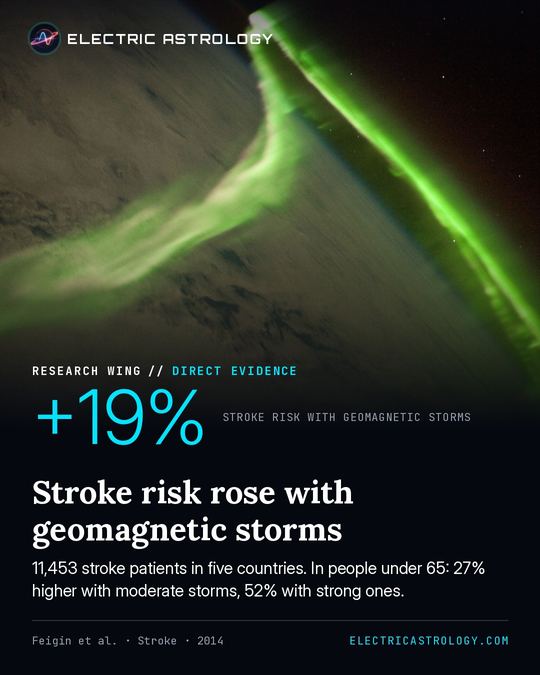
Stroke risk rose with geomagnetic storms
Researchers pooled six population-based stroke studies from New Zealand, Australia, the United Kingdom, France and Sweden: 11,453 stroke patients in all. Geomagnetic storms went with a 19% higher risk of stroke. In people under 65 the risk was 27% higher with moderate storms and 52% higher with strong ones.
Read the summary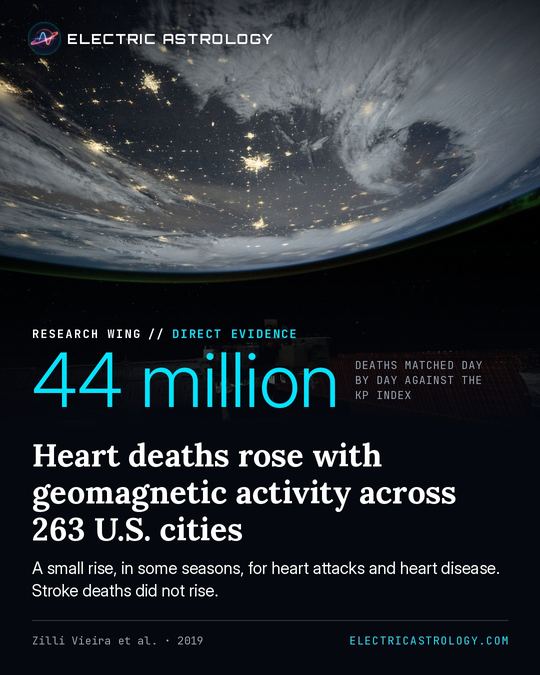
Heart deaths rose with geomagnetic activity across 263 U.S. cities
Researchers matched daily deaths in 263 U.S. cities, 44 million in all, against the Kp index of geomagnetic activity. Total deaths rose with Kp in every season; cardiovascular and heart-attack deaths rose with it in some seasons. The rises were small, fractions of a percent. Stroke deaths did not rise.
Read the summary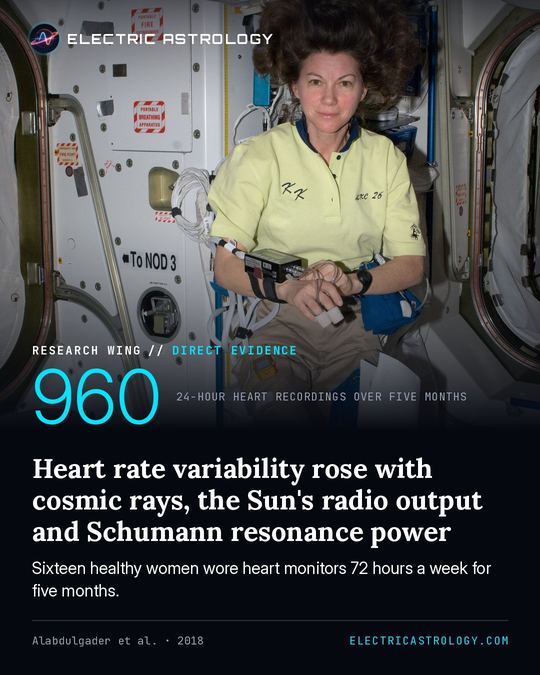
Heart rate variability rose with cosmic rays, the Sun's radio output and Schumann resonance power
Sixteen healthy women wore heart monitors 72 hours a week for five months, and their heart rate variability was compared hour by hour with the space weather record. When cosmic rays, the Sun's radio output and Schumann resonance power rose, heart rate variability and rest-and-digest activity rose with them.
Read the summary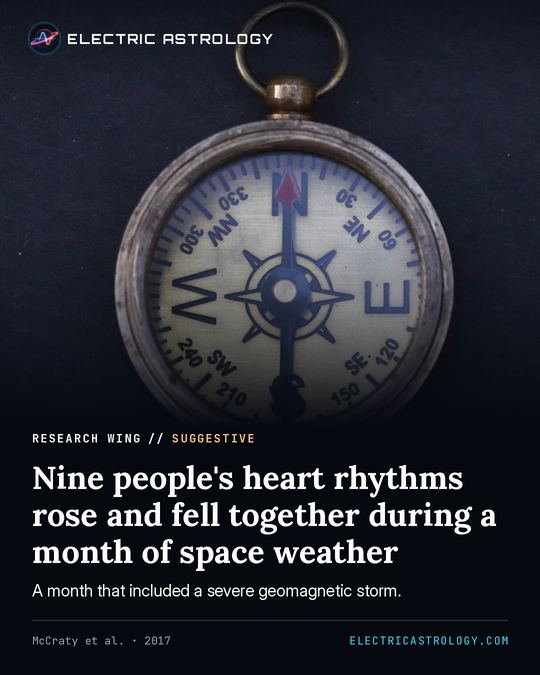
Nine people's heart rhythms rose and fell together during a month of space weather
Through a month that included a severe geomagnetic storm, the group's average heart rate variability correlated with the solar wind, the geomagnetic indices and Schumann resonance power, in ways that shifted as the month went on. Their rhythms also moved with each other: in the first half of the month the group's heart rate variability rose and fell together, in a cycle of about two and a half days.
Read the summaryDo geomagnetic storms affect mood?
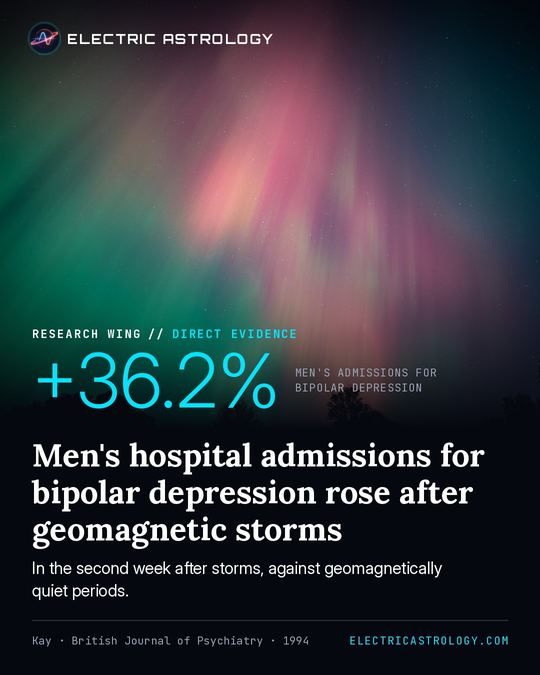
A classic hospital study found that admissions of men for the depressed phase of manic-depressive illness rose 36.2% in the second week after geomagnetic storms, compared with quiet periods.
Can the human body sense Earth’s magnetic field?
There is a measured brain response. In a shielded chamber, rotating an Earth-strength magnetic field made alpha brain waves drop by up to about half in some people, though none of them could tell it had happened. The likely receiver is magnetite: the human brain holds millions of magnetic crystals per gram, and a 2018 study found them concentrated toward the cerebellum and brain stem.
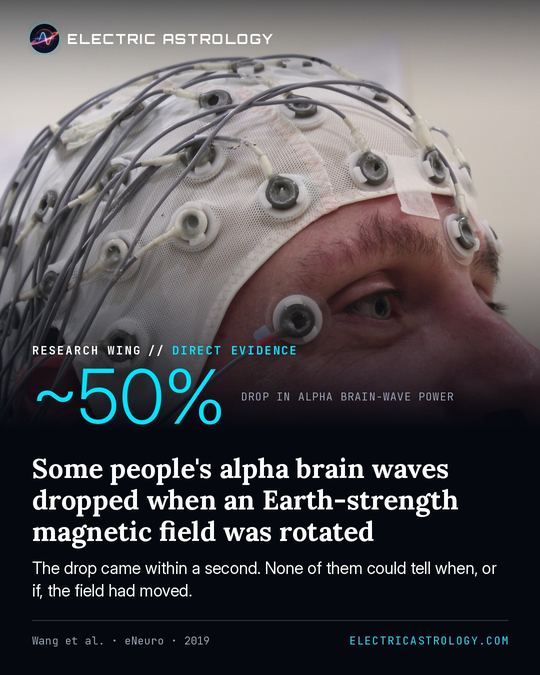
Some people's alpha brain waves dropped when an Earth-strength magnetic field was rotated
In a shielded, dark chamber, researchers rotated an Earth-strength magnetic field around people while recording their brain waves. In some participants, alpha waves dropped by about half within a second of certain rotations, then recovered. Others didn't respond. Afterwards, none of them could tell when, or if, the field had moved.
Read the summary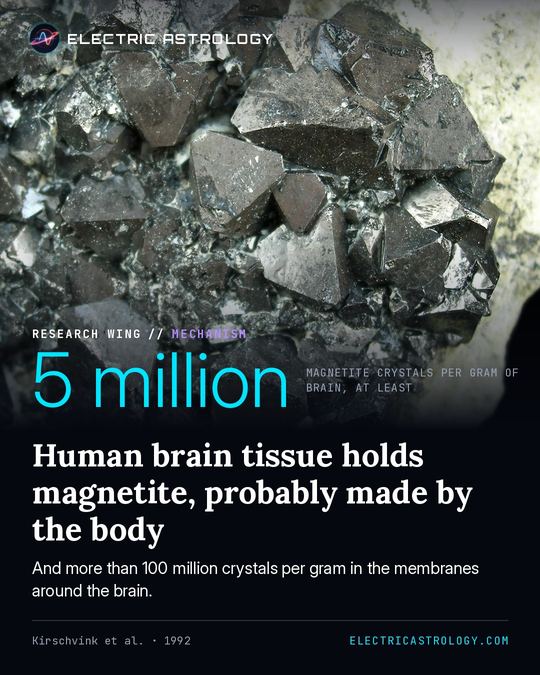
Human brain tissue holds magnetite, probably made by the body
Using an ultra-sensitive magnetometer in a clean lab, researchers found magnetite, a magnetic iron oxide, in human brain tissue: at least 5 million crystals per gram, and more than 100 million per gram in the membranes around the brain.
Read the summary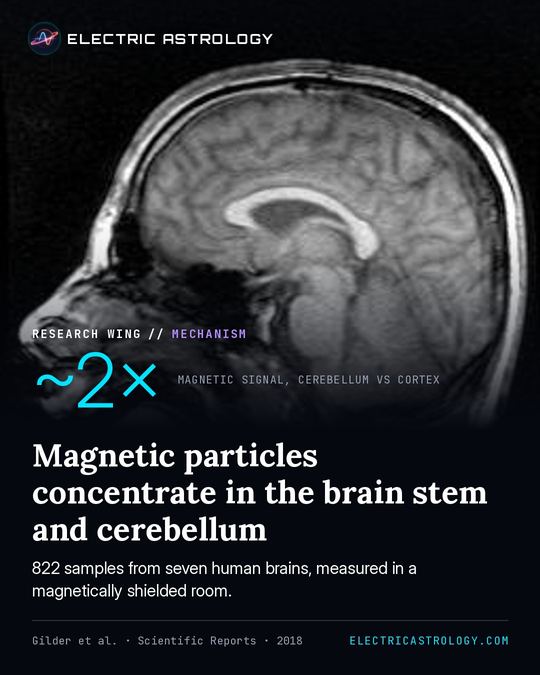
Magnetic particles concentrate in the brain stem and cerebellum
A team measured 822 pieces of seven human brains in a magnetically shielded room. All seven held magnetic particles: about twice as much in the cerebellum as in the cerebral cortex, and more still in the brain stem.
Read the summaryDo living things need Earth’s magnetic field?
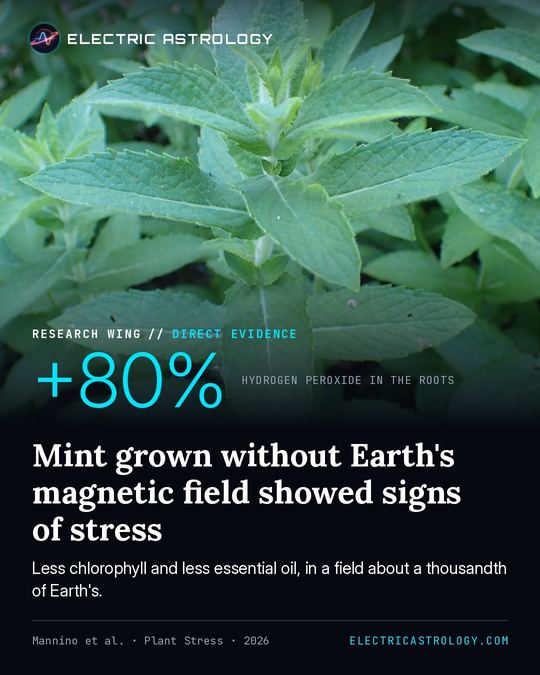
Mint grown in a near-null magnetic field, about a thousandth of Earth’s, showed a stress response across its chemistry: weaker photosynthesis, about 80% more hydrogen peroxide in the roots, about half the phenolic compounds, and less essential oil.
Does the Schumann resonance respond to the Sun?
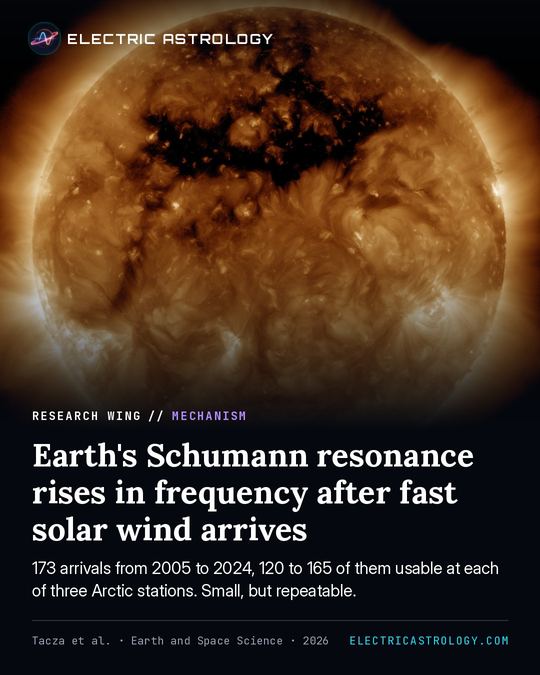
Yes, measurably. After 173 arrivals of fast solar wind between 2005 and 2024, Earth’s first Schumann resonance rose by a small but repeatable amount at three Arctic stations, and the rise lined up most clearly with geomagnetic activity.
Does the Schumann resonance affect the body?
It is an open question with measured leads. In 56 adults in Japan, average blood pressure was lower on days of strong Schumann signals, and atmospheric physicists have proposed that life’s electrical rhythms, which sit in the same low-frequency range, grew up tuned to these natural fields.
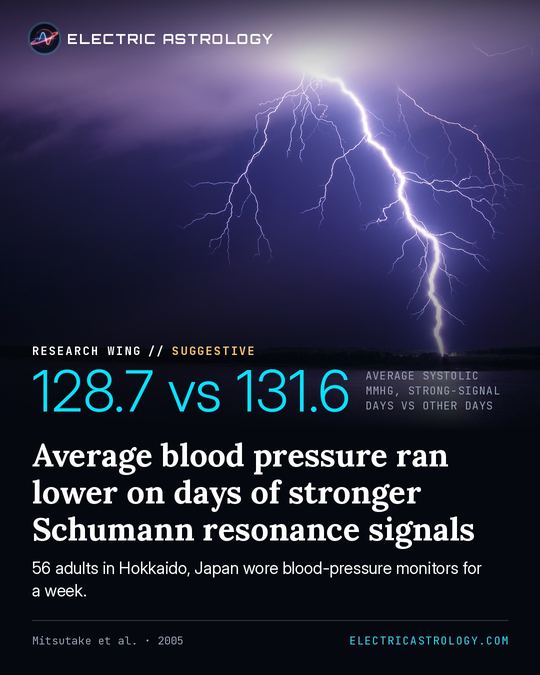
Average blood pressure ran lower on days of stronger Schumann resonance signals
Fifty-six adults in Hokkaido, Japan wore blood-pressure monitors for a week while a nearby station recorded the Schumann resonance. On days with enhanced Schumann signals, average blood pressure was lower: systolic 128.7 against 131.6. About a third of the participants had significantly lower systolic pressure on those days, two had higher, and the rest showed no clear difference.
Read the summary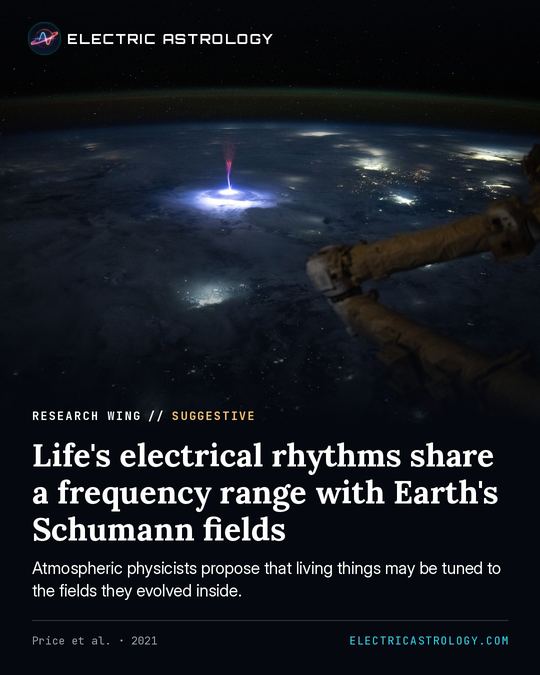
Life's electrical rhythms share a frequency range with Earth's Schumann fields
Lightning flashes dozens of times a second somewhere on Earth, so the planet is never without its very weak, extremely low-frequency Schumann fields. Atmospheric physicists point out that most electrical activity in living things, from zooplankton to people, sits in the same frequency range, and propose that life may be tuned to it.
Read the summaryDoes the Sun’s activity at birth leave a mark on a life?
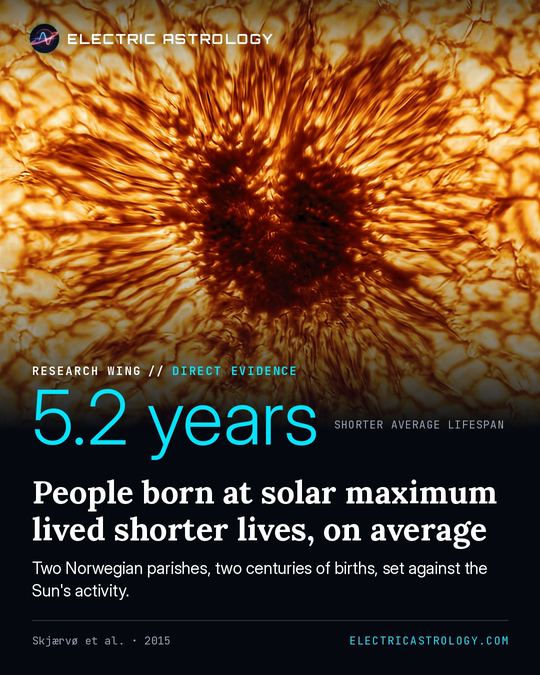
In church records of 8,662 births in historical Norway, people born in years of high solar activity lived 5.2 years less on average than people born when the Sun was quiet, and girls born then had lower survival.
Do electric currents flow between space and Earth?
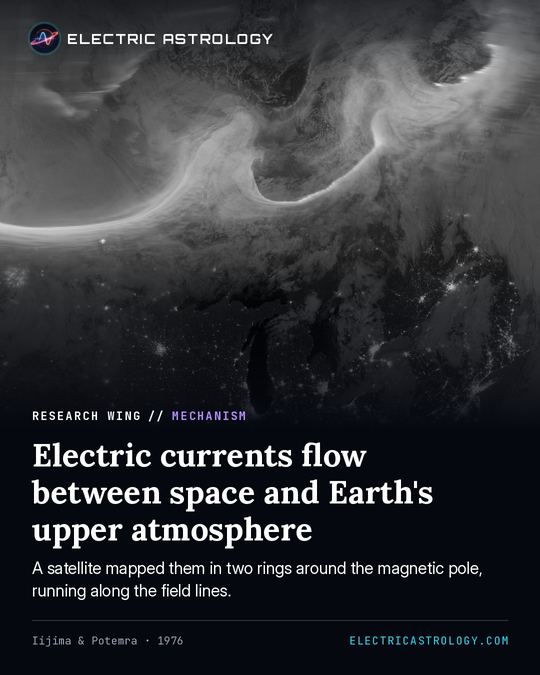
Yes. Satellites crossing the polar sky measure large-scale currents flowing along Earth’s magnetic field lines, in two rings around the geomagnetic pole, joining near-Earth space to the upper atmosphere. Near noon, a separate set of currents just poleward of the rings grows stronger as the Sun’s magnetic field turns south.
Electric currents flow between space and Earth's upper atmosphere
A 1976 study used magnetometer data from the Triad satellite to map large-scale electric currents flowing along Earth's magnetic field lines, into and out of the upper atmosphere. They run in two rings around the magnetic pole, and the ring nearer the pole persists, especially on the day side, even when geomagnetic activity is very low.
Read the summary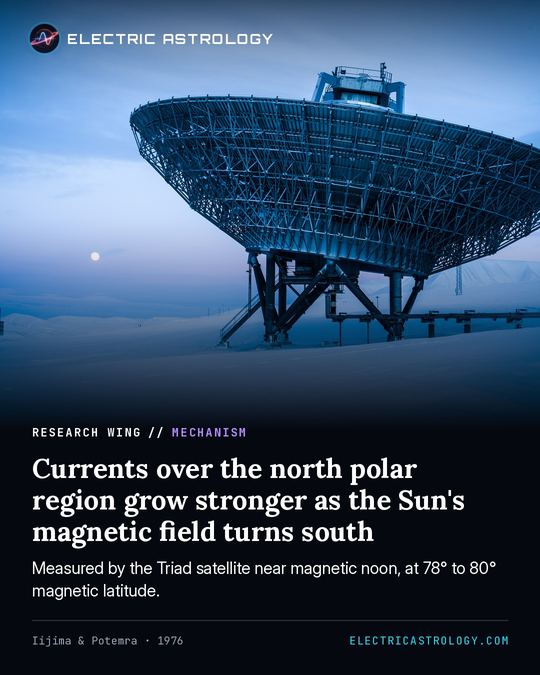
Currents over the north polar region grow stronger as the Sun's magnetic field turns south
High above the northern polar region on the day side, near magnetic noon, the Triad satellite measured electric currents flowing along Earth's magnetic field lines. Their strength rose as the magnetic field carried by the solar wind turned further south.
Read the summaryWhy are geomagnetic storms more common at the equinoxes?
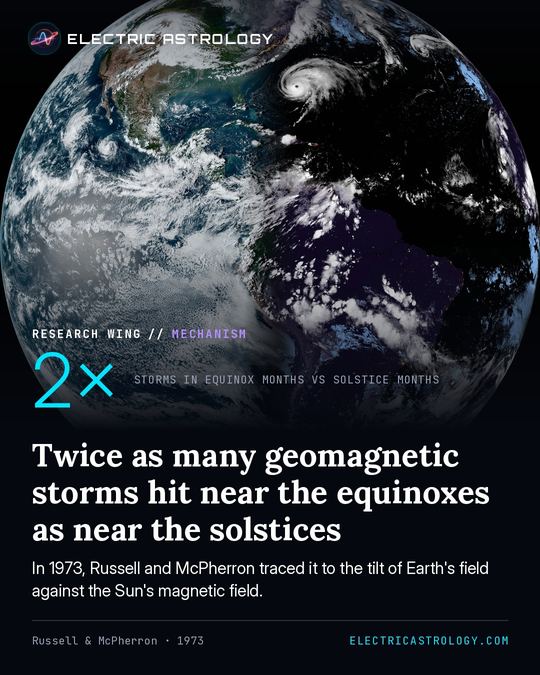
Twice as many storms come in the equinox months as in the solstice months. Russell and McPherron traced it in 1973 to how likely Earth’s magnetosphere is, through the year, to see a southward component of the Sun’s magnetic field.
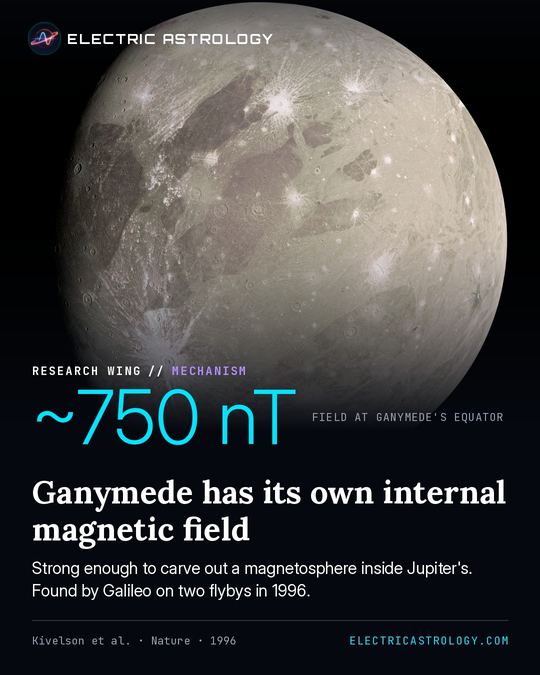
Does Ganymede have its own magnetic field?
Yes. In 1996 the Galileo spacecraft found that Jupiter’s largest moon has an internal magnetic field, about 750 nanotesla at its equator, strong enough to carve out a magnetosphere inside Jupiter’s.
Does the body make its own electricity?
Yes. Bend a bone and the compressed side turns electrically negative, even in dead bone. Every cell holds a voltage across its membrane, and that voltage tracks whether the cell divides: many cancer cells hold less voltage than healthy cells of the same tissue.
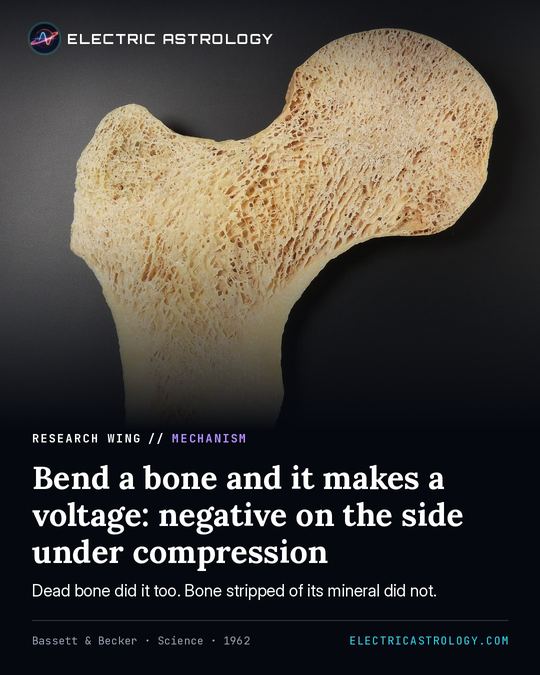
Bend a bone and it makes a voltage: negative on the side under compression
In 1962 two orthopaedic researchers bent bones from cats, rats and frogs between electrodes. The side under compression turned electrically negative at once and stayed negative while the load held. Bending the other way flipped the polarity.
Read the summary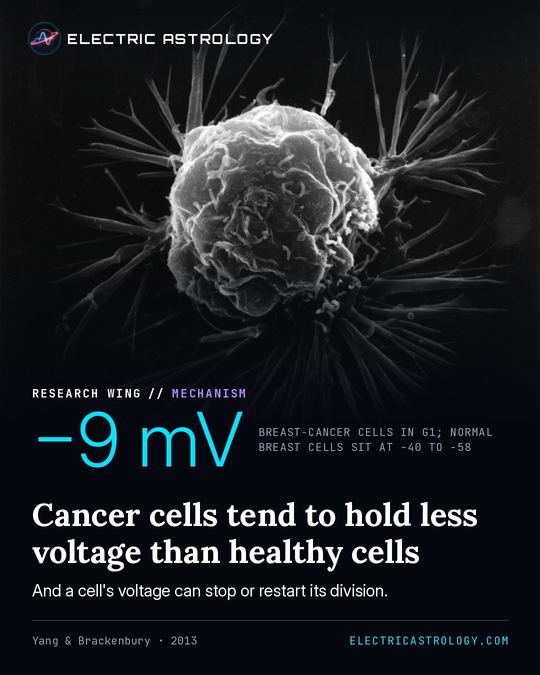
Cancer cells tend to hold less voltage than healthy cells
Every cell holds a voltage across its membrane. A 2013 review gathered the measurements: cancer cells tend to sit closer to zero than healthy cells. One breast-cancer line measured −9 millivolts in the G1 phase of its cycle; normal breast cells, −40 to −58.
Read the summaryDoes the body heal with electric currents?
Electric currents are part of healing. A salamander’s limb stump swings from positive to strongly negative as the limb regrows, while a frog’s, which only scars, does not turn negative before it heals. Currents of 10 to 100 microamps per square centimetre stream out of a regenerating newt’s stump in its first week, and the electric field a wound makes steers the cells that close the wound.
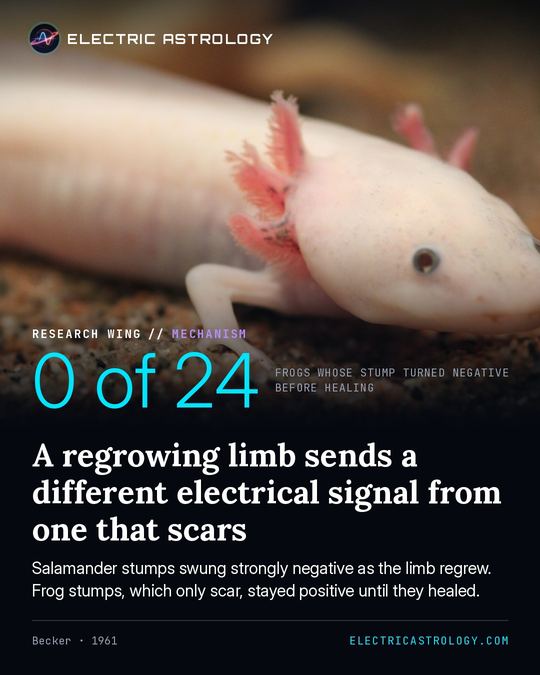
A regrowing limb sends a different electrical signal from one that scars
In 1961 Robert O. Becker amputated the limbs of salamanders, which regrow them, and of frogs, which don't, and recorded the voltage at the stump for weeks. Both stumps turned positive right after the cut. In the salamanders the voltage then crossed zero and swung strongly negative, and the regrowing limb stayed more negative than normal until it was complete. Not one of 24 frogs turned negative before it healed.
Read the summary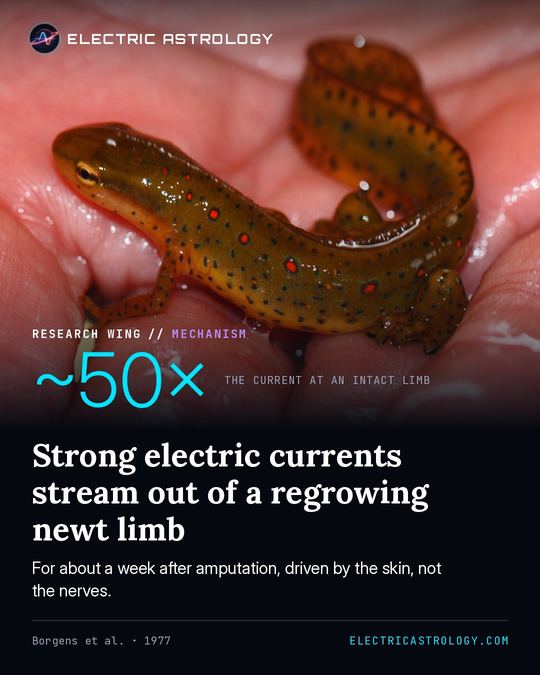
Strong electric currents stream out of a regrowing newt limb
With a vibrating probe sensitive to tiny currents, researchers at Purdue measured the electricity around newts' forelimbs. After amputation, steady currents of 10 to 100 microamps per square centimetre streamed out of the stump for the first week or so, about 50 times the current at an intact limb.
Read the summary
The electric field at a wound steers the cells that heal it
Breaking a layer of skin or other lining tissue instantly makes an electric field, in every species studied so far. A team of 17 researchers showed that fields of that natural strength guide the healing cells, and that changing a wound's field changes how it heals.
Read the summary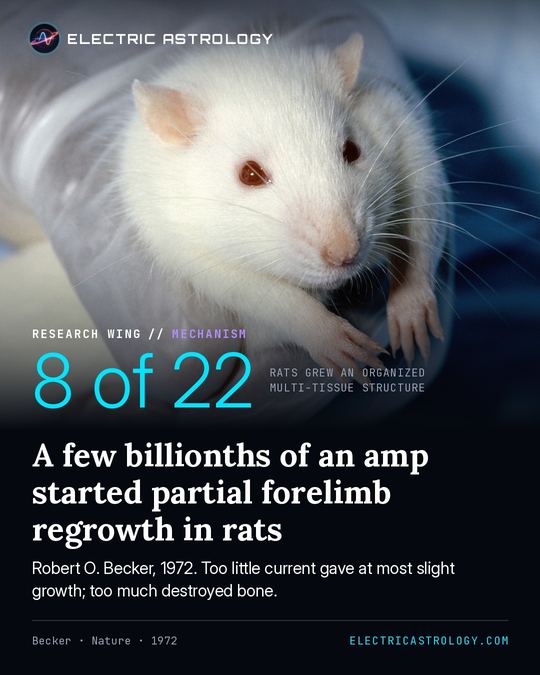
A few billionths of an amp started partial forelimb regrowth in rats
Rats, like people, don't regrow limbs. Robert O. Becker implanted a tiny silver-platinum current source, about 3 to 6 nanoamps, at amputated rat forelimbs. Eight of 22 grew an organized multi-tissue structure at the stump, most often a regrown lower end of the upper arm bone, with new muscle, nerves and blood vessels.
Read the summaryIs the body’s shape stored in voltage?
Part of it appears to be. In frog embryos a pattern of voltage and pH traces the face before the face forms, and changing the voltage of ordinary cells made complete eyes grow where no eye belongs. Flatworms whose cells were briefly uncoupled regrew with two heads and kept that plan in their cells’ voltage. In people, mutations in one potassium-channel gene change both heart rhythm and the shape of the face.
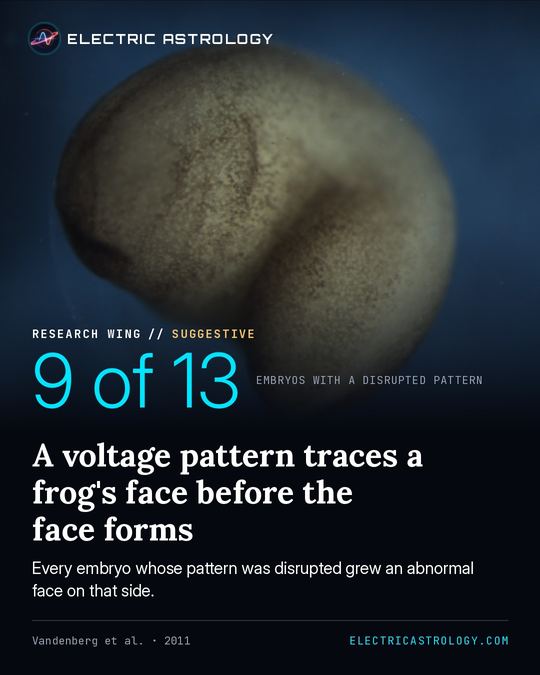
A voltage pattern traces a frog's face before the face forms
Researchers filmed frog embryos with voltage-reporting dyes. Before the face formed, patterns of voltage and pH appeared on the embryo's surface, marking where the mouth, nose and eyes would develop.
Read the summary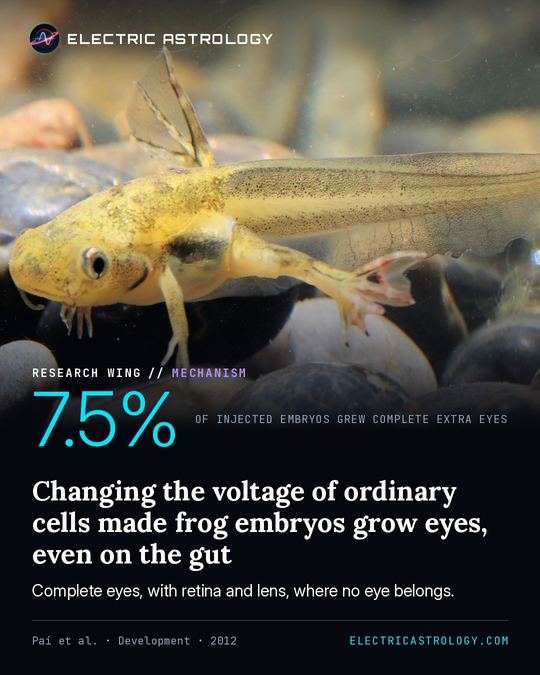
Changing the voltage of ordinary cells made frog embryos grow eyes, even on the gut
In frog embryos, the cells that will become the eyes sit at a more negative voltage than their neighbours. Researchers changed the voltage of other cells in the embryo by making them produce altered ion channels.
Read the summary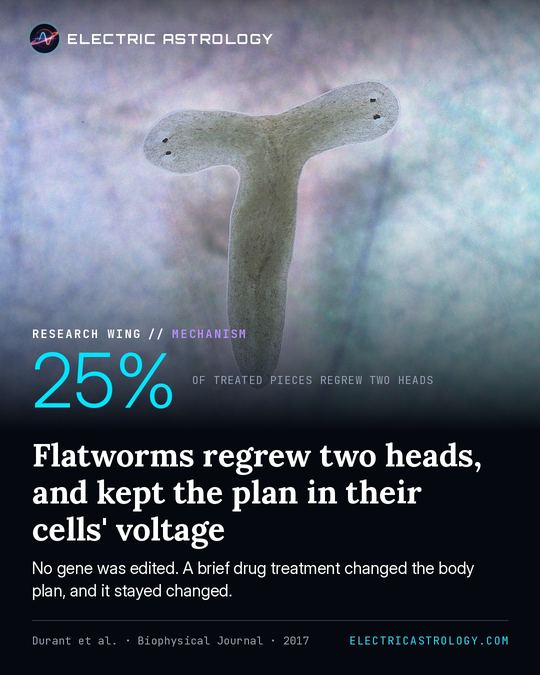
Flatworms regrew two heads, and kept the plan in their cells' voltage
Researchers cut flatworms and briefly blocked the electrical links between their cells. A quarter of the pieces regrew with a head at each end, and kept regrowing two heads every time they were cut again.
Read the summary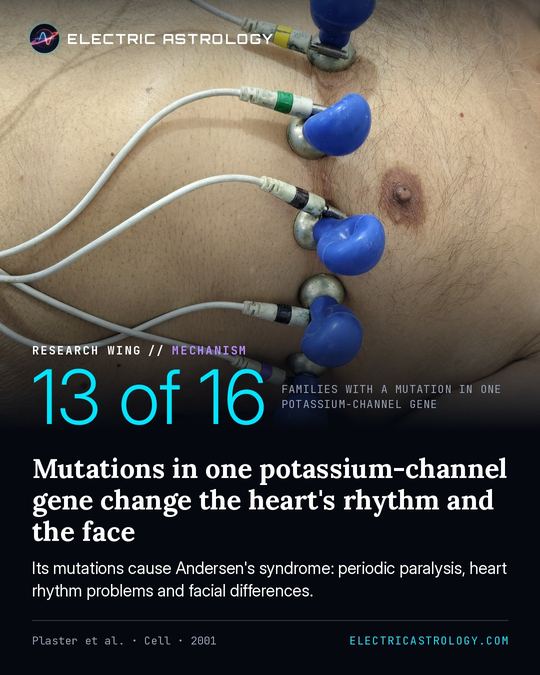
Mutations in one potassium-channel gene change the heart's rhythm and the face
Andersen's syndrome brings episodes of muscle weakness, heart rhythm problems and distinctive features such as wide-set eyes, low-set ears and a small chin. In 2001 researchers traced it to KCNJ2, the gene for a potassium channel that helps set the electrical state of heart and muscle cells. They found mutations in 13 of 16 families.
Read the summaryCan animals sense magnetic fields?
Migratory birds can. European robins find north by reading the tilt of Earth’s magnetic field lines, not which way they point. On a German university campus, robins lost that compass in background electromagnetic noise and regained it inside grounded, aluminium-screened huts that cut the noise about a hundredfold.
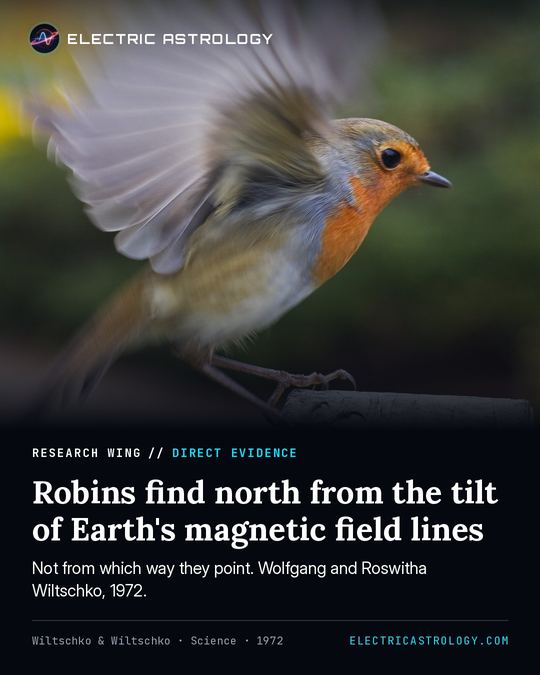
Robins find north from the tilt of Earth's magnetic field lines
A compass needle reads which way Earth's magnetic field points. In 1972 Wolfgang and Roswitha Wiltschko reported that European robins don't. They read the tilt of the field lines in space, and take as north the direction where the field lines and gravity form the smaller angle.
Read the summary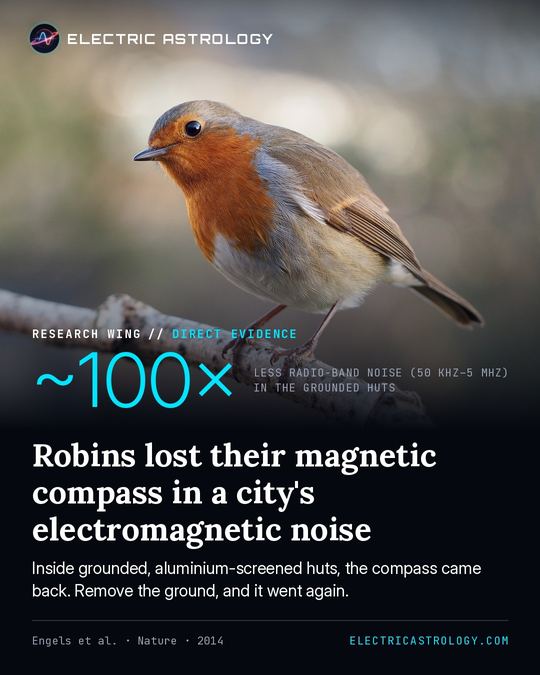
Robins lost their magnetic compass in a city's electromagnetic noise
Migratory robins tested on a university campus in Oldenburg, Germany could not orient with their magnetic compass. Inside wooden huts screened with grounded aluminium, which cut the background electromagnetic noise about a hundredfold, they could.
Read the summaryDoes the pineal gland contain crystals?
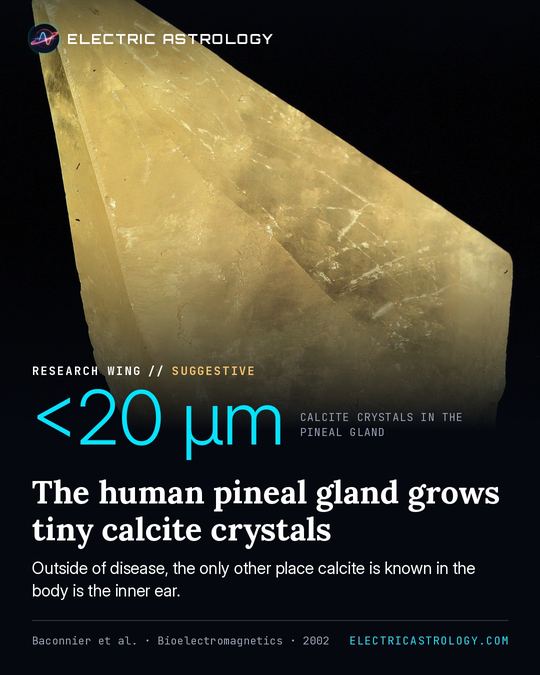
Yes. Besides the familiar mineral deposits, a 2002 study found microcrystals of calcite less than 20 micrometres long in the human pineal gland. Apart from the inner ear, that was the only known occurrence of calcite in healthy human tissue.
Does the human body give off light?
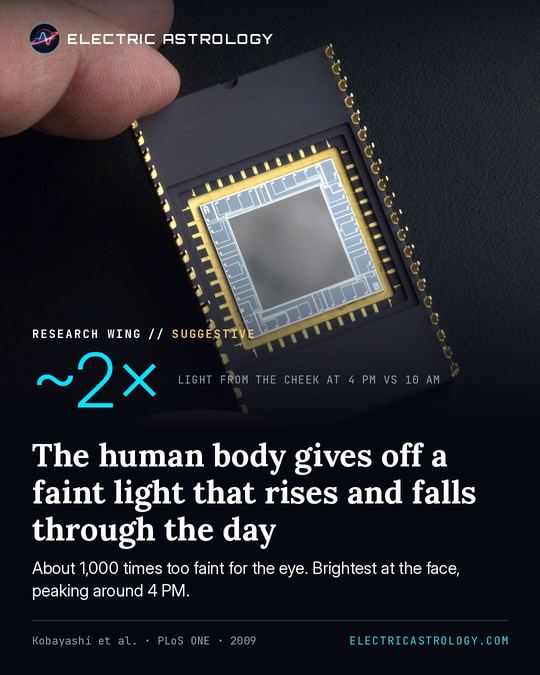
Yes, faintly. A cooled camera in total darkness imaged light from the bodies of five young men, about 1,000 times weaker than the eye can see. It was brightest at the face and rose and fell through the day, peaking around 4 PM.
Can DNA conduct electricity?
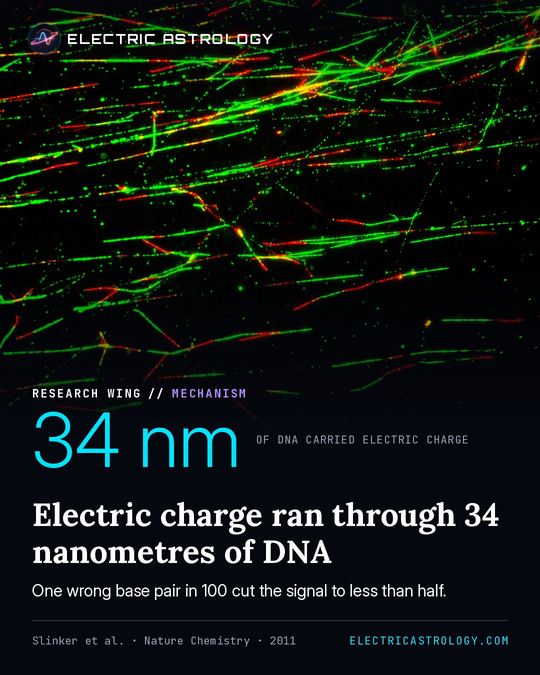
Over short distances, yes. In 2011 a Caltech team carried electric charge through 34 nanometres of DNA, 100 base pairs, on a gold electrode. The charge travelled through the stacked bases, and a single mismatched base pair cut the signal to less than half.
What is the fourth phase of water?
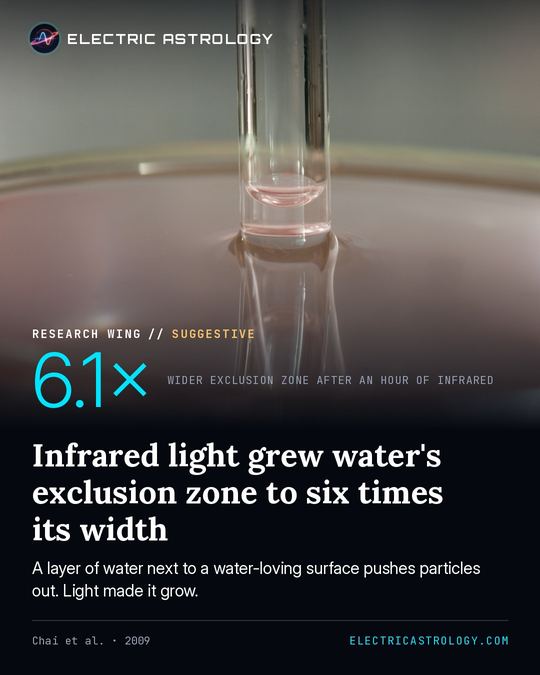
It is Gerald Pollack’s name for the “exclusion zone”: a layer of water next to water-loving surfaces that pushes out suspended particles. Several independent groups have now seen the zone; its cause is still argued. In Pollack’s lab, infrared light grew the zone to about three times its width in five minutes, a result other groups have yet to repeat.
Can conditions before birth leave a lifelong mark on our genes?
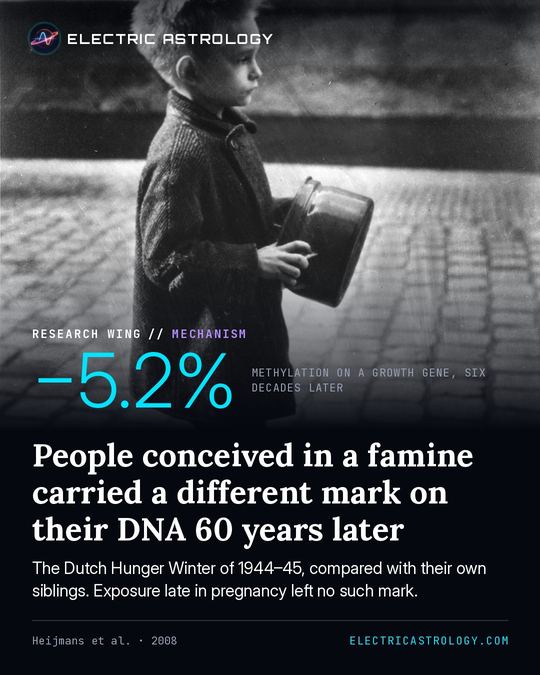
In one well-studied case, yes. Six decades after the Dutch Hunger Winter of 1944–45, people conceived during the famine carried 5.2% less methylation on a regulatory stretch of the IGF2 gene than their own same-sex siblings. People exposed only late in pregnancy showed no such difference.
Reference shelves
Books, live data and institutions
Grouped from the book’s Exhibit A bibliography. They are here as provenance and further reading, not as a claim that every source agrees with every conclusion.
Companion Shelf
Foundational Reading
The books behind the book: the longer-form lineage of the electric and bioelectric ideas Electric Astrology builds on.
Cosmic Plasma
Hannes Alfvén
NASA Technical Reports Server record for the 1981 book cited in Exhibit A.
Physics of the Plasma Universe
Anthony L. Peratt
Springer listing for the 1992 edition referenced in the manuscript.
The Body Electric
Robert O. Becker and Gary Selden
WorldCat library record for the landmark bioelectricity book.
The Fourth Phase of Water
Gerald Pollack
WorldCat library record for the 2013 Ebner & Sons edition.
Live Data
Heliophysics and Space Weather
The instruments behind the "voltage" language: real-time geomagnetic indices, event feeds and mission visualizations.
Planetary K-index Dashboard
NOAA Space Weather Prediction Center
Official Kp monitoring for geomagnetic activity.
DONKI Event Database
NASA CCMC
Solar flares, CMEs and impact notifications in one operational feed.
Kp Index Data Portal
GFZ Potsdam
The reference source for definitive and real-time Kp data.
The Heliosphere and Galactic Cosmic Rays
NASA Scientific Visualization Studio
How the heliosphere shields the planets from galactic cosmic rays.
Field Theory
Plasma Physics, Explained
Institutional explainers for the plasma framing that runs under the book.
Electric Currents in Space Plasmas
NASA Cosmicopia
NASA explainer on how electric currents arise in space plasmas.
Model of the Plasma Universe
Hannes Alfvén / IEEE Transactions on Plasma Science (1986)
Alfvén’s review proposing the “plasma universe” as an alternative to the universe seen in visible light.
About Plasmas and Fusion
Princeton Plasma Physics Laboratory
Institutional overview of plasma behavior and confinement.
Science of the Heart
HeartMath Institute
Heart-rate variability, coherence and the heart’s own field, in one long overview.
Hardware Logic
Engineering, Propulsion and Signal Systems
Real propulsion, plasma and radio engineering that echoes the book’s hardware metaphors.
Instrument Model
Radio Astronomy and Interferometry
The array physics, beamforming and synthesis imaging behind the book’s instrument model.
VLA Capabilities and Specifications
National Radio Astronomy Observatory
Frequency coverage and instrument capabilities.
Interferometry and Synthesis in Radio Astronomy
Thompson, Moran and Swenson
WorldCat record for the third edition of the standard reference.
Antenna Theory: Analysis and Design
Constantine A. Balanis
Phased arrays and beamforming.
Aperture Synthesis
Martin Ryle, Nobel Lecture
How large-aperture radio telescopes were built from many small ones.
The long record
Sunspots and geomagnetic activity, as measured
Historical Field Records — Source Data
The Data Behind Your Commissioning Voltage
This is the actual archive — not a summary, not a chart generated from internal assumptions. SILSO sunspot records back to 1818. GFZ Potsdam Kp readings back to 1932. Your commissioning voltage was pulled directly from these datasets. Drag the handles at the bottom of each chart to zoom in.
Solar Activity — International Sunspot Number (SSN)
SILSO · Royal Observatory of Belgium · 1818–present
LOADING ARCHIVE…
Geomagnetic Activity — Kp Index (Daily Average)
GFZ Potsdam · Helmholtz Centre · 1932–present
LOADING ARCHIVE…
SSN v2.0 — SILSO, Royal Observatory of Belgium (1818–present) · Kp 3-hourly definitive — GFZ Potsdam / Helmholtz Centre (1932–present) · Data bundled locally; no third-party requests.
Watch the same quantities these papers measure, live.