Blood pressure ran lower on days of strong Schumann resonance signals
Fifty-six adults in Hokkaido, Japan wore blood-pressure monitors for a week; average blood pressure was lower on days when a nearby station recorded enhanced Schumann resonance signals.
The short version
Fifty-six adults in Hokkaido, Japan wore blood-pressure monitors for a week while a nearby station recorded the Schumann resonance. On days with enhanced Schumann signals, average blood pressure was lower: systolic 128.7 against 131.6. About a third of the participants had significantly lower systolic pressure on those days, two had higher, and the rest showed no clear difference.
The authors call for larger studies.
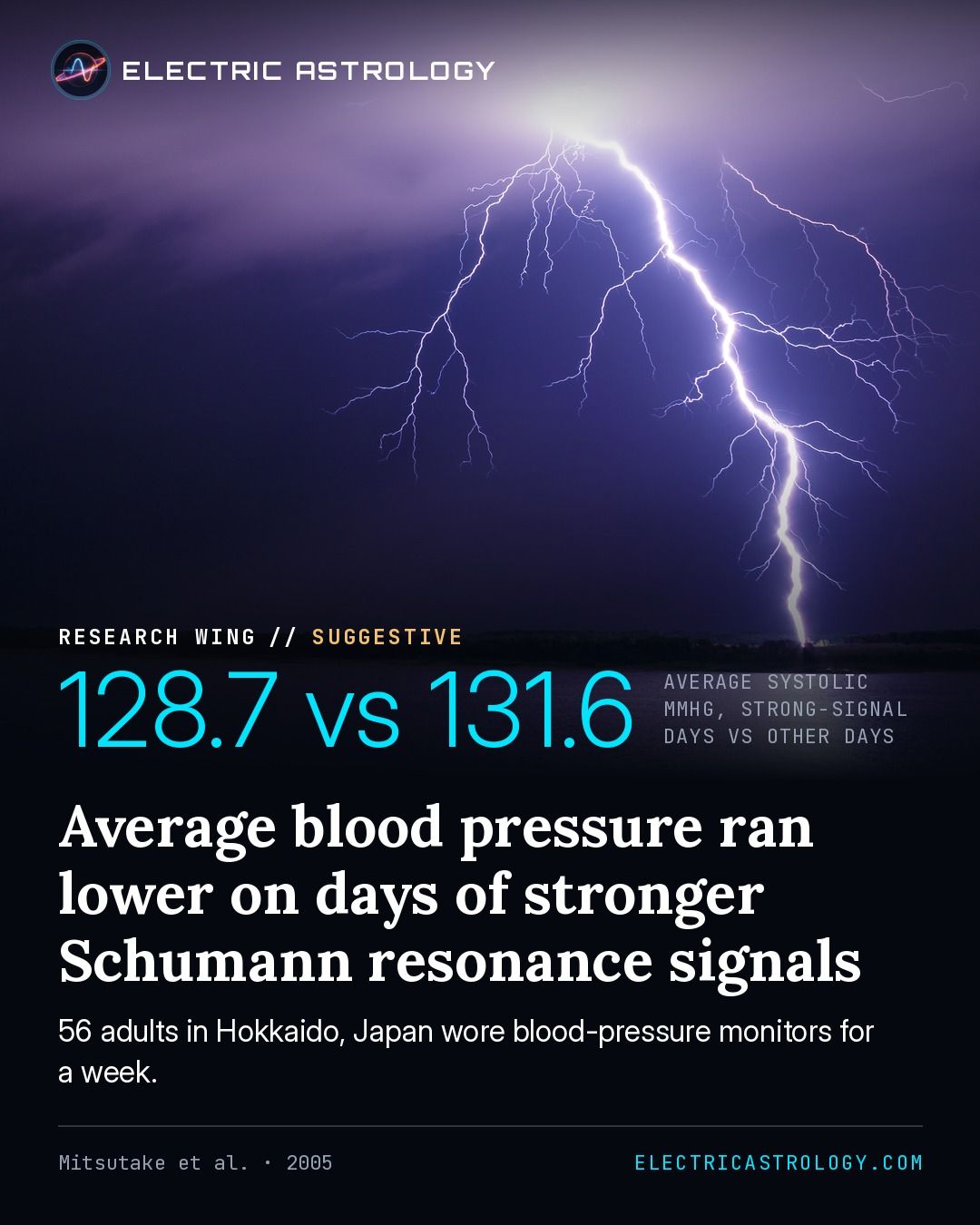
128.7 vs 131.6
Average systolic blood pressure on enhanced-Schumann days against normal days (p = 0.008).
The paper
Does Schumann resonance affect our blood pressure?
Mitsutake, G., Otsuka, K., Hayakawa, M., Sekiguchi, M., Cornélissen, G., Halberg, F. (2005). Does Schumann resonance affect our blood pressure?. Biomedicine & Pharmacotherapy, 59(Suppl 1), S10–S14.
Checked against the paper’s full text on November 9, 2026.
What they measured
Fifty-six residents of Urausu, Hokkaido (30 men and 26 women, aged 24 to 73) wore an ambulatory blood-pressure monitor for seven consecutive days, with readings every 30 minutes from 07:00 to 22:00 and every 60 minutes overnight.
The Moshiri station in Hokkaido recorded the Schumann resonance near 8 Hz across the four months of the study, April to July 2001. Days above the 64th percentile of signal strength (0.697 pT per root hertz) counted as enhanced, and blood pressure on those days was compared with normal days.
What they found
Average systolic, diastolic and mean arterial pressure, and the double product of heart rate and systolic pressure, were all lower on enhanced-Schumann days (p = 0.005 to 0.036). Systolic pressure averaged 128.7 against 131.6; diastolic 79.3 against 81.2.
Person by person, 32.1% of the 56 had significantly lower systolic pressure on enhanced days and only 3.6% significantly higher; the rest showed no significant difference.
Heart rate did not differ significantly.
How it bears on the hypothesis
SuggestivePoints the same way, from a smaller study or a proposed mechanism still being tested.
The Schumann resonance is the planet’s own electromagnetic tone, driven by lightning and nudged by the Sun. This study found blood pressure shifting with it, toward the calmer side.
It is one week and 56 people, so it is a lead rather than a law. The direction is what makes it worth testing at scale.
The authors’ own caution: The authors call for larger studies to see whether the effect generalizes.