Atmospheric physicists propose that life’s electrical rhythms are tuned to Earth’s natural ELF fields
Atmospheric physicists lay out the case that the electrical rhythms of living things, from zooplankton to people, sit in the same low-frequency range as the natural fields life evolved inside, and may be tuned to them.
The short version
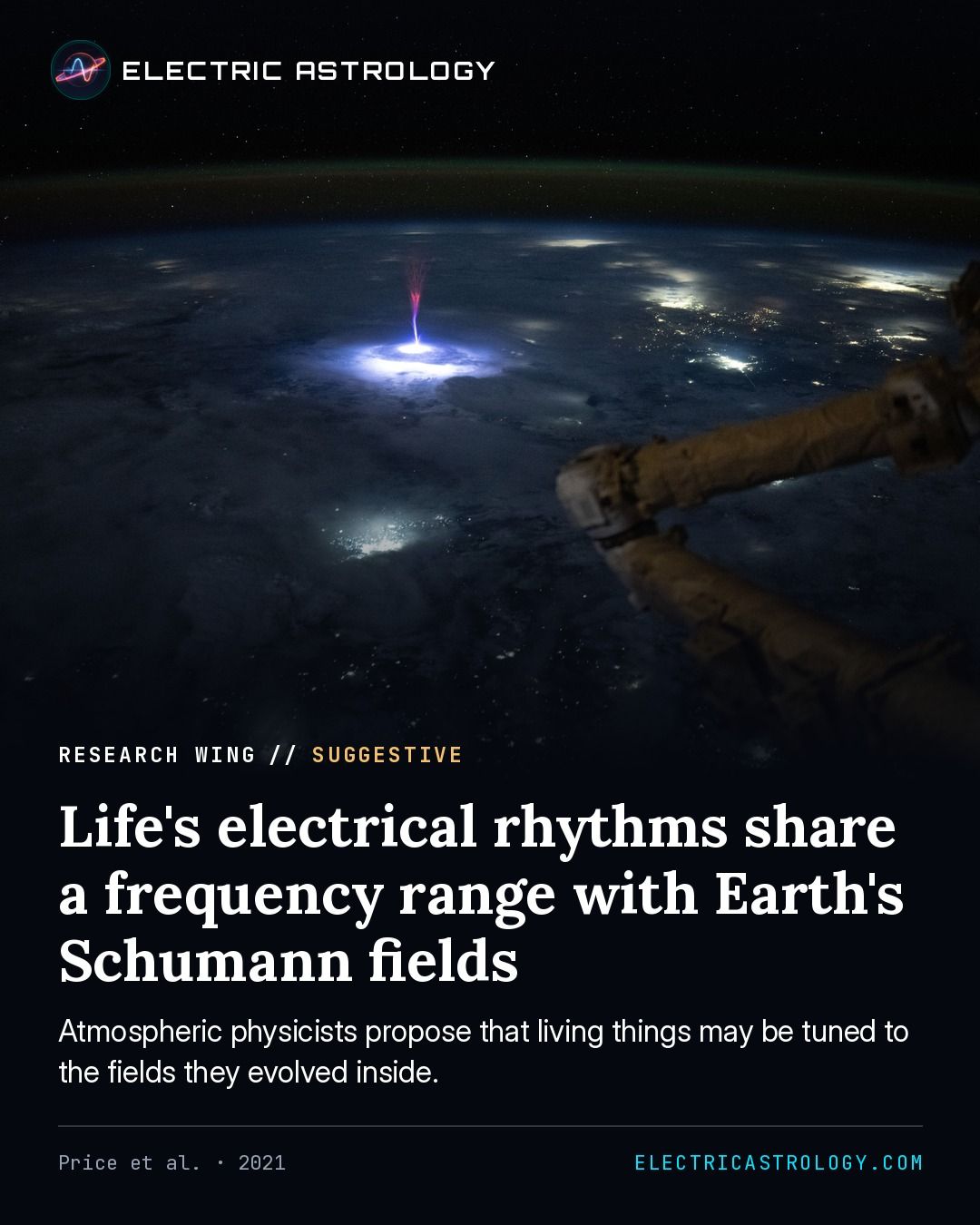
Lightning flashes dozens of times a second somewhere on Earth, so the planet is never without its very weak, extremely low-frequency Schumann fields. Atmospheric physicists point out that most electrical activity in living things, from zooplankton to people, sits in the same frequency range, and propose that life may be tuned to it.
They are clear that the fields are extremely weak and that no mechanism has been found yet.
210 m
Skin depth of an 8 Hz field in blood, far larger than any body: a living body sits wholly inside the Schumann fields.
The paper
Natural ELF fields in the atmosphere and in living organisms
Price, C., Williams, E., Elhalel, G., Sentman, D. (2021). Natural ELF fields in the atmosphere and in living organisms. International Journal of Biometeorology, 65(1), 85–92.
Checked against the paper’s full text on November 9, 2026.
What they measured
This is a review and a hypothesis, not a new experiment. The authors gather what is known about the natural extremely-low-frequency (ELF) fields in the atmosphere, chiefly the Schumann resonances, and about the electrical activity of living things, including their own earlier laboratory work.
What they found
With 50 to 100 lightning flashes every second somewhere on the globe, the Schumann background field is present at all times. Its magnetic part is measured in picotesla, about 10 million times weaker than Earth’s steady field.
Most electrical activity in vertebrates and invertebrates sits at extremely low frequencies, with characteristic peaks below 50 Hz; zooplankton show electrical activity peaking around 7 and 14 Hz, near the first two Schumann modes.
In the authors’ own earlier study of rat heart-muscle cells, an applied ELF magnetic field reduced stress-induced damage by about 40% against controls, and the frequency of the field, not its strength (tested from 20 pT to 200 nT), made the difference.
How it bears on the hypothesis
SuggestivePoints the same way, from a smaller study or a proposed mechanism still being tested.
This is the Schumann half of the hypothesis, stated by atmospheric scientists in a biometeorology journal: life evolved inside an electromagnetic cavity that rings in the same low-frequency range its own nerves and hearts work in, and may have tuned itself to it.
The authors call it a controversial, perhaps revolutionary, idea, and they are clear that the physical mechanism is still missing.
The authors’ own caution: The authors note the Schumann fields are extremely weak and that no physical mechanism for these biological effects has yet been found.