The film · The Schumann Resonance
What is the Schumann resonance?
A low electric hum the whole planet makes, about eight beats a second. This film starts on the one night we knocked it out of tune, then works through what it is, why it’s that number, what moves it, what the charts online actually show, and what’s honestly known about the body.
- The night the sky turned red over Honolulu
- You’re standing inside it
- Lightning, fifty times a second
- Why 7.8
- What moves it, and what doesn’t
- Reading the chart you’ve seen online
- The body’s own rhythms
- The bunker experiment
- Granada’s heart admissions
- How an electrician reads it
- What’s missing, and how you’d test it
The short answer
The Schumann resonance is the planet ringing like a bell, at about 7.8 beats a second. The ground conducts electricity, and so does the ionosphere about fifty miles up, with air in between. Lightning strikes that gap about fifty times every second, and the longest radio waves run all the way around the Earth and meet themselves coming back. The size of the Earth sets the note. The frequency barely moves; the volume swings with the world’s afternoon thunderstorms.
Whether it affects the body is an open question. The first ring sits right on the line between the brain’s settling rhythm and drifting toward sleep. In a 1960s bunker, a faint electric rhythm nobody could feel pulled volunteers’ body clocks back together in ten trials out of ten. In Granada, Spain, heart and circulation admissions bunched on the days the frequency sat lowest, over one year. Neither has been repeated, and nobody has yet lined up the measured record against how people sleep and feel at scale.
The film in six numbers
The planet’s hum, right now
This is the readout Ganymede explains in the film. It is a model, and it says so: it takes the real clock, the world’s lightning patterns and the Sun’s live X-rays, and works out what the physics says the spectrum should look like right now.
Horizontal magnetic power at Tomsk, Siberia, relative units. Computed from the Ishaq & Jones cavity model driven by three tropical lightning centres at today's UTC time.
Lightning clicks at the real global rate ringing the modeled modes, shifted up four octaves (×16) so 7.8 Hz becomes about 123 Hz. Headphones help.
The full transcript
The narration, chapter by chapter. Ganymede’s lines are marked.
The night the sky turned red over Honolulu
This is the Schumann resonance. A low electric hum the whole planet makes, about eight beats a second.
And this is the chart you've probably seen, the one people say keeps spiking.
So what is it, really? And does it do anything to us?
The best place to start is the one night we knocked it out of tune.
It's Sunday night in Honolulu, and the whole town is facing the same direction. Southwest, out over the ocean.
The morning paper said tonight's show might be dazzling. The hotels are throwing parties on their roofs.
Nine hundred miles away, there's a hydrogen bomb on top of a rocket. At eleven o'clock it goes off two hundred and fifty miles up. About as high as the space station flies today.
The sky turns pink. Then red. A reporter writes that the moon is hanging in the middle of it, and the clouds have gone black against the light.
Up in Manoa, on Ferdinand Street, the streetlights go out. At the same instant, across the island, a street in Kailua goes dark.
Burglar alarms start ringing in shops nobody's touched. An air-raid siren starts to wail. Nobody on the island can tell them why.
Five thousand miles away, in Massachusetts, two engineers have an instrument listening for something almost nobody in Honolulu has heard of. A low electrical hum the whole planet makes, eight times a second, day and night.
At eleven o'clock Hawaii time, that hum drops. The whole planet slips half a beat a second lower, and it takes three or four hours to come back.
We knocked the whole Earth out of tune. Once. With a bomb.
That hum has a name: the Schumann resonance. It runs at about seven point eight beats a second. And it sits right on the edge of the rhythm your own brain runs at when you close your eyes and start to settle.
Search for it and you'll get two answers. It's rising, it's shifting, it's why you can't sleep. Or: it's too weak to matter, forget it. I've spent my working life around electricity, and neither answer satisfies me.
So here's what it is. Why it's that number. What moves it. What the internet gets wrong. What's been measured in people. And what nobody has tested yet.

You’re standing inside it
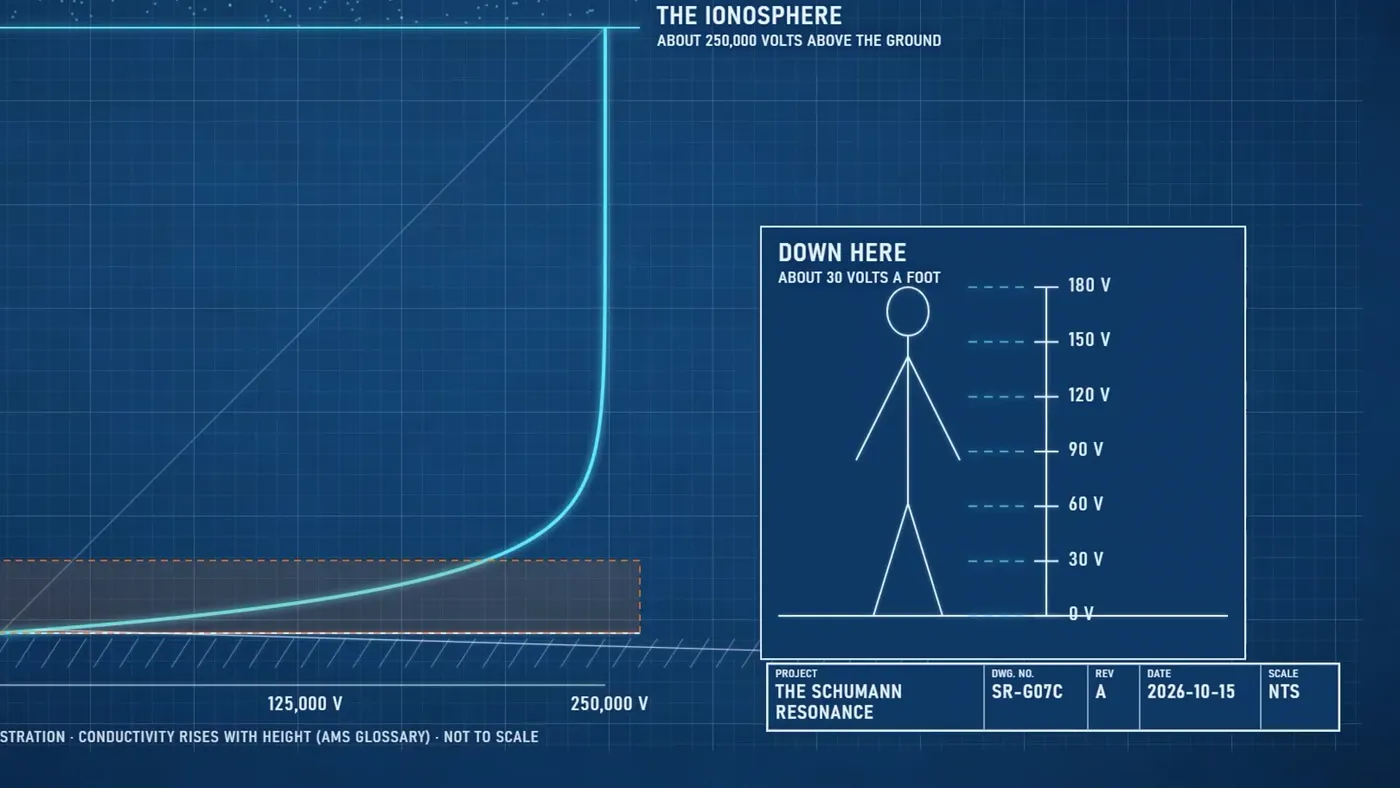
If you're about six feet tall, the air around the top of your head is sitting close to two hundred volts higher than the ground under your boots. Right now. On a calm, sunny day.
You are walking through a high-voltage field every moment of your life.
Here's why it's there. The ground under you conducts electricity. Wet dirt, rock, and most of all the ocean, because salt water carries current.
Now go up about fifty miles. The air there is so thin, and so blasted by sunlight, that it conducts too. That layer is called the ionosphere.
So the whole planet is wrapped in two conductors with insulation in between. Two walls, one inside the other, and every living thing on Earth lives in the gap.
If you've ever screwed a cable into the back of a TV, you've held the same thing. Cut the end and look: a wire in the middle, white insulation around it, a braided metal sleeve around that. Now wrap that cable around the world. The ground is the wire in the middle. The air is the insulation. The ionosphere is the braid.
Like any cable that's hooked up, there's a voltage across it. The ionosphere sits about a quarter of a million volts above the ground. That voltage drops all the way down through the air, but not evenly. High up, the air is thin and lets current through. Down low it's thick and fights it, so most of the drop happens in the bottom few miles. Down here, where you're standing, it works out to about thirty volts for every foot. That's where the two hundred volts over your head comes from.
Two hundred volts, measured against what? Against the ground. And here's how I've always thought about the ground. In a building, the most important wire isn't the black one or the white one. It's the green wire. The ground. The ground doesn't provide the power. The ground provides reference. Without a ground you have no zero point to measure against, and the system floats: unstable, erratic, and dangerous.
To me, the Earth is the ground wire for everything that lives on it.
Lightning, fifty times a second
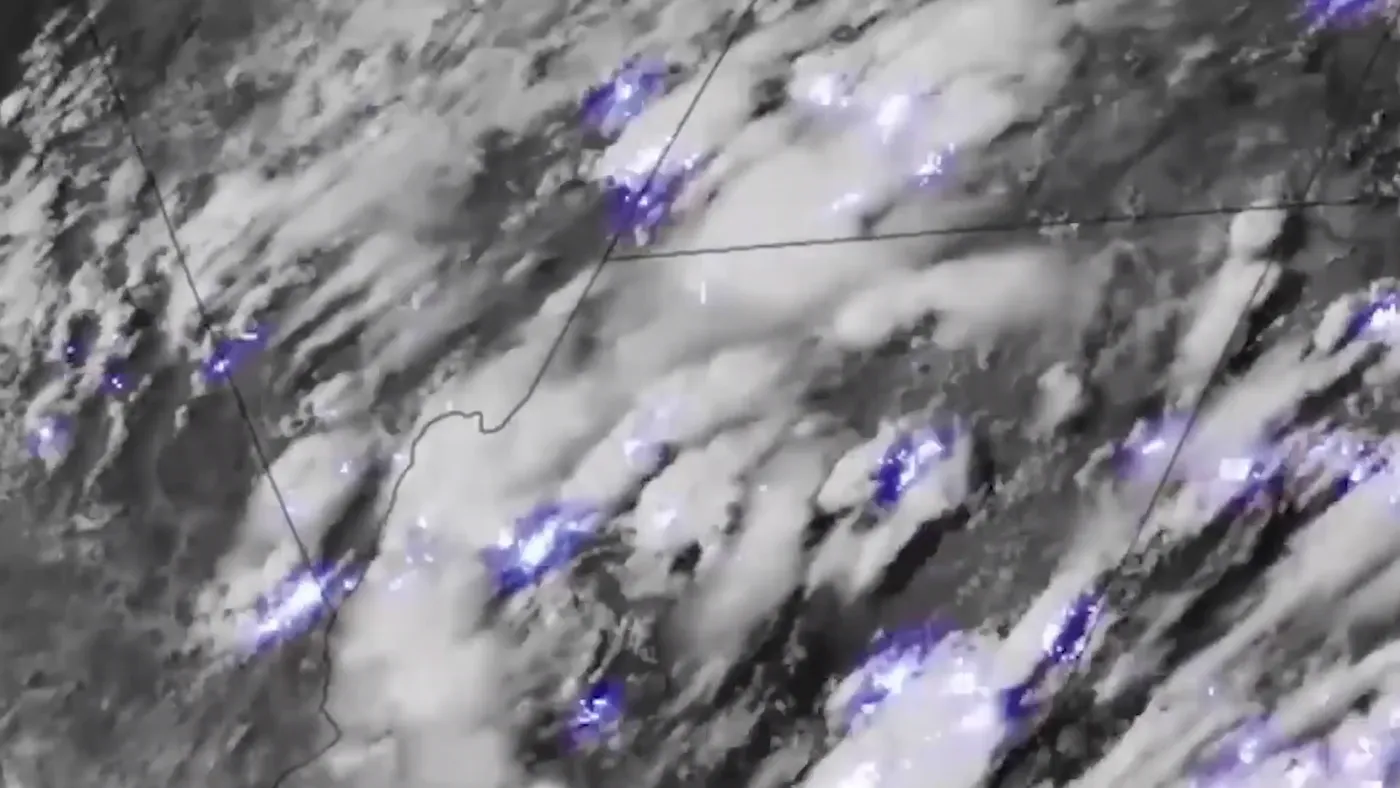
Something is always hitting that cable. Lightning. Somewhere on Earth, about fifty times every second.
Mostly over land, mostly in the tropics, mostly in the afternoon. Every strike is a huge jolt of current, and it throws a radio wave out into the gap between the ground and the sky.
Most of those waves fade out. But the longest ones, waves as long as the Earth is around, run all the way around the planet and meet themselves coming back. When a wave lands on top of itself in step, it builds.
That's what a bell does. Hit a church bell with a hammer and it doesn't go clunk. It rings. A big bell rings low, a small one rings high. The size of the bell sets the sound, not the hammer.
So: fifty hammers a second, all over the world, and the whole planet rings at its own frequency. About eight times a second.
Too low to hear. Your ears stop at about twenty.
So let's cheat. Speed it up sixty-four times, six octaves, and this is what the planet sounds like.
It isn't one tone. It's a stack: about eight, fourteen, twenty, twenty-six, thirty-three. And like a real bell, those upper rings don't sit in a perfectly tidy row. That's what a round thing does when it rings.
Why 7.8
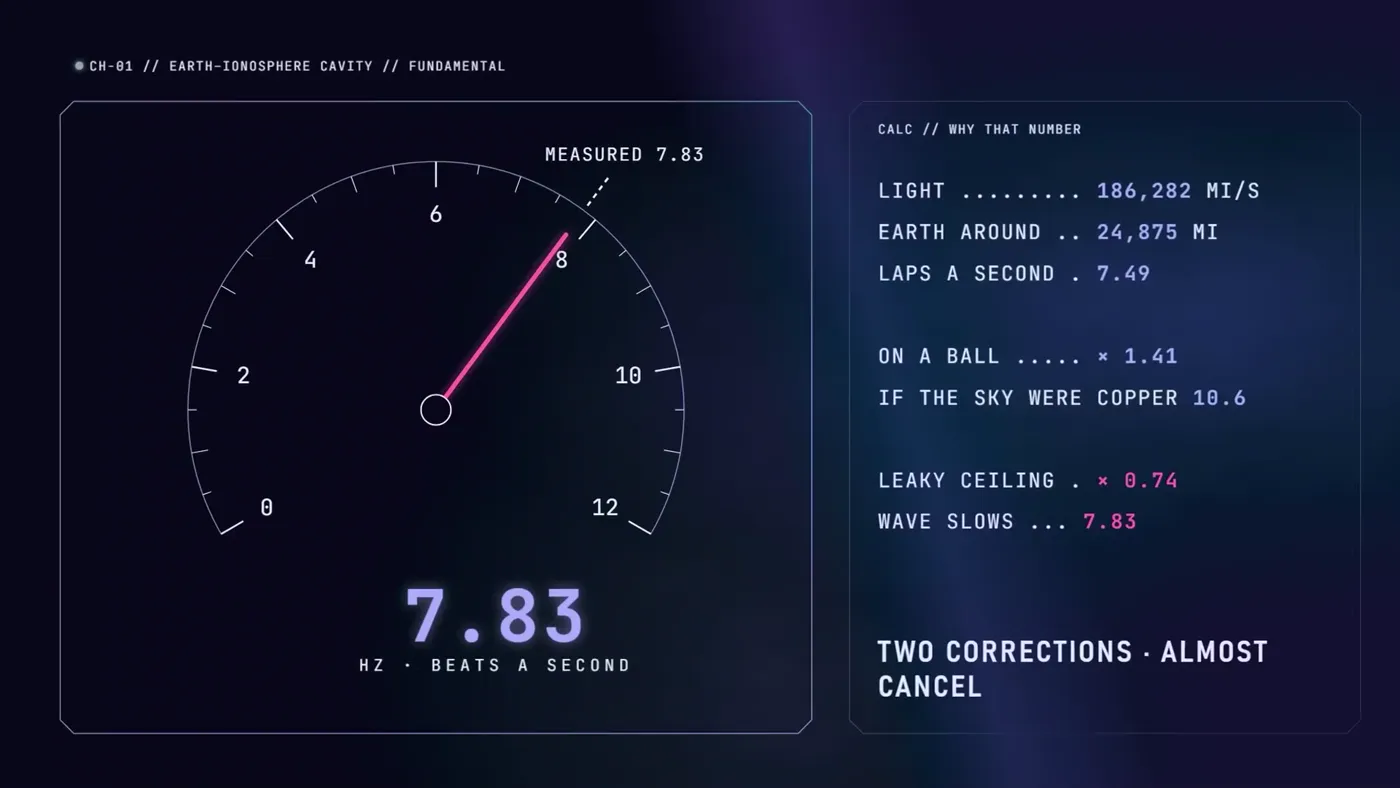
So why about seven point eight? Here's the shortcut you'll find online. Light can lap the Earth about seven and a half times in one second. So the planet rings about seven and a half times a second.
It's close. It's also wrong.
A wave on a ball doesn't run like a car on a racetrack. It spreads from the strike in every direction, like a ripple on a pond, wraps around, and squeezes back together on the exact opposite side of the world. Work that out for a perfect ball and the number comes out higher. About ten and a half.
If the sky were a solid sheet of copper, the planet would ring at ten and a half. But the ionosphere isn't clean copper. Remember the braid on that TV cable? Up there it's leaky and soft, more like wet dirt than copper braid. The wave drags against it, loses speed, and that pulls the frequency down to about seven point eight.
Two corrections that almost cancel each other. That's why the shortcut looks right.
What really sets the number is the size of the Earth. A bigger planet would ring lower. The height of the ceiling barely matters.
A German physicist, Winfried Schumann, worked out in 1952 that this gap ought to ring. It took eight years to catch it. Two engineers from MIT tried a sensor on a boat in Boston Harbor; the mast rocked and they got nothing. They tried beside a highway in New Hampshire and got a glimpse. Then they bolted a sensor to a solid tower, and the peaks came up right where the math said. One of them told a colleague years later that they had a big party that night.
What moves it, and what doesn’t
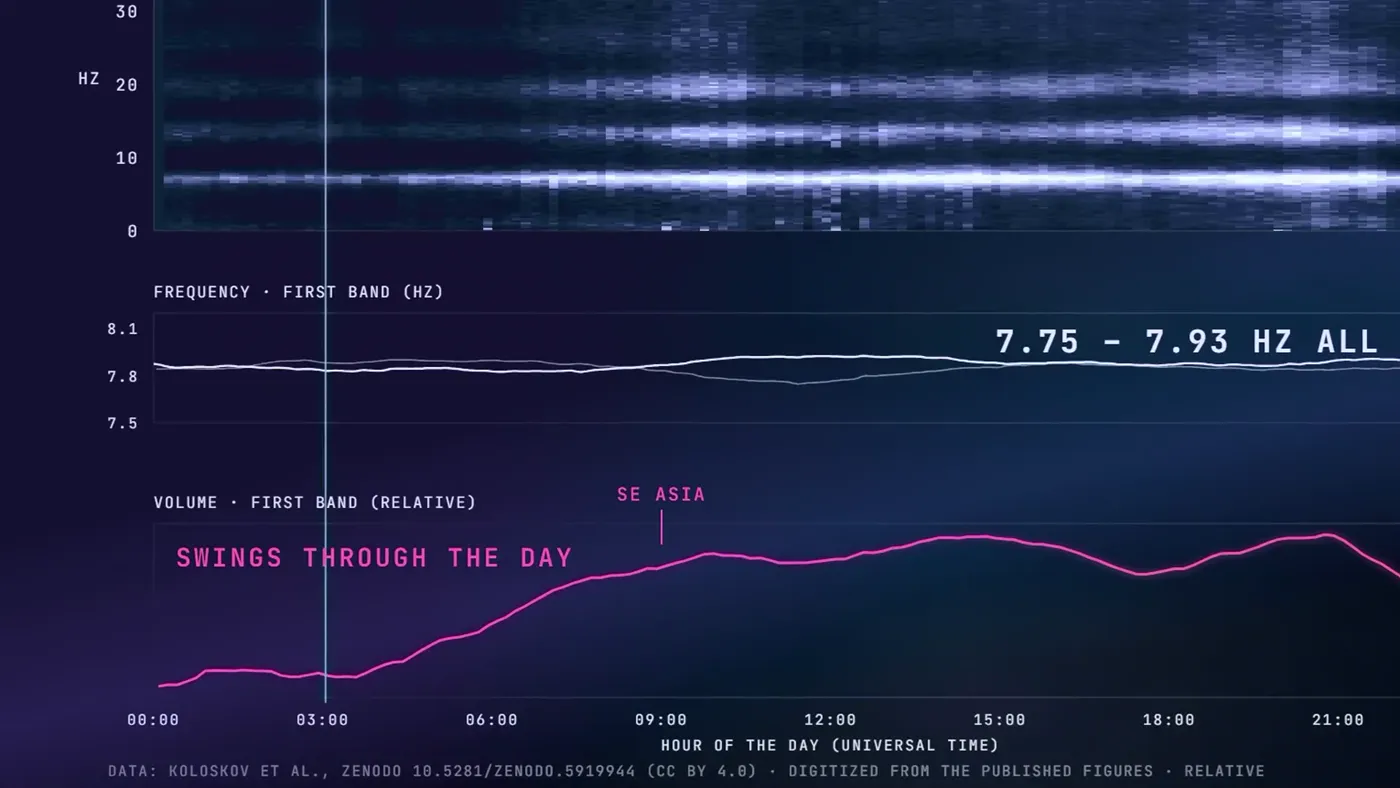
Here's the part most videos get wrong. The frequency barely moves. The volume does.
About seven point eight on a quiet day. About seven point eight in a storm. Through a day it wanders a few tenths up and down.
The volume is another story. It swings by tens of percent, sometimes hundreds.
Watch it for one day and it gets loud three times. Afternoon over Southeast Asia. Afternoon over Africa. Afternoon over the Americas. Afternoon heat builds thunderstorms, thunderstorms throw lightning, and the bell gets hit harder. Africa usually rings it loudest.
Then there's the Sun. A big solar flare pushes the ceiling down, the gap gets a little smaller, and the frequency ticks up, about two tenths of a beat, for as long as the flare lasts. A strong magnetic storm makes the whole thing a little louder.
And over the Sun's eleven-year cycle it drifts. At one observatory in Slovakia, the yearly average fell from seven point eight five to seven point five five as the Sun went into its deepest quiet in a century, in 2008 and 2009. The scientists called that drop extraordinary.
Now go back to that Sunday night in Honolulu. Half a beat a second, in one instant. That's still one of the biggest single drops anyone has ever recorded. And people did it.
Reading the chart you’ve seen online
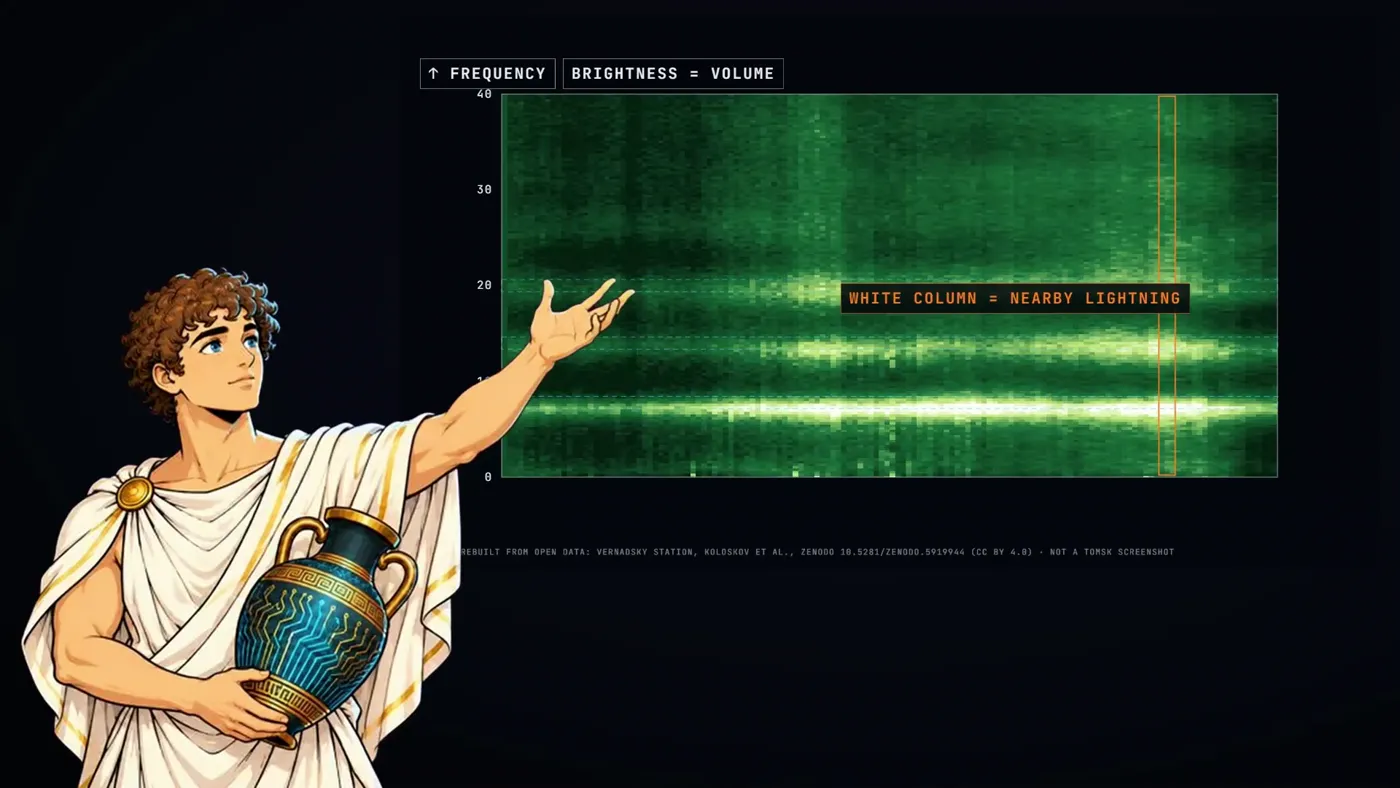
If you've searched for this before, you've probably seen a chart like this, and a post saying the Schumann resonance just spiked to forty.
I built a guide into the Electric Astrology app to read instruments like this one. His name is Ganymede. I'll let him show you what you're actually looking at.
GanymedeThank you, William. Let's read it the way you'd read any gauge.
GanymedeUp the side is frequency. Brightness is volume. These flat bands that never move are the resonance itself: about eight, fourteen, twenty. That is the planet ringing.
GanymedeThese white columns are lightning near the station. A thunderstorm close to the microphone. They reach the top because the top of the chart is forty. That is where the paper ends, not where the Earth went.
GanymedeMost of these charts come from one station, in Tomsk, in Siberia. The ring it hears is the same ring around the whole planet. The thunder it hears is Siberia's. A white column over Tomsk tells you about the weather over Tomsk.
GanymedeAnd the frequency is not climbing toward forty. To ring at forty, the Earth would have to shrink to about a fifth of its size.
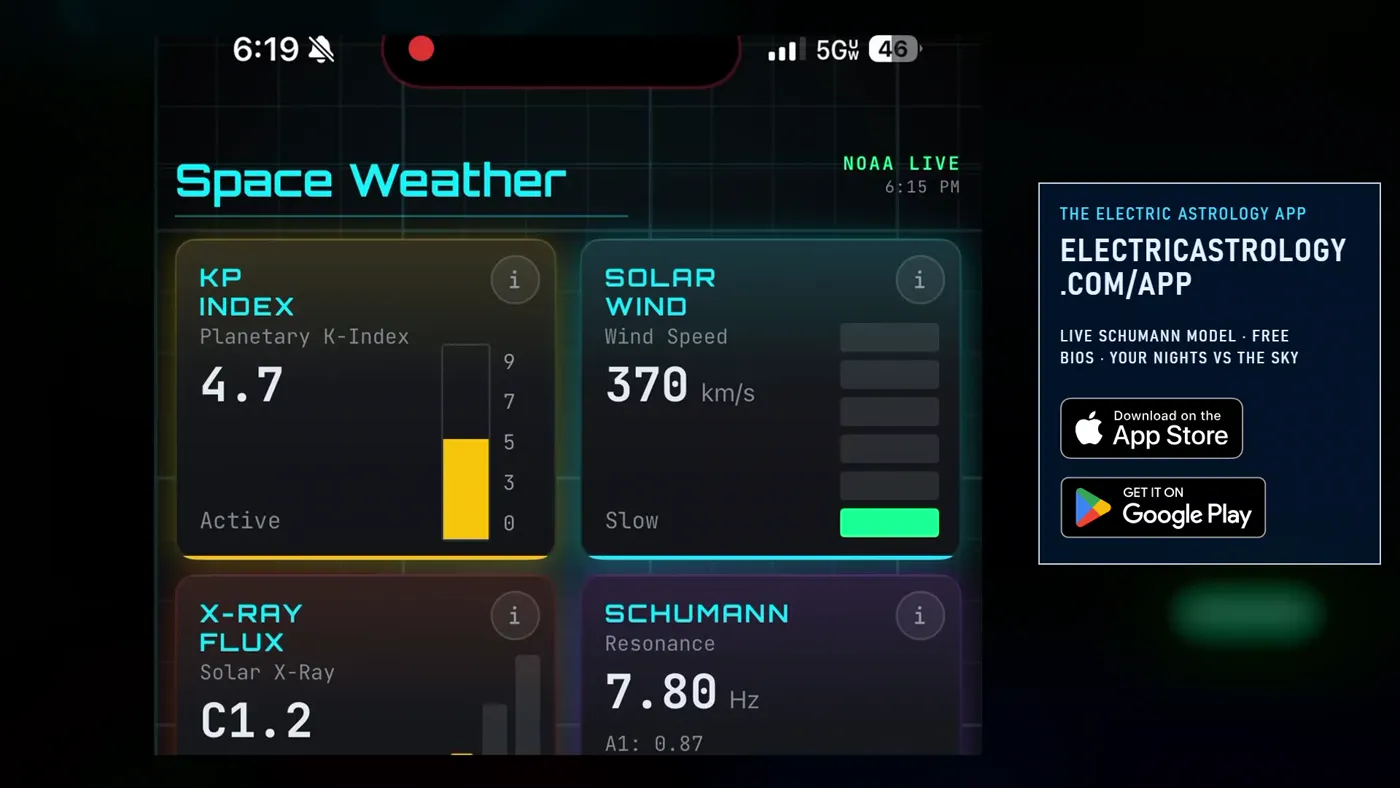
GanymedeThe Schumann readout in the app's space-weather screen, and on the website, is a model. It takes the real clock, the world's lightning patterns, and the Sun's live X-rays, and works out what the physics says the spectrum should look like right now. It says MODELED, because it is.
GanymedeBack to you, William.
One more you might have read: that NASA puts Schumann generators in spacecraft so astronauts don't get sick. We looked. There's no such machine. What exists is a suggestion that someone should test whether people far from Earth miss this signal. A question, not a box on the wall.
The body’s own rhythms
So, does any of this touch us? Here's the honest version.
Your brain runs on rhythms. Wide awake and busy, it runs fast, above thirteen beats a second. Close your eyes and settle, and it slows to between eight and thirteen. Drift toward sleep and it drops below eight.
The planet's first ring sits at seven point eight. Right on the line between settling down and drifting off. And the rings above it, fourteen, twenty, twenty-six, climb straight up through the rest.
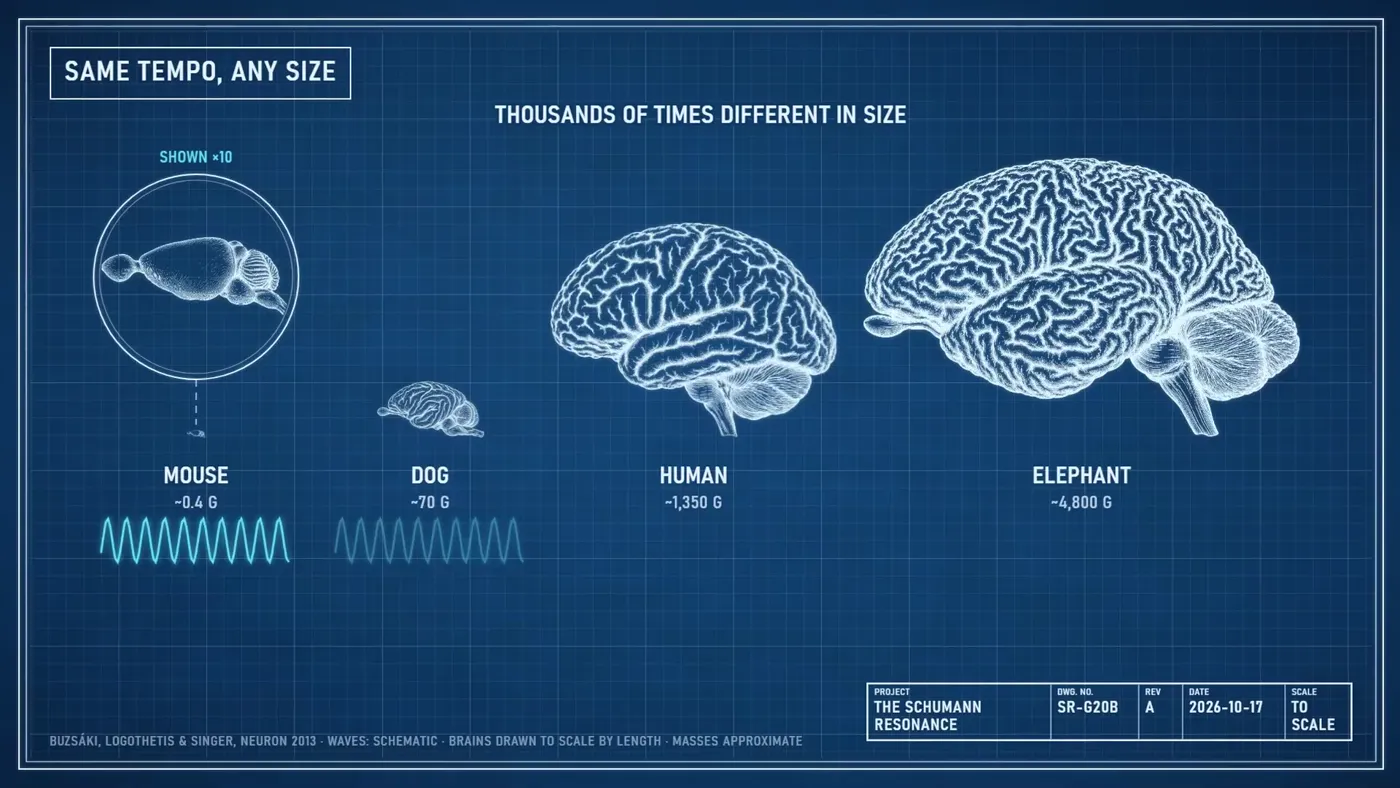
Coincidence? Maybe. But here's what I can't let go of. A mouse brain and a human brain are thousands of times different in size, and they run their rhythms at the same speeds. Neuroscientists who studied that in 2013 found the timing held steady through all of that growth, and the wiring grew to keep it steady.
And in 2021, a group of atmospheric physicists, people who measure lightning for a living, wrote that why living things run their electrical activity at these low frequencies "is unknown and remains a mystery." Their proposal: life spent billions of years growing up inside this ringing gap, and its own electrical rhythms developed against that background.
The bunker experiment
Somebody did go looking. In the 1960s, in Bavaria, a scientist named Rütger Wever built an underground bunker with two apartments. One of them was shielded from the Earth's natural electric and magnetic fields. Volunteers lived down there for weeks. No windows, no clocks. Meals came through a double door. They wrote letters to the outside.
In the shielded room, their days ran longer, and their sleep and their body temperature started drifting apart.
Then Wever switched on a faint electric field, ten beats a second, that nobody inside could feel. In every one of those ten trials the day got shorter, by more than an hour on average, and the rhythms came back together.
Now, Wever didn't use the planet's seven point eight. He used ten, right in the middle of that settling rhythm. And his field was thousands of times stronger than anything the sky makes. He wasn't copying nature. He was asking a simpler question: can a faint electric rhythm that nobody can feel take hold of a human body clock? Ten times out of ten, it did. That was the 1960s. Nobody has run it on people again since.

Granada’s heart admissions
And there's one study that lines up hospital records against the real, measured resonance. Granada, Spain. A full year of heart and circulation admissions. They didn't land at random. They bunched up on the days the planet's frequency sat at its lowest. That's one province, for one year. The obvious next step is to run it across the world, for years. As far as I can find, nobody has.
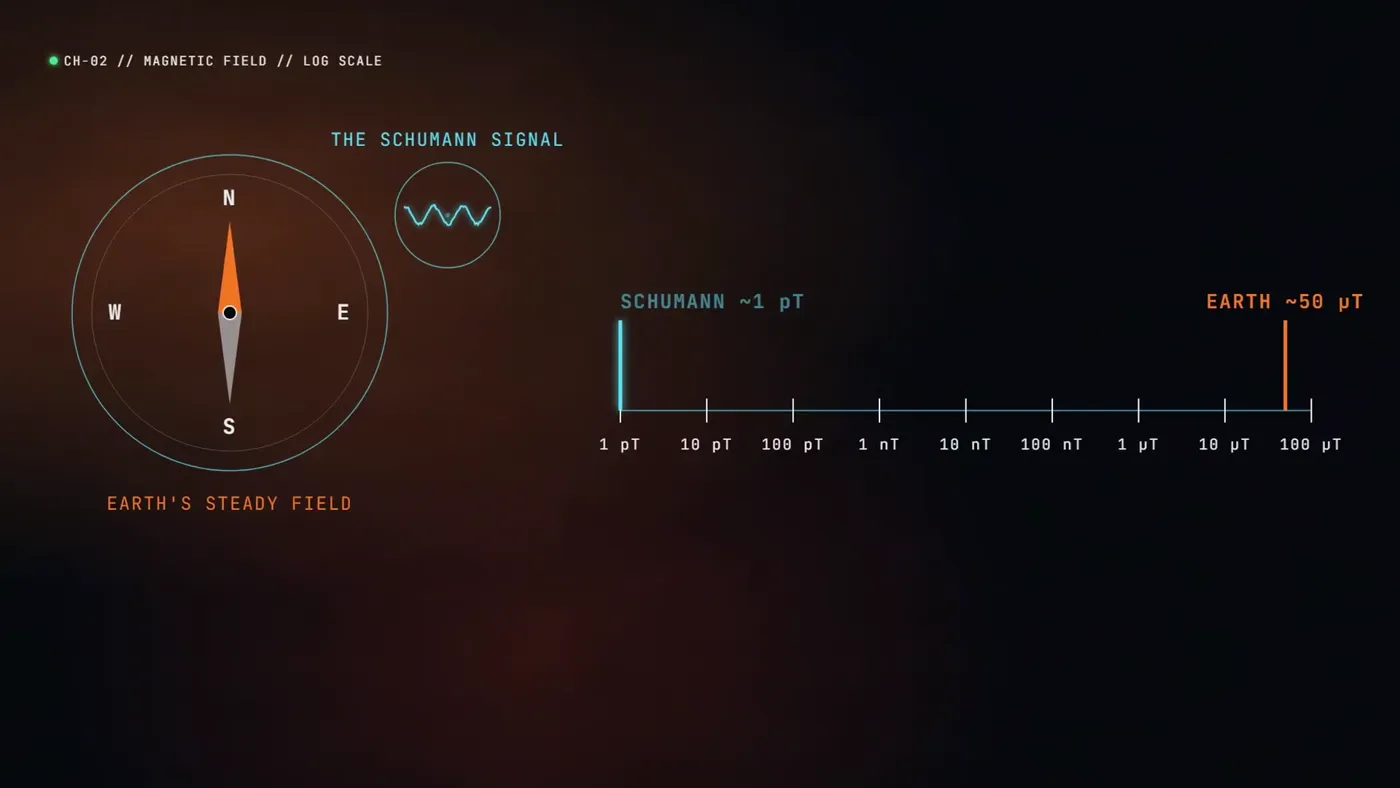
Now the strongest argument against all of it. This signal is faint. Its magnetic part is tens of millions of times weaker than the steady field that turns a compass needle. If your body hears it, it's hearing a whisper in a loud room.
But a whisper isn't nothing. Your body clock doesn't run on sunlight. It uses sunlight as a signal. A faint signal that never stops, for billions of years, is a very different thing from a loud one that comes and goes.
How an electrician reads it
So here's where I land. This is how an electrician reads it.
Every control system I've ever worked on needs a reference. A sensor reads a voltage, but a voltage is only ever measured against something. Lose the ground and the circuit floats. The readings drift, they jump, and the machine starts doing things nobody told it to do. Nothing is broken. It just has nothing steady to measure against.
We aren't just living on the Earth. Every living thing on this planet grew up inside that ring. Lightning has been striking it fifty times a second for longer than there have been eyes to see it. I think our rhythms grew up keeping time with it. A system clock, running in the background, under everything, that never stops.
And if that's right, then a body is like any other control system. Most days the reference is steady and you never think about it. But on the days the reference moves, I want to know what moves in us.
The measurements are where I start. They aren't where I have to stop thinking.
What’s missing, and how you’d test it
Here's what's missing. Nobody has lined up the real, measured Schumann record against how people actually sleep and feel. Not at any scale. Granada is one province for one year. The bunker was a handful of people, sixty years ago.
A real test looks like this. A lot of people. Wearing what they already wear to bed. Night after night, on quiet days and storm days, lined up against a real station's record.
That's what we're building. The space-weather screen in the Electric Astrology app shows our live Schumann model, free. And inside the app there's a tool called Bios. It takes the sleep and heart data your watch already collects and lines your nights up against the storm record. If you switch it on, your nights also join an anonymous pulse from everyone using it. That empty row doesn't get filled by one lab. It gets filled by a lot of people, one night at a time.
That Sunday night in 1962, a whole town looked southwest and watched the sky turn red. Five thousand miles away, a pen on a chart dipped. The planet has been ringing the whole time, before the bomb and long before us. What I want to know is whether we've been ringing along with it.
Keep following the wire
The live instruments, articles, films and the book this film connects to.
Questions people ask
What is the Schumann resonance?
A low electric hum the whole planet makes, about eight beats a second. The ground conducts electricity, and so does the ionosphere about fifty miles up, with air in between. Lightning strikes that gap about fifty times every second. The longest radio waves run all the way around the planet and meet themselves coming back, so the whole Earth rings like a bell: about 7.8, 14, 20, 26 and 33 beats a second.
Why is the Schumann resonance 7.83 Hz?
Light can lap the Earth about seven and a half times a second, which is the shortcut you’ll find online, and it’s wrong. A wave on a ball spreads from the strike and squeezes back together on the far side, which works out to about ten and a half for a perfect ball. The ionosphere is leaky, more like wet dirt than copper, so the wave drags and the frequency drops to about seven point eight. Two corrections that almost cancel. What really sets the number is the size of the Earth.
Is the Schumann resonance spiking to 40 Hz?
No. Most of the charts people share come from one station, in Tomsk, Siberia. The white columns are lightning near that station, and they reach the top because the top of the chart is forty: that is where the paper ends, not where the Earth went. To ring at forty, the Earth would have to shrink to about a fifth of its size.
Does the Schumann frequency change?
Barely. It wanders a few tenths up and down through a day. The volume is what swings, by tens of percent, louder each afternoon over Southeast Asia, Africa and the Americas. A big solar flare nudges the frequency up about two tenths for as long as the flare lasts, and at one observatory in Slovakia the yearly average fell from 7.85 to 7.55 during the Sun’s deep quiet in 2008 and 2009.
What happened to the Schumann resonance in 1962?
On July 8, 1962, a hydrogen bomb went off 250 miles above Johnston Atoll, about 900 miles from Honolulu (the Starfish Prime test). Two engineers in Massachusetts were recording the planet’s hum, and at eleven o’clock Hawaii time it dropped half a beat a second and took three or four hours to come back. It is still one of the biggest single drops ever recorded.
Does the Schumann resonance affect the human body?
Nobody knows yet. The planet’s first ring sits right on the line between the brain’s settling rhythm and drifting toward sleep. In the 1960s Rütger Wever’s bunker experiment found that a faint 10-beat electric field nobody could feel shortened the volunteers’ day in all ten trials, but his field was thousands of times stronger than the sky’s, and nobody has repeated it in people. A 2020 study from Granada, Spain found heart and circulation admissions bunched on the days the frequency sat lowest, in one province over one year. The signal’s magnetic part is tens of millions of times weaker than the field that turns a compass needle.
Does NASA put Schumann generators in spacecraft?
We looked, and there is no such machine. What exists is a suggestion that someone should test whether people far from Earth miss this signal: a question, not a box on the wall.
Is the Schumann reading in the Electric Astrology app measured?
No, it is a model, and it says MODELED. It takes the real clock, the world’s lightning patterns and the Sun’s live X-rays, and works out what the physics says the spectrum should look like right now. It is free on the app’s space-weather screen and on this website.
Sources
Every study in the film was opened and checked at its source.
- Schumann, W. O. (1952). Zeitschrift für Naturforschung (the prediction that the gap should ring).
- Balser, M. & Wagner, C. A. (1960). Nature 188, 638 (the first measurement).
- Balser, M. & Wagner, C. A. (1963). JGR 68, 4115 (the Starfish Prime dip, July 8, 1962).
- Christian, H. J. et al. (2003). JGR (about 44 lightning flashes a second worldwide).
- Sátori, G., Williams, E. & Mushtak, V. (2005). JASTP (the solar cycle).
- Williams, E. R. (1992). Science (the global tropical thermometer).
- Wever, R. (1967). The Andechs bunker.
- Buzsáki, G., Logothetis, N. & Singer, W. (2013). Neuron (brain rhythms across species).
- Price, C., Williams, E., Elhalel, G. & Sentman, D. (2021). International Journal of Biometeorology.
- Fdez-Arroyabe, P. et al. (2020). Science of the Total Environment (Granada).
Stills on this page are from the film: drawn scenes and graphics by Electric Astrology; satellite lightning from NOAA/CIRA (public domain). The full footage and photo credits are in the YouTube description.
One tap
On the nights the sky gets loud, does anything move in you?
The test nobody has run
Line your nights up against the storm record.
The space-weather screen in the Electric Astrology app shows the live Schumann model, free. Bios takes the sleep and heart data your watch already collects and lines your nights up against the storm record. If you switch it on, your nights also join an anonymous pulse from everyone using it.
Get the free app →Want the whole circuit on paper? Read the book →