Episode 005 · The Lunar Capacitor
Why can’t I sleep on a full Moon?
Night workers have stories about the full Moon. Sleep studies disagree. NASA has measured electrical charge on the Moon, but whether it affects sleep is an open question. This film follows the evidence and the model behind the Lunar Capacitor.
Take the film into your own chart
Find your Moon sign. Keep your free natal schematic.
The film shows four ways a Moon can hold a charge. Your birth chart tells you which Moon is yours.
- A helicopter that almost fell out of the sky
- An electrician recognizes it
- What a capacitor is
- “You gotta look at the Moon”
- Read the craters like a welder
- Is there a charge?
- Every full Moon happens inside Earth’s magnetic tail
- You are salt water and iron
- What the sleep studies found
- Two in the morning
- The old burn
- Your Moon sign is a capacitor
- How to drain it
- What we know, and what’s still missing
The short answer
Some studies find people sleep worse around the full Moon, and some don’t. In 2013 a Swiss sleep lab found its volunteers, who could not see the sky, took about five minutes longer to fall asleep, slept about twenty minutes less, and lost 30% of their deep-sleep brain activity around the full Moon. A bigger study the next year couldn’t repeat it. In 2021, wrist trackers in Argentina and Seattle showed sleep starting later and running shorter on the nights before the full Moon.
Gravity isn’t the reason: the Moon’s pull across your body is about a million times weaker than a mosquito landing on your arm. What is measured is a charge. Around full Moon, the Moon crosses Earth’s magnetic tail; in some crossings its night side can reach about 1,000 volts negative. Whether that charge affects sleep is William Edwards’s Lunar Capacitor model, not an established finding. The app places your chart beside live sky conditions so you can explore the model for yourself.
Live · tonight
Is the Moon in Earth’s magnetic tail?
Working out the Moon…
Full-Moon time calculated (Meeus), accurate to a few minutes. The crossing is NASA’s account: the Moon enters the tail about three days before full and takes about six days to cross. The tail flaps in the solar wind, so the edges move by about a day. The voltages are Lunar Prospector’s measurements (Halekas et al., 2008); they vary crossing to crossing.
The full Moon in six numbers
The part you need in your pocket
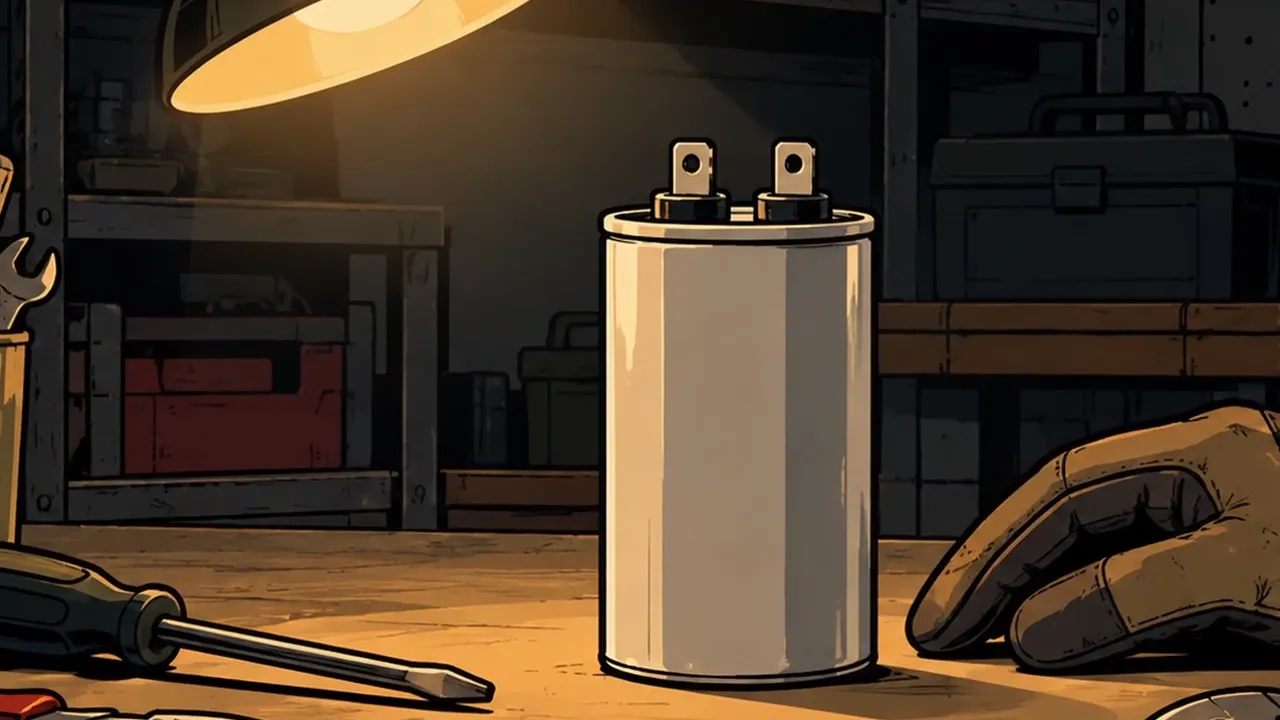
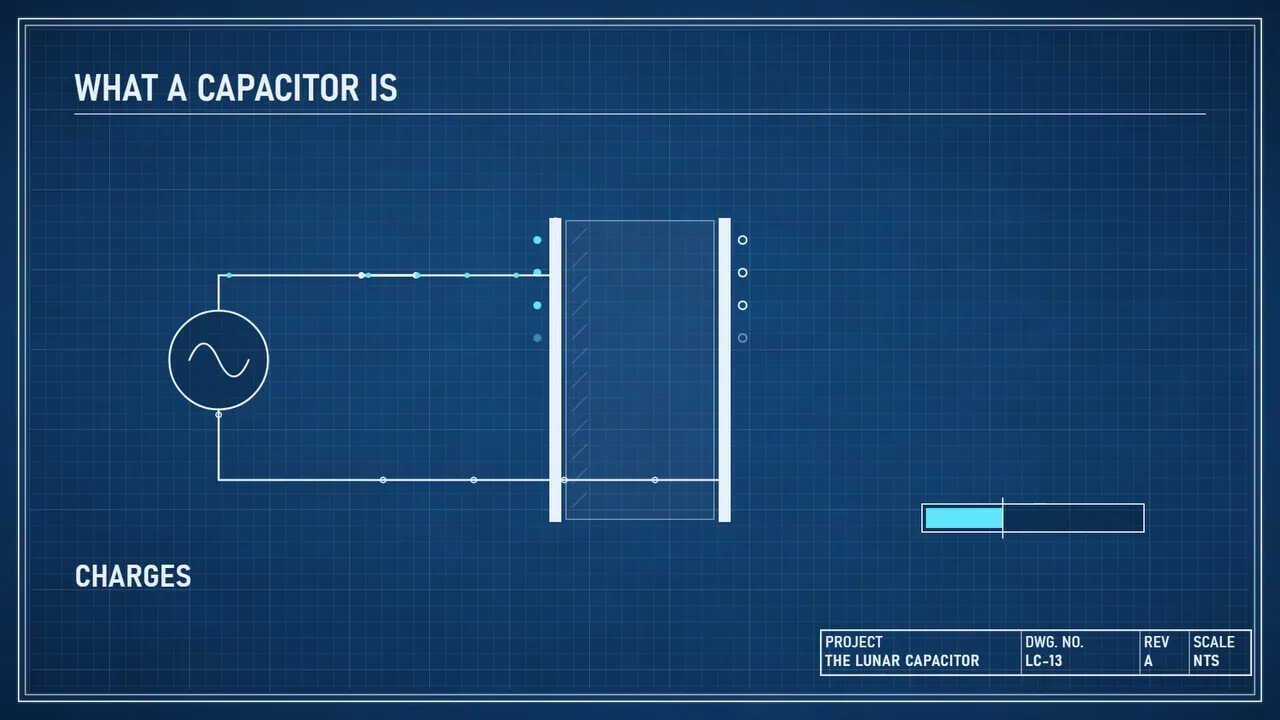
A capacitor is about the simplest thing in electricity. Two pieces of metal, close together, with something between them that won’t let current through. Push charge onto one side and it piles up, and it stays there after you cut the power. It’s why a repairman won’t reach into a microwave just because it’s unplugged.
It charges. It holds. And it lets go: slowly, if you give it a path, or all at once, if the layer in the middle gives out. A thundercloud over the ground is one, right up until the lightning. The Moon, sitting in Earth’s magnetic tail every full Moon, is another.
Your Moon sign
Which capacitor is your Moon?
Two plates and a layer between them. What that layer is made of decides how much it holds, how fast it lets go, and how it fails. In Electric Astrology, your Moon sign is that layer.
Don’t know your Moon sign? Most people have never looked theirs up.
Get your free natal schematic in the app →The full transcript
The narration, chapter by chapter. Craig Abington’s words are typed on screen in the film as the narrator reads them.
A helicopter that almost fell out of the sky
I want to talk about the Moon. But I don't want to start with astrology. I want to start with a helicopter that almost fell out of the sky.
A friend of mine was heading back to base after a long day on a training range. He's a pilot, but he wasn't flying that leg. He was strapped into the jump seat behind the cockpit when, suddenly, the bird died.
The hydraulics failed. The controls went mushy. The helicopter became a falling brick.
He watched the forest come up to meet them. Then they were below the treetops, and he could see single branches whipping past the glass.
He knew he had seconds. And in those seconds something happened that he later described to me the way a pilot reports a fault. Exactly.
"My life flashed before my eyes."Lt. Col. Craig Abington
We've all heard that phrase. He meant it literally. It wasn't a blur. Every picture was sharp. His childhood. His mother. Vietnam. The faces of people he hadn't thought about in forty years. All of it, at once, in less time than it takes to blink.
Then the pilot got the controls back by hand, pulled the nose up, and cleared the ground by a few feet. They didn't crash. But my friend was never the same. He had seen the file structure of his own soul.

An electrician recognizes it
I'm an electrician. And when he told me that story, I recognized it.
Inside almost everything you own that plugs into a wall, there's a part called a capacitor. Its whole job is to soak up charge and hold it. It's why a repairman won't reach into a microwave just because it's unplugged. The power is off. The capacitor is still holding.
That's what I heard in his story. The engine was dead. And something in him was still holding forty years of charge. When the pressure got high enough, the insulation failed, and it let go all at once.
Astrology has always had a name for that part of you. The part that keeps your memory, your instincts, everything under the surface. It calls it the Moon.
And the real Moon, the one over your house tonight, turns out to be holding a charge of its own. NASA has put a number on it.
What a capacitor is
Before we go anywhere, you need one part in your pocket. A capacitor.
It's about the simplest thing in electricity. Two pieces of metal, close together, with something between them that won't let current through. Paper. Plastic. Glass. Even air. That's the whole part.
Push charge onto one side and it can't get across. So it piles up. And it stays there after you cut the power. That's all a capacitor does. It takes on charge, and it holds it.
It gives it back one of two ways. Slowly, if you give it a path. Or all at once, if the layer in the middle gives out.
Three things to remember, because they keep coming back. It charges. It holds. And it lets go.
A thundercloud over the ground is one. Cloud, ground, and air in between. Right up until the lightning.
“You gotta look at the Moon”
The man in that jump seat is Lieutenant Colonel Craig Abington. He flew helicopters in Vietnam as a young man, and then he spent a career flying LifeFlight, the air ambulance, over the hills of Tennessee. He has steel nerves, and he does not exaggerate.
I was telling him about my work. That the Sun throws off an electrical wind, and I think our bodies feel it. He listened the way he'd watch a gauge. Then he leaned forward.
"You gotta look at the moon. Start there."Lt. Col. Craig Abington
"Without fail. If the moon was full, we were in the air. Car crashes, shootings, overdoses. The radio wouldn't stop. You could set your watch by it. The city just... swelled."Lt. Col. Craig Abington
Ask anyone who works nights in an emergency room. When researchers surveyed them, eight out of ten ER nurses and nearly two out of three ER doctors said the Moon changes their patients.
A physicist will tell you they're fooling themselves, and on one point the physicist is right. The only thing the Moon is supposed to reach us with is gravity. And across your whole body, the Moon's pull is about a million times weaker than the weight of one mosquito landing on your arm.
Gravity can't do it. So either a career's worth of flight crews and night nurses all imagined the same thing, or the Moon has something else to reach us with.
Craig said start there. So let's look at it.

Read the craters like a welder
You've looked at the Moon your whole life. Look at it now the way somebody who works with sparks would.
It's covered in craters, and we all learned why: rocks, flying in from every direction. But throw a rock into mud at an angle and you get a skid mark. An oval. On the Moon, almost every crater is a clean circle. The floors are flat. And a lot of them have a single mountain standing straight up in the middle.
Shoot a bullet into a wall. It doesn't leave a mountain in the middle of the hole.
The textbook has an answer, and you should hear it. A rock moving that fast doesn't dig. It explodes, and explosions are round. The mountain is the ground bouncing back.
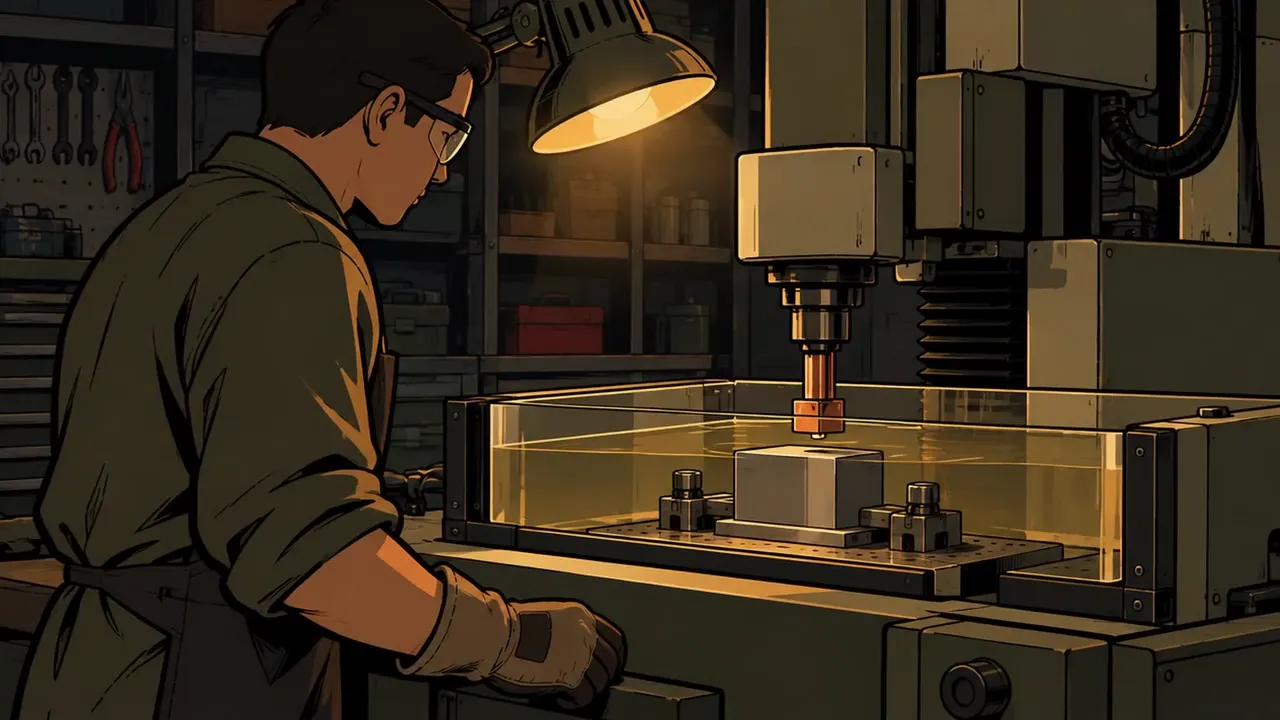
Here's what I know from my side. There's a machine in tool shops that cuts steel with nothing but sparks. No blade. And a spark always lands square to the surface, whatever angle it comes from. Every one leaves the same mark: a round pit with a flat floor.
In 1965, a British researcher named Brian Ford put a piece of steel under one of those machines and photographed what it left. Round craters. Some of them with a peak in the middle.
Show the Moon to the guy who runs that machine and he'll tell you, "That's not an impact. That's an arc flash."
When I look at the Moon, I don't see a shooting gallery. I see scar tissue. A record of lightning on a scale we don't have a word for.
But a spark needs a charge. So is there one?
Is there a charge?
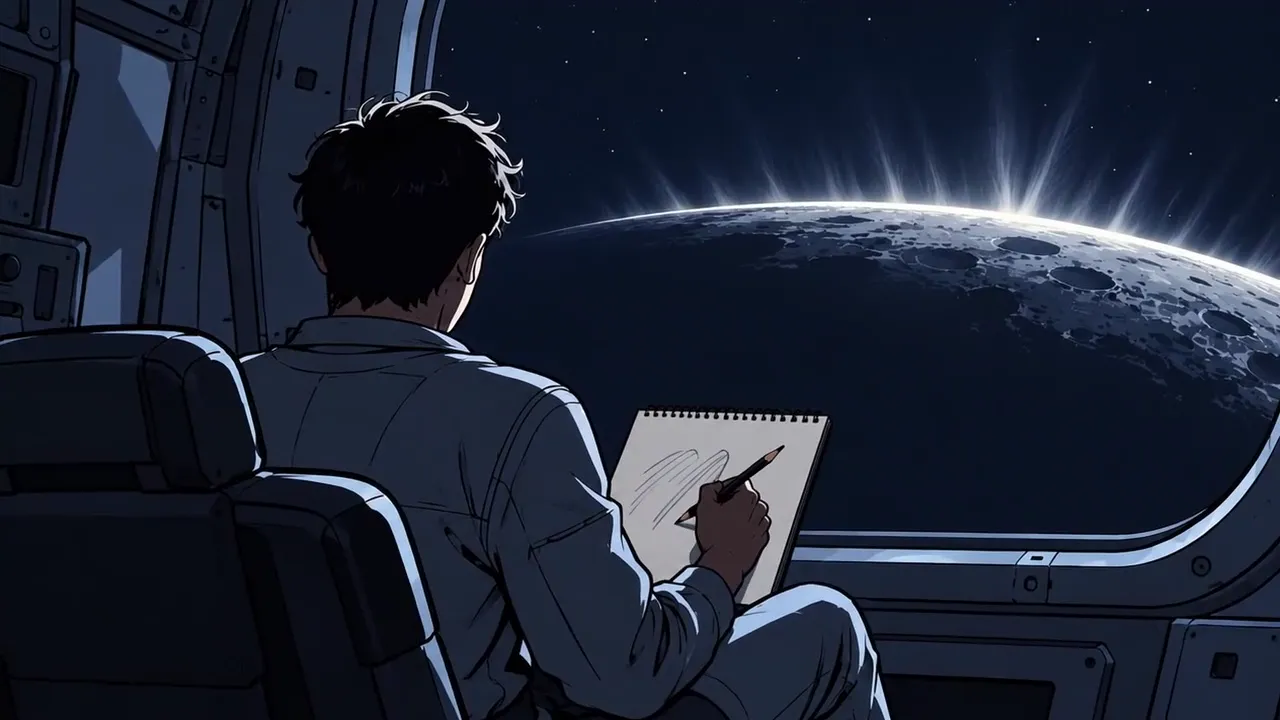
Start with something an astronaut drew. In 1972, Gene Cernan was in orbit around the Moon on Apollo 17, in the dark, just before sunrise. He saw streamers of light standing up off the horizon, and he sketched them.
The Moon has no air. Nothing up there should glow. The explanation NASA's own scientists reached for was dust, lifted off the ground by static charge. The same thing that stands your hair up when you pull off a sweater.
Then the charge itself got measured. To follow it you need one picture.
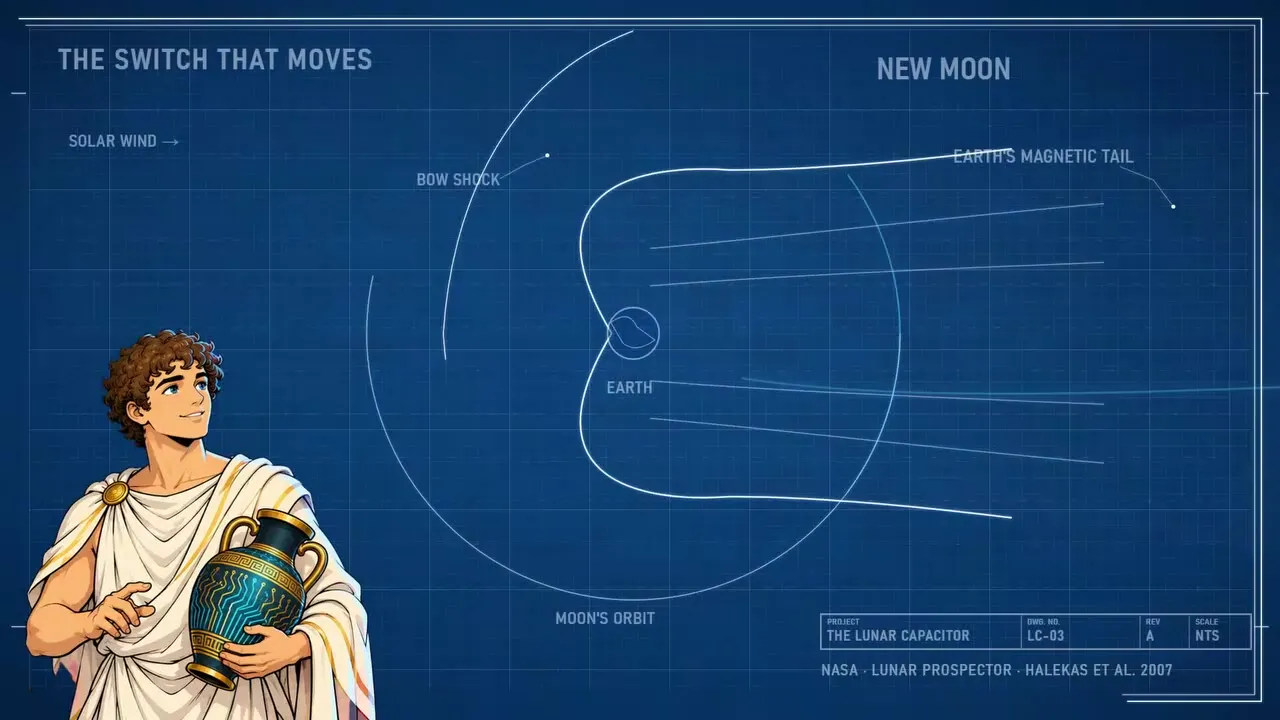
The Sun blows a constant wind of charged particles. That wind pushes Earth's magnetic field out behind the planet into a long tail, like a windsock. The tail reaches well past the Moon.
Once a month the Moon swings around behind the Earth and passes through that tail. You already know that night, because from here the Moon is opposite the Sun and fully lit. It's the full Moon.
Every full Moon happens inside Earth’s magnetic tail
Every full Moon happens inside Earth's magnetic tail, and the Moon is in there for about six days.
Ganymede is the guide inside the Electric Astrology app. Reading instruments is his job, so I'll let him read this one.
GanymedeThank you, William. So, the Moon. New Moon. The Moon is out front, in the open solar wind. Its night side sits around two hundred volts negative.
GanymedeQuarter Moon. It's crossing the edge, where the solar wind piles up against Earth's field.
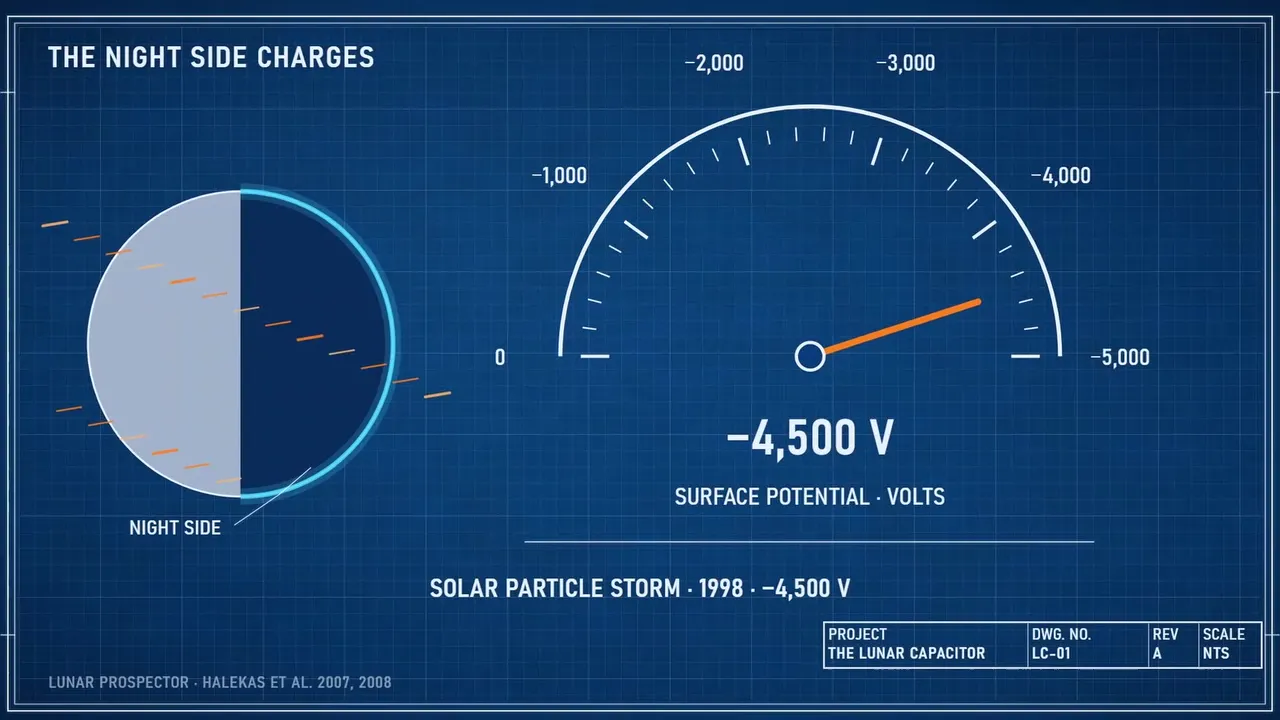
GanymedeFull Moon. Inside the tail. Each time the hot sheet of charged gas in the middle of that tail sweeps over it, the night side jumps. Two hundred volts. A thousand.
And in the spring of 1998, during a solar storm, NASA's Lunar Prospector caught it at forty-five hundred.
So the Moon holds a charge. It builds on a monthly schedule, and it runs highest on the nights Craig was in the air. It charges. It holds. You know that part now.
Hold on to that. You've got one too, and it comes in four kinds. We'll get to yours.
First: the Moon is two hundred and forty thousand miles away. Why would any of that reach you?
You are salt water and iron
Because of what you're made of. You are mostly salt water, and salt water carries current. Your nerves fire with it. Your heart beats on it. Every heart monitor you've ever seen is reading electricity off a person.
Your blood carries iron. In 1936, Linus Pauling showed that blood answers to a magnet: weakly drawn to it without oxygen, weakly pushed away with it.
And every red blood cell carries a small negative charge. Like charges push apart, and that's what keeps your blood cells from sticking together. In 1973, researchers lowered that charge in the lab and watched the cells stack up like rolls of coins. Stacked blood is thicker blood, and a heart has to push harder to move it.
Here's where measured ends and mine begins. Nobody has measured the Moon thickening anyone's blood. That link is my model, and I intend to test it.
What the sleep studies found
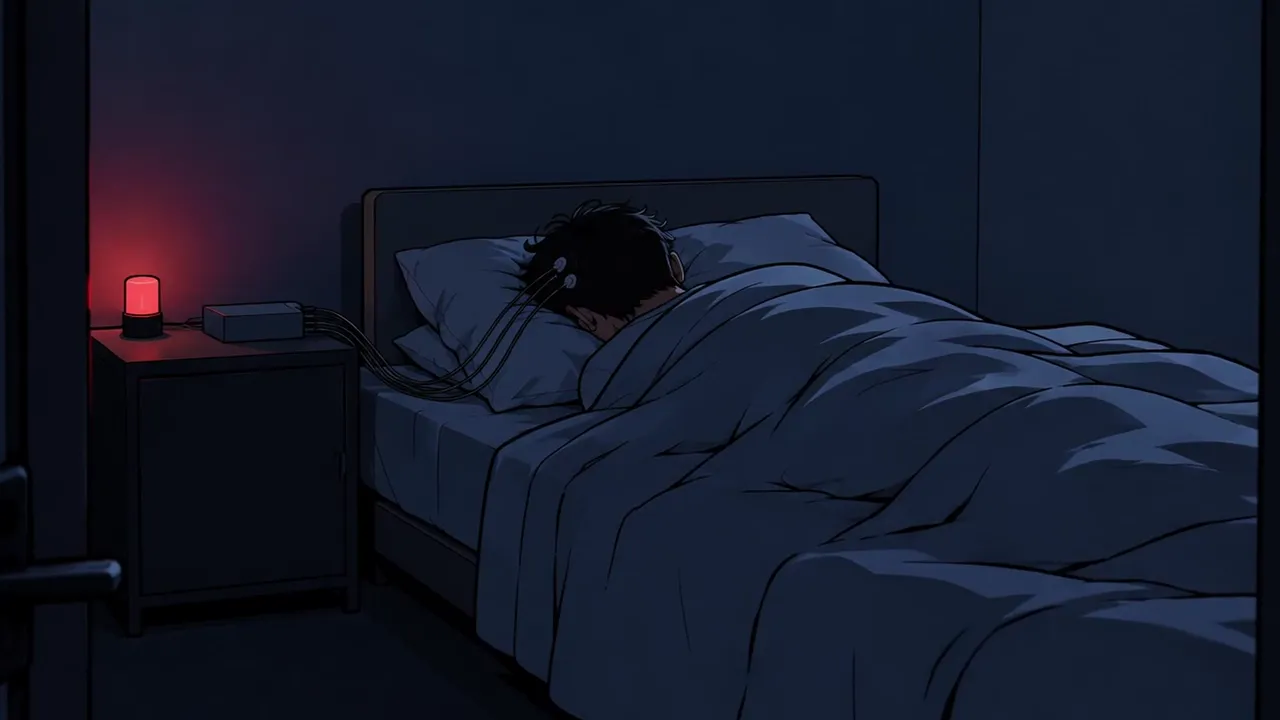
Sleep is where it has been tested. In 2013, a Swiss lab went back through its own sleep recordings: volunteers shut in a room with no windows and no clocks. Around the full Moon they took five minutes longer to fall asleep, slept twenty minutes less, and their deepest sleep dropped by thirty percent. They couldn't see the Moon. Nobody in the room knew anyone would ever check.
A bigger study the next year couldn't repeat it. Then in 2021, researchers put wrist trackers on people in three communities in Argentina, some with electricity and some without, and on college students in Seattle. Every group fell asleep later and slept less on the nights before the full Moon. The researchers put it down to moonlight. I'd point out that college students in Seattle don't get much of that.
So that's what's on the bench. A Moon that charges up every month, and a body made of salt water and iron. Now I can tell you what happens at two in the morning.
Two in the morning
All day, you run on the Sun. It's up, you're up: lit, busy, distracted. The Sun is the generator.
Then it sets. Every hospital has a switch for the moment the power fails. The main feed dies, the switch clunks over, and the building runs on what it stored. You throw that same switch every night. Charge by day. Hold. Then run the house on what's in the capacitor.
That's why the world feels so much heavier at two in the morning than at two in the afternoon. At two in the afternoon, you're on the grid. At two in the morning, you're running on what you stored.
If what you stored is clean, you sleep. If it isn't, it comes out. Every argument you never finished. Every fear you sat on. Every insult you've swallowed in the last twenty years. That's what is looping while you stare at the ceiling.
People have always known the night does this. The werewolf is a decent man until the full Moon comes up. Jekyll and Hyde is the same story. Here's what an electrician hears in it. The most dangerous moment in a circuit isn't while the power is running. It's the instant you cut it, when everything that was stored comes out at once.
And what comes out isn't random. It follows a path.
The old burn
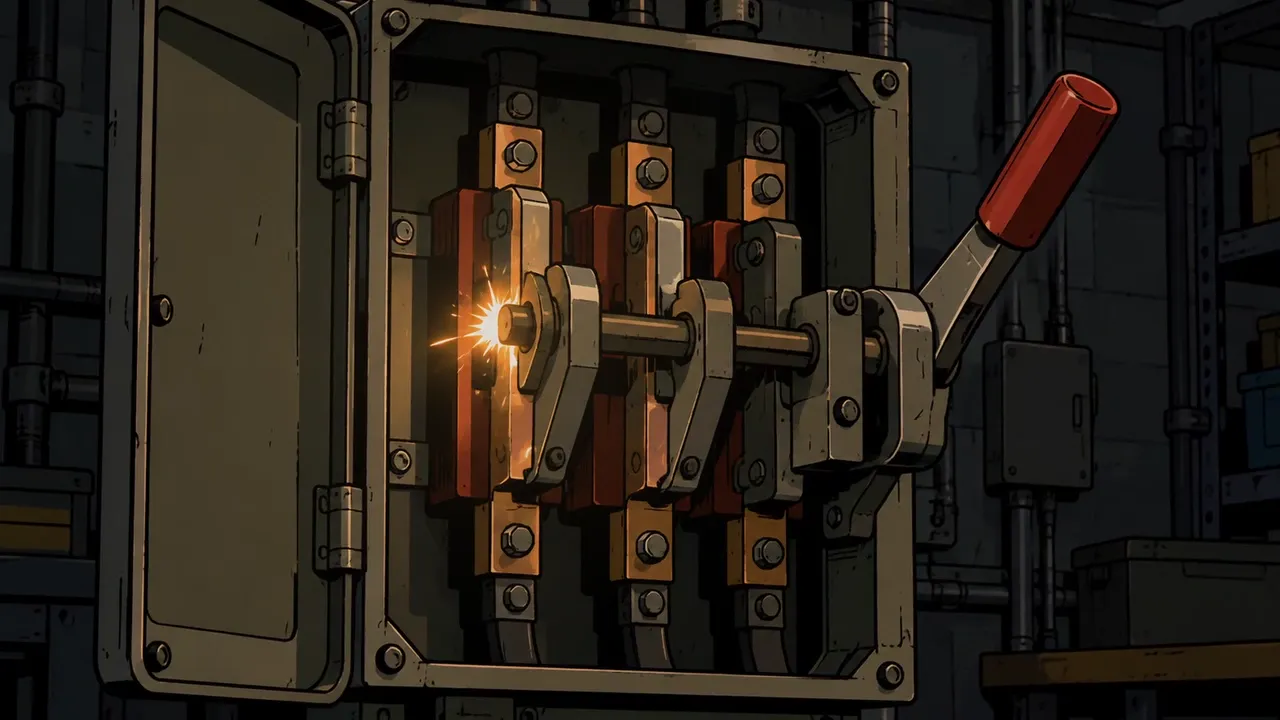
Remember the layer in the middle, the one built to stop the current? When electricity jumps across it anyway, it burns a trail. A thin black line of carbon. And carbon conducts. So the next time the voltage climbs, the current doesn't hunt for a new way through. It runs straight down the old burn. Every time.
Now you. At some point, maybe when you were a kid, maybe last year, something came at you with more than you were built to take. You couldn't stop it, and you couldn't send it anywhere. The insulation failed.
It left a track. And ever since, when the pressure climbs, you don't answer what's in front of you. You run down the old burn. That's how you end up reacting to a new boss the way you reacted to your father. You're not crazy. You're a circuit doing what a circuit does.
The Moon wears its scars on its face. You keep yours in the part of you that takes over when the lights go out. How you keep them depends on what you were built with. And that is what a Moon sign is.
Your Moon sign is a capacitor
You know your Sun sign. It's the one in the horoscope column. Your Moon sign is the sign the Moon was in at the hour you were born, and most people have never looked theirs up.
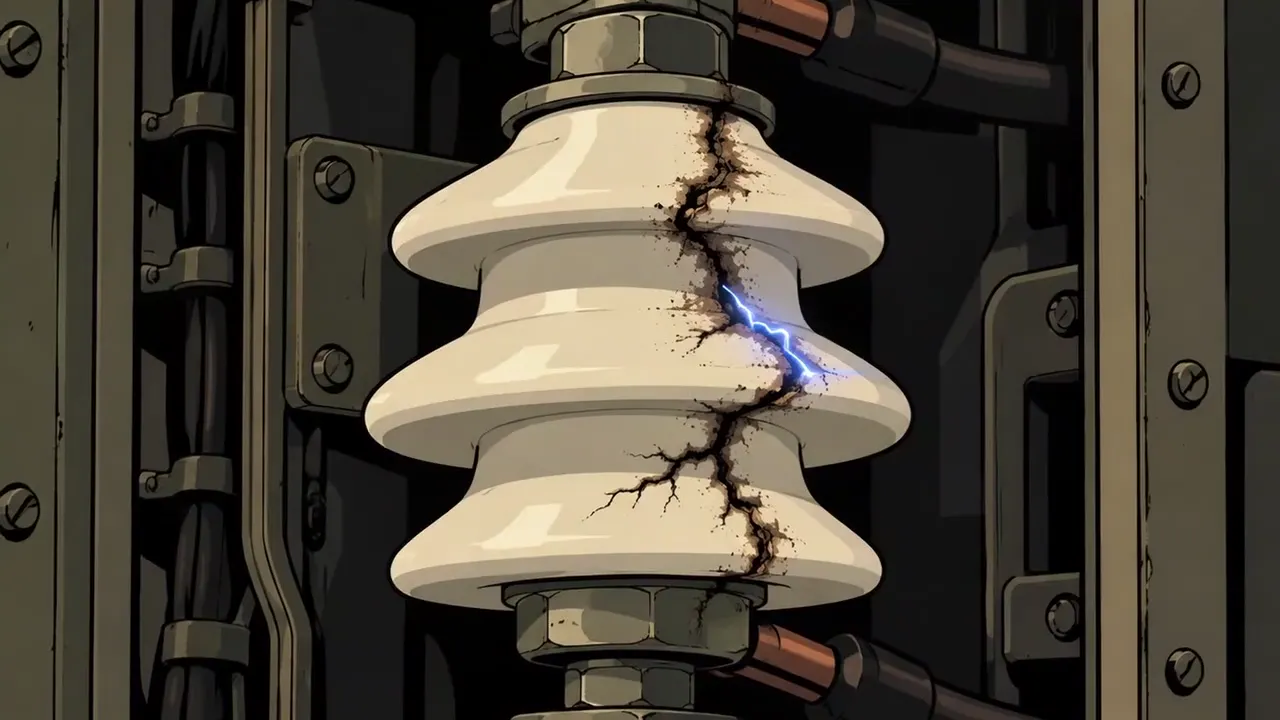
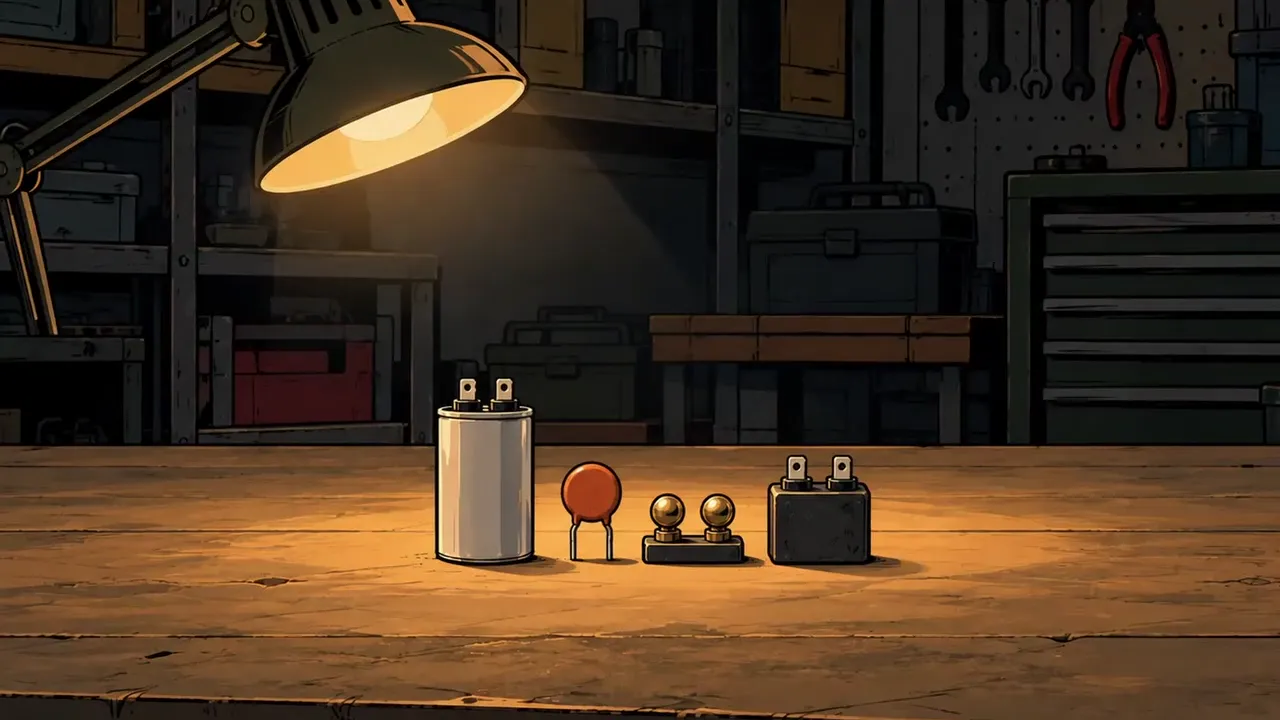
You already know the part. Two plates, and a layer between them. What that layer is made of decides everything: how much it holds, how fast it lets go, and how it fails. In Electric Astrology, your Moon sign is that layer. There are four kinds.
Water Moons. Cancer, Scorpio, Pisces. The big wet capacitor, built to hold a deep charge for a long time. You don't just feel a thing, you bank it. Your trouble is that you're hard to drain.
Air Moons. Gemini, Libra, Aquarius. The little ceramic disc. Small, dry and fast. A feeling comes in, you read it like data, and you move on. Your trouble is noise.
Fire Moons. Aries, Leo, Sagittarius. The spark gap. You don't store it. You flash, and it's over. The trouble is whoever is standing next to you.
Earth Moons. Taurus, Virgo, Capricorn. The solid-state capacitor. Steady. You carry the load until the job is done. And when you fail, you fail hot and quiet.
How to drain it
Whichever one you are, the question at two in the morning is the same. How do you drain it?
Most people try to think their way out. You can't argue with stored energy.
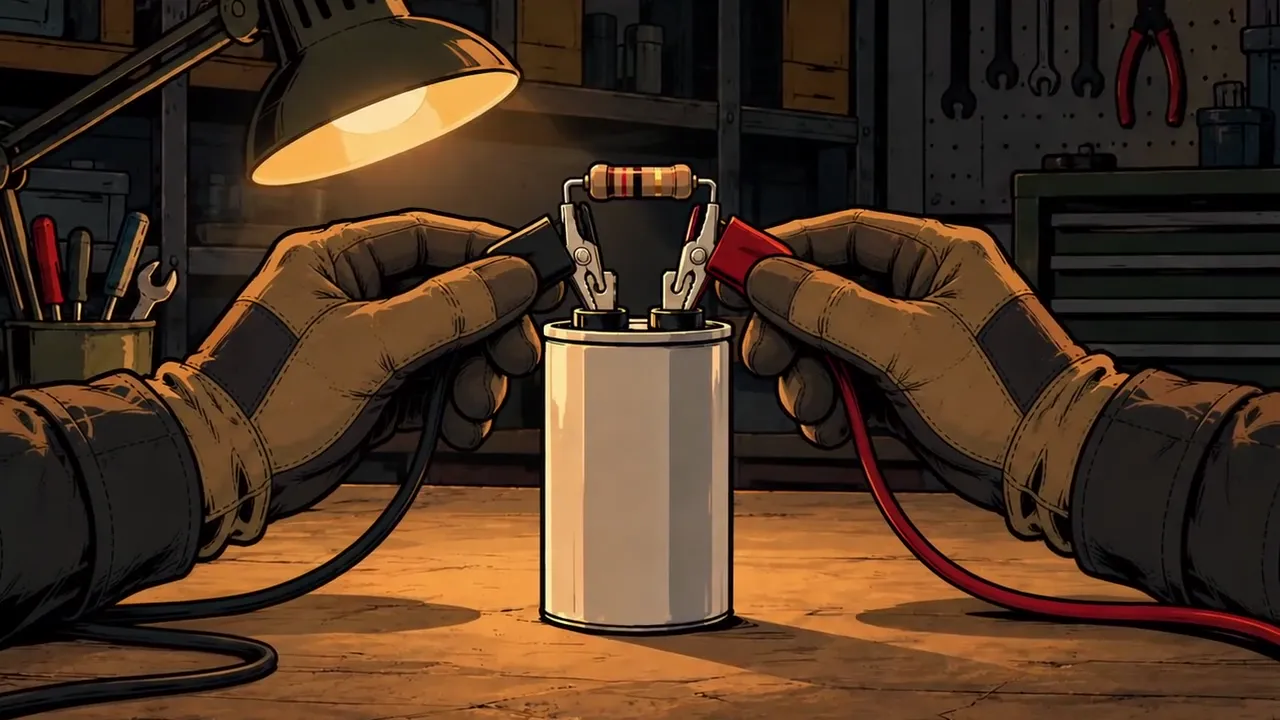
Before anyone works on a big capacitor, they clip a resistor across it and let it drain to ground. Slowly, on purpose. It's called a bleed resistor. It's the slow way out: a path, on purpose. You have three.
Your feet. Put them on the floor. Better, on the grass.
Your breath. A long, slow breath out is a pressure valve.
And a pen. A thought that loops is an alarm ringing in an empty room. Write it down, and somebody has finally answered it.
The Moon is not your enemy. The night is not a curse. If you're afraid of the dark, it isn't the dark. It's what you're holding.
What we know, and what’s still missing
So here is what we've got. You know what a capacitor is now: it charges, it holds, and it lets go. Gravity can't explain what Craig saw. But the Moon carries a charge. Inside Earth's tail, around every full Moon, its night side runs to a thousand volts, and in a solar storm NASA caught it at forty-five hundred. Its face is covered in the kind of mark a spark leaves. You are salt water and iron. And astrology has said the same thing about the Moon in you all along: it's where you keep the charge.
My last film ended on a Thursday night in October 2020. A blank Sun, a full Moon, and my own heart giving out. Now you know what that Moon was doing. Craig told me where to start, and he was right.
So find out what you were built with. Your Moon sign is on your free natal schematic, in the Electric Astrology app.
One thing is still missing. The Sun is a generator. The Moon is a capacitor. And there is not one wire between them, or between them and you.
So how does anything get across?
Keep following the wire
The live instruments, films and the book this episode connects to.
Questions people ask
Why can’t I sleep on a full Moon?
Some studies find people sleep worse around the full Moon. In 2013 a Swiss sleep lab went back through its own recordings: around the full Moon, volunteers who could not see the sky took about five minutes longer to fall asleep, slept about twenty minutes less, and their deep-sleep brain activity dropped by 30%. A bigger study the next year could not repeat it. In 2021, wrist trackers in Argentina and in Seattle showed sleep starting later and running shorter on the nights before the full Moon; the authors put it down to evening moonlight. Electric Astrology’s model, the Lunar Capacitor, says the Moon’s electrical charge is part of it. That is a model, not a finding, and the app is built to test it.
Does the full Moon really affect people?
Plenty of people who work nights think so. When researchers surveyed emergency rooms in 1987, 80% of ER nurses and 64% of ER physicians said the Moon changes their patients. Gravity can’t be the reason: across a whole human body, the Moon’s pull is about a million times weaker than the weight of a mosquito landing on your arm. So either a career’s worth of night crews imagined the same thing, or the Moon reaches us some other way.
Is the Moon electrically charged?
Yes, and it has been measured. NASA’s Lunar Prospector found the Moon’s night side sits around 200 volts negative out in the solar wind, and swings to about 1,000 volts negative when the hot sheet of charged gas in the middle of Earth’s magnetic tail sweeps over it. In a solar particle storm in the spring of 1998 it read about −4,500 volts, the largest the spacecraft recorded.
What does the full Moon have to do with Earth’s magnetic tail?
The solar wind blows Earth’s magnetic field out into a long tail on the night side, like a windsock. Every full Moon happens inside that tail: the Moon enters it a few days before full and spends about six days crossing it.
What is a capacitor?
About the simplest part in electricity: two pieces of metal close together with something between them that won’t let current through. Push charge onto one side and it piles up, and it stays there after you cut the power. It charges, it holds, and it lets go, either slowly down a path, or all at once if the layer in the middle gives out.
What does my Moon sign mean in Electric Astrology?
Your Moon sign is the sign the Moon was in at the hour you were born. In Electric Astrology it is the layer in your capacitor, which decides how much you hold, how fast you let go, and how you fail. Water Moons are the big wet capacitor, Air Moons the ceramic disc, Fire Moons the spark gap, Earth Moons the solid-state capacitor. Your Moon sign is on your free natal schematic in the Electric Astrology app.
How do I drain it at two in the morning?
Before anyone works on a big capacitor, they clip a resistor across it and let it drain slowly, on purpose: a bleed resistor. The film gives three. Your feet: put them on the floor, better on the grass. Your breath: a long, slow breath out is a pressure valve. And a pen: a thought that loops is an alarm ringing in an empty room; write it down and somebody has finally answered it.
Why are the Moon’s craters round?
The textbook answer: a rock moving that fast doesn’t dig, it explodes on contact, which makes a round crater at all but very shallow angles, and the ground rebounds into a central peak. The film puts the other answer on the table too: in 1965 Brian J. Ford showed that spark-machining makes round craters in steel, some with central peaks.
Sources
Every study in the film was opened and checked at its source.
- Danzl, D. F. (1987). Lunacy. Journal of Emergency Medicine 5(2):91–95 (80% of ER nurses, 64% of ER physicians).
- Ford, B. J. (1965). Origin of the Lunar Craters. Spaceflight VII(1):13–16 (spark-machined craters in steel, some with central peaks).
- NASA Photojournal: Oblique Impact (impacts at most angles make round craters).
- McCoy, J. E. & Criswell, D. R. (1974). Evidence for a high altitude distribution of lunar dust. Proc. Fifth Lunar Conference 3:2991–3005 (Gene Cernan’s Apollo 17 sketches).
- Halekas, J. S. et al. (2007). Extreme lunar surface charging during solar energetic particle events. Geophysical Research Letters 34, L02111 (about −4.5 kV, 1998).
- Halekas, J. S. et al. (2008). Lunar Prospector observations of the electrostatic potential of the lunar surface. JGR Space Physics (−200 V to −1 kV in the plasma sheet).
- NASA Science (2008). The Moon and the Magnetotail (about six days of every full Moon inside the tail).
- Pauling, L. & Coryell, C. D. (1936). The Magnetic Properties and Structure of Hemoglobin. PNAS 22(4):210–216.
- Jan, K.-M. & Chien, S. (1973). Role of surface electric charge in red blood cell interactions. Journal of General Physiology 61:655.
- Cajochen, C. et al. (2013). Evidence that the lunar cycle influences human sleep. Current Biology 23(15):1485–1488.
- Cordi, M. et al. (2014). Lunar cycle effects on sleep and the file drawer problem. Current Biology 24(12):R549–R550.
- Casiraghi, L. et al. (2021). Moonstruck sleep: synchronization of human sleep with the moon cycle under field conditions. Science Advances 7(5):eabe0465.
Film image credits: NASA/NOAA, NASA/JPL, U.S. Navy / PO1 James Stenberg; adapted CC BY 4.0 images by WizardTim, Giovanna 27, and Oleh Lysak. License. Film crops and motion adapt the stills.


One tap
Do you sleep worse around the full Moon?
The next step
Find the Moon in your circuit.
Your Moon sign is on the free natal schematic in the Electric Astrology app. The schematic is yours to keep. From there, put your chart beside the changing sky in the Planetary Logic Controller.
Get my free natal schematic →Want the full argument on paper? Read Chapter 4 in the book →