A salamander’s limb stump swings from positive to strongly negative as it regrows; a frog’s stays positive until it heals
Measuring the steady voltage of amputated limbs for weeks, Robert O. Becker found that salamanders, which regrow limbs, and frogs, which scar, follow different electrical courses.
The short version
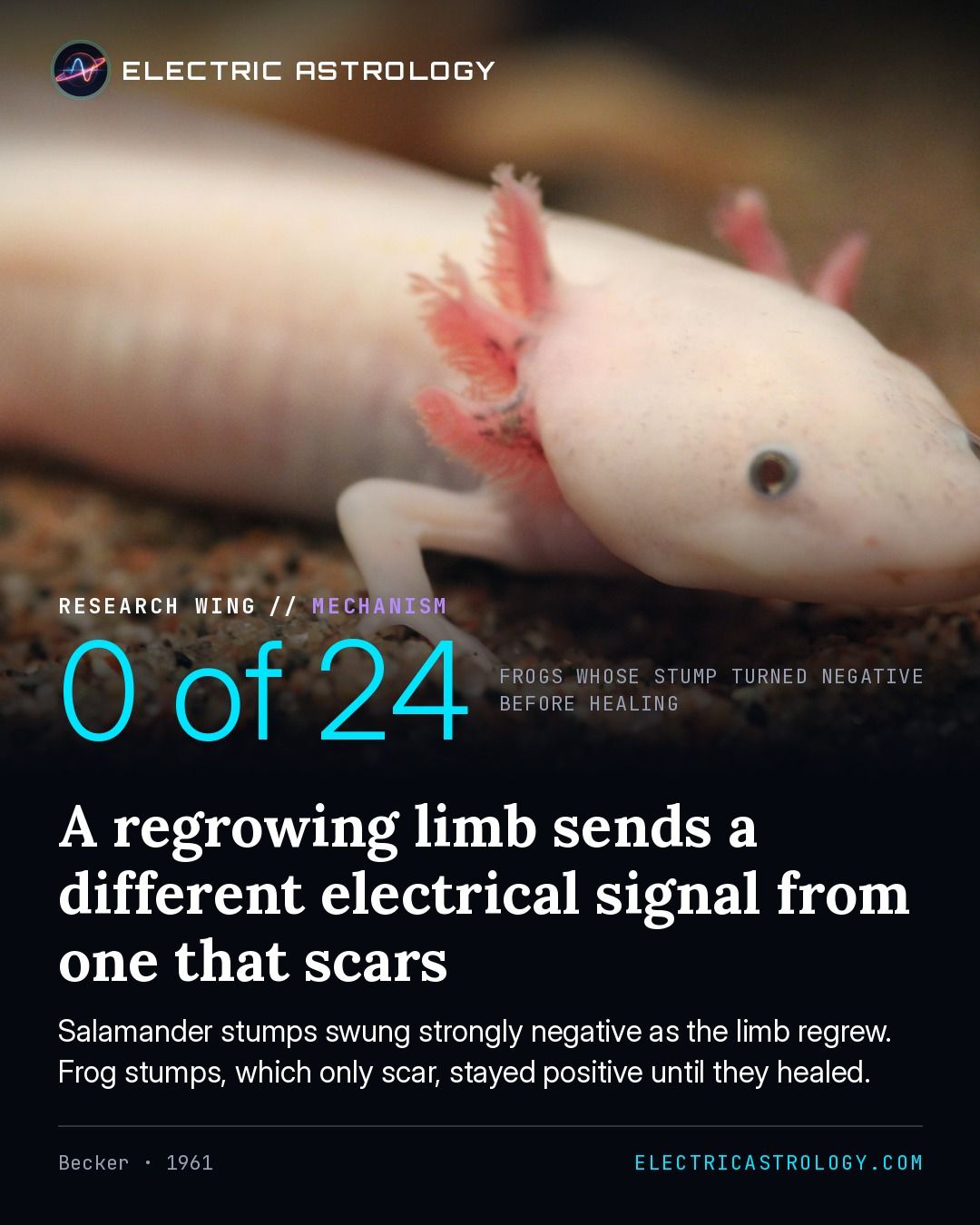
In 1961 Robert O. Becker amputated the limbs of salamanders, which regrow them, and of frogs, which don't, and recorded the voltage at the stump for weeks. Both stumps turned positive right after the cut. In the salamanders the voltage then crossed zero and swung strongly negative, and the regrowing limb stayed more negative than normal until it was complete. Not one of 24 frogs turned negative before it healed.
Becker called the body's direct-current voltages a data transmission and control system.
0 of 24
Frogs whose limb stump showed even a brief shift to negative voltage before healing was complete. Regenerating salamanders swung strongly negative.
The paper
The Bioelectric Factors in Amphibian-Limb Regeneration
Becker, R. O. (1961). The Bioelectric Factors in Amphibian-Limb Regeneration. The Journal of Bone and Joint Surgery (American volume), 43(5), 643–656.
Checked against the paper’s full text on November 13, 2026.
What they measured
Becker amputated limbs of four salamander species that regrow limbs (Triturus viridescens, Ambystoma tigrinum, Ambystoma opacum and Necturus maculosus) and of the grass frog Rana pipiens, a close relative that does not, and recorded direct-current voltages from up to eight points on each animal over the following weeks.
In small follow-up groups of six salamanders he passed currents of a few microamperes through the stump, of one polarity or the other, to see whether regrowth changed.
What they found
In both regrowing and non-regrowing animals, amputation instantly reversed the stump’s polarity to positive.
In the salamanders the positive voltage fell, rose again, then crossed zero sometime between the fifth and tenth day, followed by a negative swing of high amplitude, larger than either the normal limb voltage or the injury’s positive swing, peaking between the eighth and fifteenth day. The regrowing limb stayed more negative than normal until regeneration was complete.
Not one of 24 frogs showed even a brief shift to negative voltage before healing was complete.
Six larval salamanders given 2 microamperes for the first five days grew a blastema, the bud of a new limb, almost twice as large as controls by days 10 to 12, though their later growth and digit formation then lagged the controls by four to six days.
How it bears on the hypothesis
MechanismShows a working part of the circuit: a receiver in the body, a current in space, a field that couples them.
The same wound gives two electrical answers, and the answer matches the outcome: the animals that rebuild a limb swing negative, the one that scars does not. Becker read this as a control signal for regrowth, and he called the body’s direct-current potentials a data transmission and control system.
Later work found the source of the stump current in the skin rather than the nerves (Borgens, Vanable and Jaffe 1977), and showed wound fields steering healing cells (Zhao 2006), both in this wing.
The authors’ own caution: Becker stresses the preliminary nature of the experiments, notes the current-treated groups were too small for statistical significance, and says the tissue that generates the currents had not been identified.
On Electric Astrology
More on: Does the body heal with electric currents?
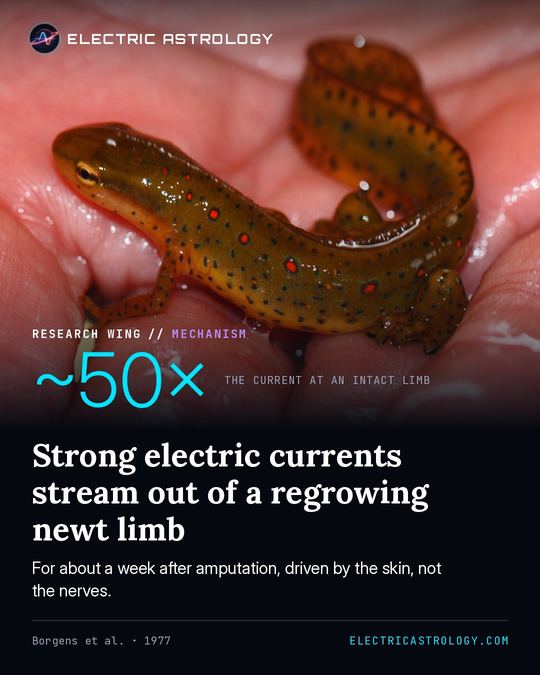 Strong electric currents stream out of a regrowing newt limbBorgens et al. · 1977 · Proceedings of the National Academy of Sciences
 The electric field at a wound steers the cells that heal itZhao et al. · 2006 · Nature
 A few billionths of an amp started partial forelimb regrowth in ratsBecker · 1972 · Nature