Tiny implanted currents started partial forelimb regrowth in rats, a mammal that does not regrow limbs
Robert O. Becker implanted a tiny silver-platinum current source at the amputated forelimbs of young rats and saw partial regrowth that controls did not show.
The short version
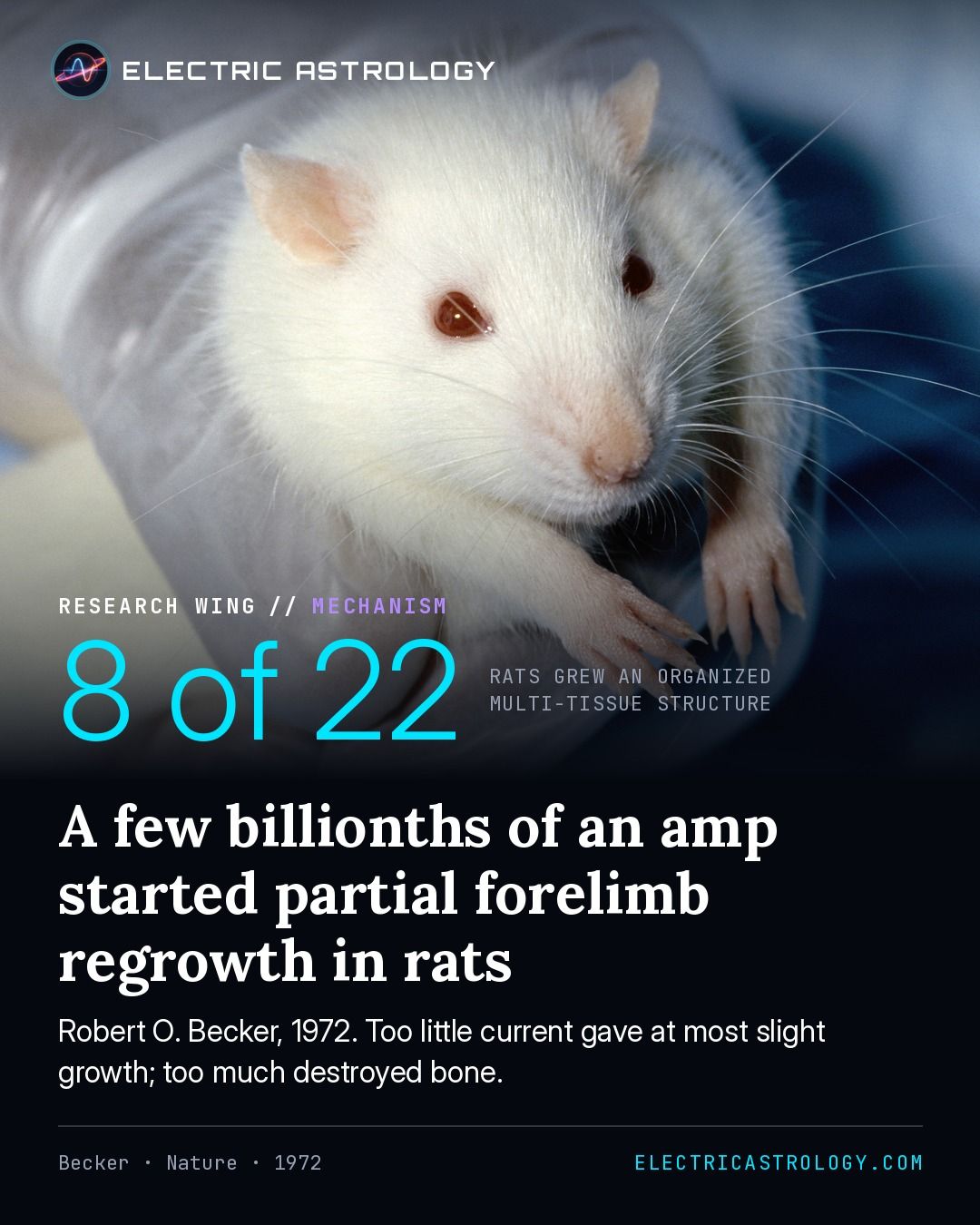
Rats, like people, don't regrow limbs. Robert O. Becker implanted a tiny silver-platinum current source, about 3 to 6 nanoamps, at amputated rat forelimbs. Eight of 22 grew an organized multi-tissue structure at the stump, most often a regrown lower end of the upper arm bone, with new muscle, nerves and blood vessels.
Rats with no device, or a much weaker one, did not. A stronger current destroyed bone.
8 of 22
Rats with the 3 to 6 nanoamp device that grew an organized multi-tissue structure at the stump, the top score (4+).
The paper
Stimulation of Partial Limb Regeneration in Rats
Becker, R. O. (1972). Stimulation of Partial Limb Regeneration in Rats. Nature, 235(5333), 109–111.
Checked against the paper’s full text on November 13, 2026.
What they measured
Twenty-one-day-old male Sprague-Dawley rats had the right foreleg amputated through the upper arm bone. Twenty-two received a silver-platinum device joined through a 10-megohm resistor, delivering about 3 to 6 nanoamps; controls had no device (8 rats), a very low-current device of 0.001 to 0.1 nA (7), or a high-current device of 5 to 15 nA (2).
Controls were examined at 7 days and the treated rats at 3 to 28 days. Growth was scored from 0, the usual result of a simple amputation, to 4+, an organized multi-tissue structure.
What they found
Simple amputation gave a fibrous cap and some new bone at the cut. No rat with the very low-current device grew beyond 1+, and the high-current device destroyed bone.
Among the 22 treated rats only two were as low as 1+; the rest scored higher, including eight with 4+ growth. The commonest 4+ result was regrowth of the lower end of the humerus with two growth centres, and one rat grew a complete extra humerus.
Every rat with 3+ or 4+ growth formed new, organized skeletal muscle beyond the cut, with nerves and blood vessels growing in.
Becker concludes the results support his thesis that regrowth could be restored in mammals by electrical stimulation at the right level.
How it bears on the hypothesis
MechanismShows a working part of the circuit: a receiver in the body, a current in space, a field that couples them.
Mammals scar where salamanders regrow. Here a current of a few billionths of an amp, at the right level, pushed a mammal’s limb some way back toward regrowth: too little gave at most slight growth, too much destroyed bone.
The authors’ own caution: Becker says the origin of the regrowing tissue was unknown, and that further work was needed on the best electrical method, other mammals and older animals, and possible side effects.
On Electric Astrology
More on: Does the body heal with electric currents?
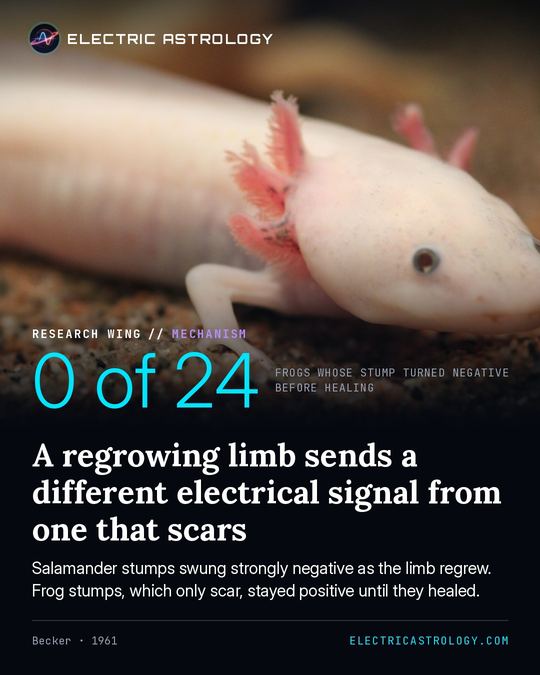 A regrowing limb sends a different electrical signal from one that scarsBecker · 1961 · The Journal of Bone and Joint Surgery (American volume)
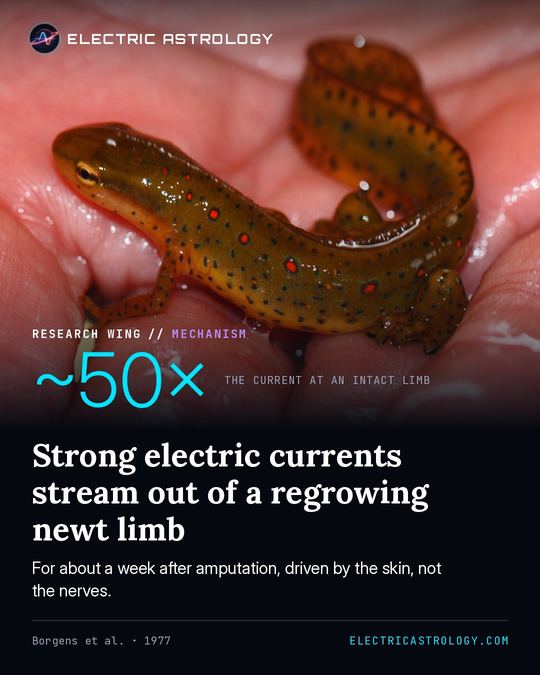 Strong electric currents stream out of a regrowing newt limbBorgens et al. · 1977 · Proceedings of the National Academy of Sciences
 The electric field at a wound steers the cells that heal itZhao et al. · 2006 · Nature