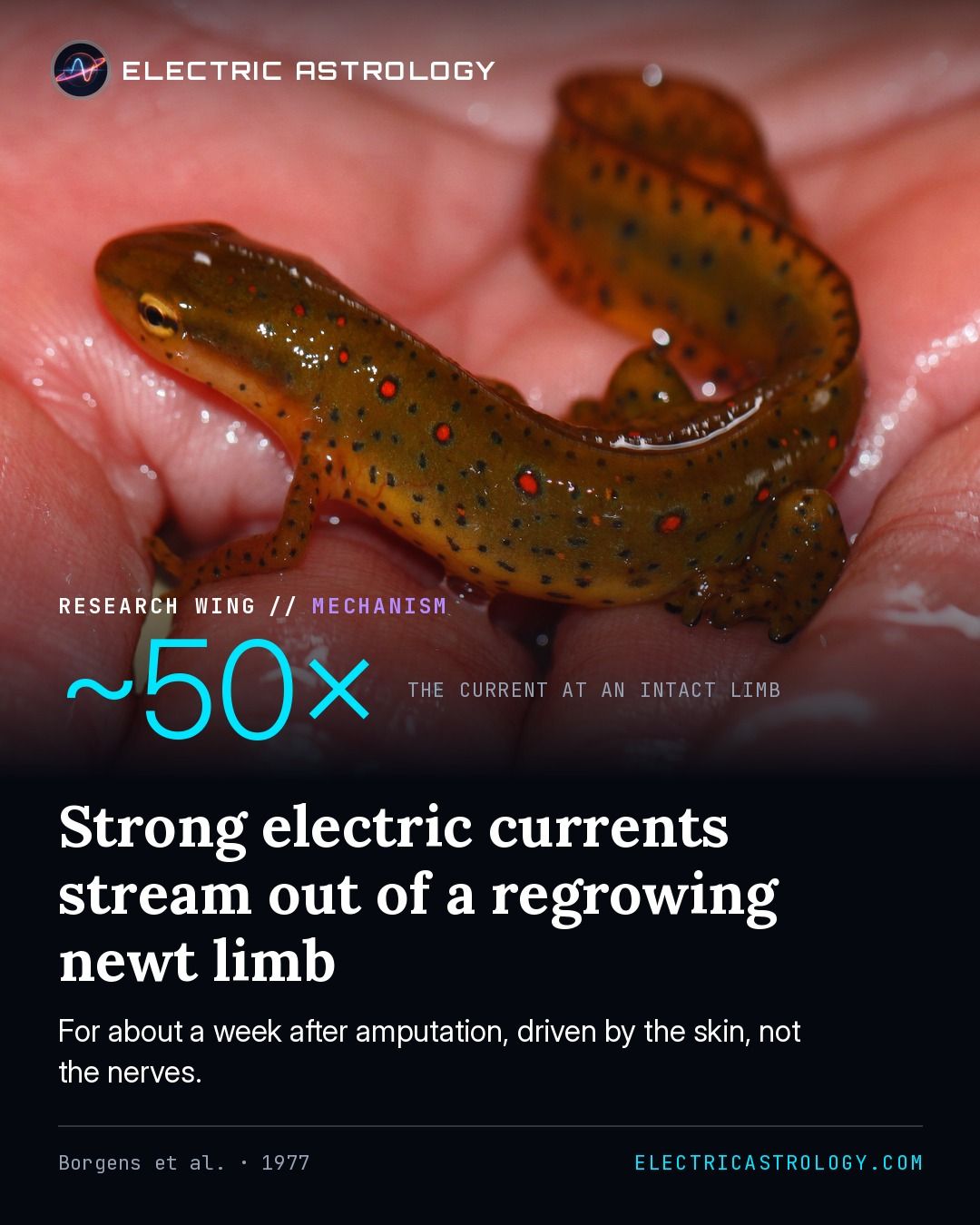
Strong electric currents stream out of a regenerating newt’s limb stump in its first week
With an ultrasensitive vibrating probe, a Purdue team measured the steady electric current leaving the stumps of amputated newt forelimbs, and traced its driver to the skin.
The short version
With a vibrating probe sensitive to tiny currents, researchers at Purdue measured the electricity around newts' forelimbs. After amputation, steady currents of 10 to 100 microamps per square centimetre streamed out of the stump for the first week or so, about 50 times the current at an intact limb.
Cutting the nerves didn't reduce it. Blocking the skin's sodium uptake cut it sharply: the skin is the pump.
10–100
Microamps per square centimetre leaving the stump during the first 5 to 10 days after amputation, about 50 times the current at an intact limb.
The paper
Bioelectricity and regeneration: large currents leave the stumps of regenerating newt limbs
Borgens, R. B., Vanable, J. W., Jr., Jaffe, L. F. (1977). Bioelectricity and regeneration: large currents leave the stumps of regenerating newt limbs. Proceedings of the National Academy of Sciences, 74(10), 4528–4532.
Checked against the paper’s full text on November 13, 2026.
What they measured
Adult red-spotted newts (Notophthalmus viridescens), 6 to 11 cm long, had the right forelimb amputated through the elbow. A 30-micrometre vibrating probe, with noise of about 0.004 µA/cm², mapped the current in the pond water around the limb; in 11 animals the current was measured daily from amputation to the late bud stage, 2 to 3 weeks later.
To find what drives the current, the team cut the nerves to the limb in three animals, changed the sodium in the water, and added amiloride, a drug that blocks sodium uptake through skin.
What they found
Steady currents of 10 to 100 µA/cm² or more left the end of the stump during the first 5 to 10 days, balanced by currents of only 1 to 3 µA/cm² entering the intact skin around it. At intact limbs the currents were around 0.2 to 1.4 µA/cm² leaving.
Every peak current in the first week was outward. The currents then fell, or even reversed, at about the time the blastema, the bud of the new limb, became visible.
Cutting the nerves did not reduce the current: all three denervated stumps drove more current than the control stumps (99, 61 and 47 against 28, 39 and 38 µA/cm²). Amiloride cut the peak current by an average of 68% within 15 minutes.
The authors conclude the skin, not the nerves, is the pump driving the stump current, and, comparing with their earlier work on frogs, suggest that the current plays some causal role in starting regeneration.
How it bears on the hypothesis
MechanismShows a working part of the circuit: a receiver in the body, a current in space, a field that couples them.
This is the measured current behind Becker’s voltages: a steady flow of charge out of the wound for the week in which regrowth is set up, about 50 times the current at an intact limb.
It also found the battery. The skin, pumping sodium, drives the current, a living cell layer acting as a power source.
The authors’ own caution: The authors note that once a new epithelium covers the stump, the ions that carry the current out are unknown. (Our note: the paper does not test whether blocking the current stops regeneration in newts.)
On Electric Astrology
More on: Does the body heal with electric currents?
 A regrowing limb sends a different electrical signal from one that scarsBecker · 1961 · The Journal of Bone and Joint Surgery (American volume)
 The electric field at a wound steers the cells that heal itZhao et al. · 2006 · Nature
 A few billionths of an amp started partial forelimb regrowth in ratsBecker · 1972 · Nature