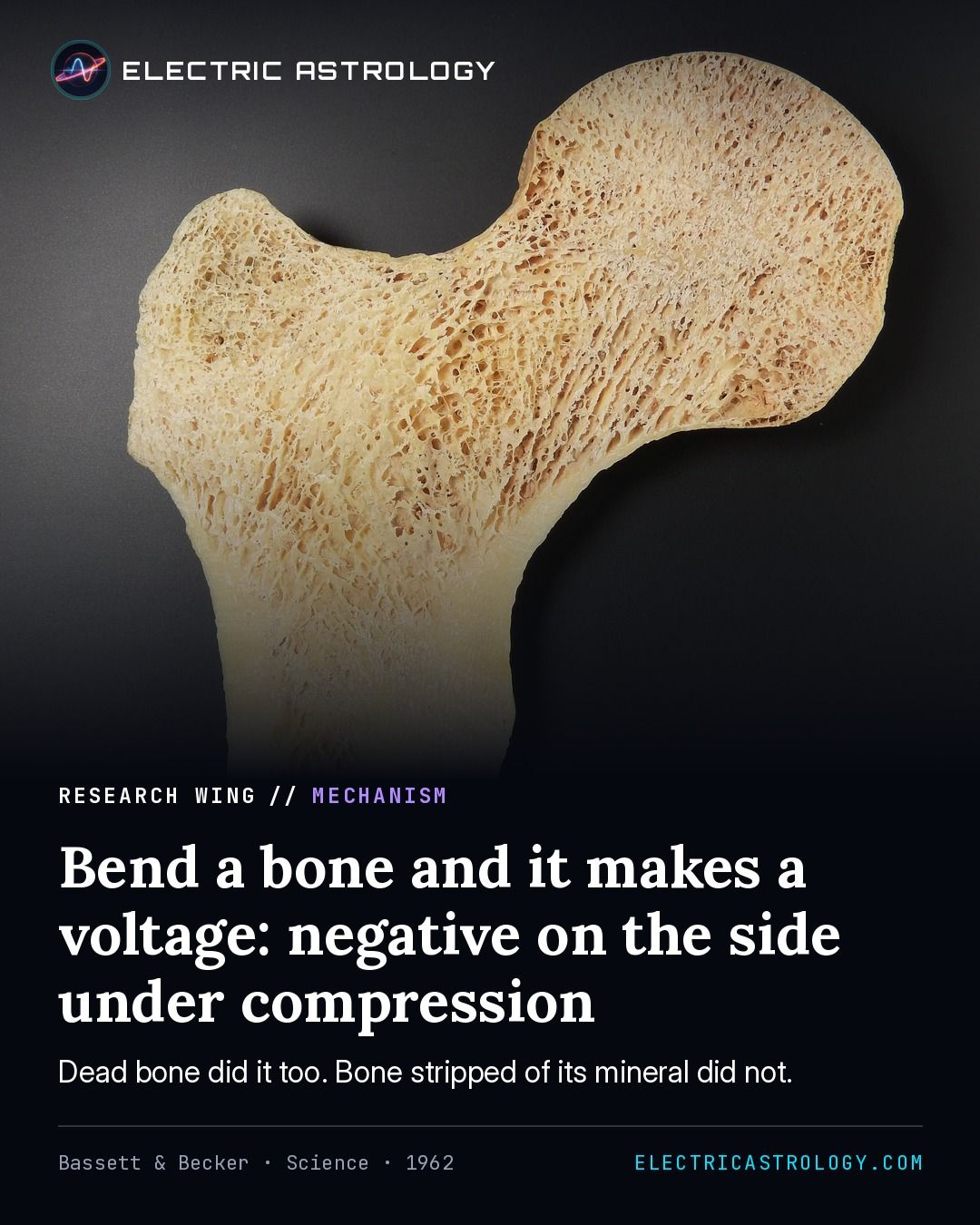
Bend a bone and its compressed side turns electrically negative, even when the bone is dead
Bending fresh and dead bones from cats, rats and frogs, two orthopaedic researchers found that bone makes a voltage under stress, negative where it is squeezed.
The short version
In 1962 two orthopaedic researchers bent bones from cats, rats and frogs between electrodes. The side under compression turned electrically negative at once and stayed negative while the load held. Bending the other way flipped the polarity.
Frozen and dried bone did the same, so the voltage was a property of the bone itself. The authors judged it probable that these voltages influence the bone cells directly.
The paper
Generation of Electric Potentials by Bone in Response to Mechanical Stress
Bassett, C. A. L., Becker, R. O. (1962). Generation of Electric Potentials by Bone in Response to Mechanical Stress. Science, 137(3535), 1063–1064.
Checked against the paper’s full text on November 13, 2026.
What they measured
C. Andrew L. Bassett (Columbia University) and Robert O. Becker (State University of New York, Syracuse) bent bones between silver–silver chloride electrodes connected to direct-coupled amplifiers: cat fibulae stripped of soft tissue at midshaft, then freshly removed cat fibula, rat femur and bullfrog tibio-fibula held in insulated clamps.
They repeated the test on frozen-and-thawed and air-dried bone, on bone with its mineral removed, and on wood, polyethylene and fresh cat Achilles tendon, and compared the traces with those from a quartz piezoelectric crystal on the same instruments.
What they found
The electrode on the compressed side instantly became negative and stayed so, slowly decreasing, until the force was removed. Bending the bone the other way reversed the polarity with equal size; the size of the voltage depended on how fast and how far the bone was bent.
Frozen-and-thawed and air-dried bone behaved like fresh bone, with about 25 percent less voltage, so the effect did not depend on living cells. Wood, polyethylene and tendon gave no voltage, and decalcified bone lost the ability.
Unlike the quartz crystal’s, the bone’s voltage decayed slowly and held while the stress lasted (steady voltages were seen for as long as 60 seconds), so the authors suggest that piezoelectricity, while probably present, was not the sole cause.
The authors suggest it is probable that these voltages influence the activity of bone cells directly, and that they may direct how the bone’s matrix is laid down.
How it bears on the hypothesis
MechanismShows a working part of the circuit: a receiver in the body, a current in space, a field that couples them.
Electric Astrology treats the body as a circuit, and here is one of its oldest measured parts: the skeleton turns pressure into voltage, with a polarity that says where the load falls.
This line of work led to electrical bone-growth stimulation. The paper mentions experiments then in progress, not yet published, that steered the pattern of bone growth in the laboratory with applied currents and magnetic fields.
The authors’ own caution: The authors say their experiments do not establish the link between bone-cell activity and electric charge, and that the mechanism is unknown. In a note added in proof they credit E. Fukada and I. Yasuda with a similar study in 1957.