The short answer
Yes, and it can be measured. A hospital reads your heart, your brain and your muscles by their electricity. Bend a bone and the side being squeezed turns electrically negative.[1] A wound makes an electric field, and the cells that close it follow that field.[4] The human brain holds crystals of magnetite,[12] and in a shielded room at Caltech, some people’s alpha brain waves dropped by up to about half when an Earth-strength magnetic field was turned around them, though none of them could tell it had happened.[13]
The Body Electric is the film this page goes with. It follows that electricity through the body part by part, the way William Edwards, who spent his career in the electrical trade, would trace a circuit. What the circuit is plugged into, the Sun’s storms, the Earth’s hum and the planets, is his hypothesis. This page keeps what has been measured apart from what is proposed, and links each measurement to the paper it comes from.
The film · November 21, 2026 · 37:15 · read the full transcript
Does your body run on electricity?
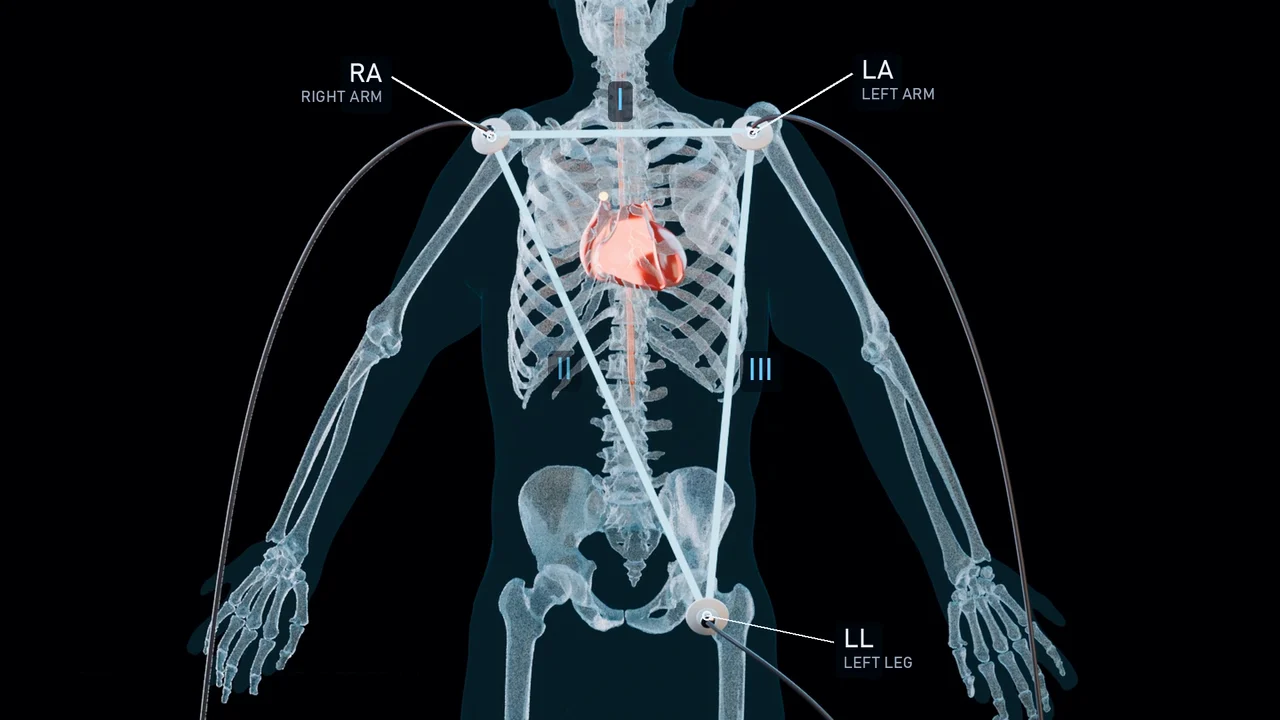
To read your heart, a hospital sticks ten pads on your skin. To read your brain, it puts wires on your scalp. To read a muscle, it puts pads over it. The electrocardiogram, the electroencephalogram and the electromyogram are all recordings of voltage, and when the heart’s trace goes flat, that is how a hospital knows. Willem Einthoven won the 1924 Nobel Prize “for his discovery of the mechanism of the electrocardiogram”.[29] The film opens in that room and asks one question: if the body is an electrical machine, what else is it picking up?
Electric Astrology rests on four claims: the cosmos is electric, the Sun is electric, the Earth is electric, and so are you. The film takes on the fourth, because if it isn’t true the other three have nothing to act on.
It answers the way someone from the trade would, by tracing the circuit one part at a time: a generator, a battery, the wiring, a transmitter, a receiver. Each part below has a published measurement behind it. The last step, what the whole circuit is connected to, does not, and the page says so when it gets there.
Do your bones make electricity?
Measured In 1962 C. Andrew Bassett and Robert O. Becker bent the bones of cats, rats and frogs between electrodes. The side being squeezed turned negative at once and stayed that way until the force came off. Bend the bone the other way and the polarity reversed. Dead bone did the same, with about a quarter less voltage, so it did not depend on living cells; bone stripped of its mineral made no voltage at all (Bassett & Becker, 1962[1]). Five years earlier, in Japan, Eiichi Fukada and Iwao Yasuda had measured a piezoelectric effect in dried bone, about a tenth as strong as quartz’s.[30]
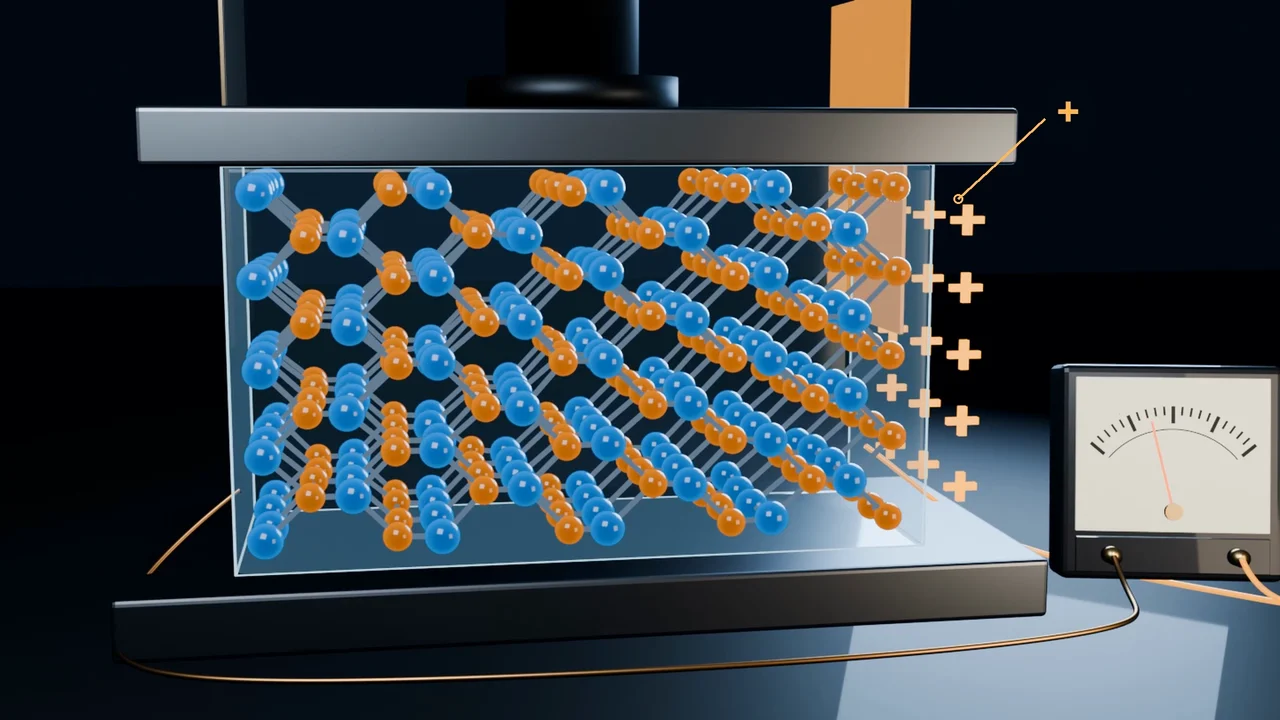
The film’s picture for it is a grill lighter. There is no battery in one: a spring-loaded hammer strikes a crystal, and the crystal gives up a spark. Pressure in, voltage out. The paper is a shade more careful than the picture. Bone’s voltage held for as long as the stress lasted, which a quartz crystal’s does not, so the authors thought piezoelectricity was probably present but not the whole cause. They also suggest, without claiming to have shown it, that these voltages tell bone cells where to build.
Take the load away and the bone goes with it. NASA’s figure for spaceflight is that weight-bearing bones lose 1% to 1.5% of their mineral density a month on average.[31] And the body turns out to have a second way of feeling pressure: the 2021 Nobel Prize in medicine went in part to the discovery of Piezo1 and Piezo2, channels in the cell membrane that pressure opens directly.[32]
William’s reading Every step you take squeezes your skeleton, and the skeleton answers with a signal that says where the load falls. Astrologers have a name for that weight. They call it Saturn.
From the book · Chapter 7 · The Body Electric
We are designed to be under load. The ‘Saturnian’ weight of the world—the gravity, the struggle, the heavy boots—isn’t there to crush us. It is the fuel. We are Solid-State Generators that require the ‘squeeze’ of the physical world to keep the lights on.
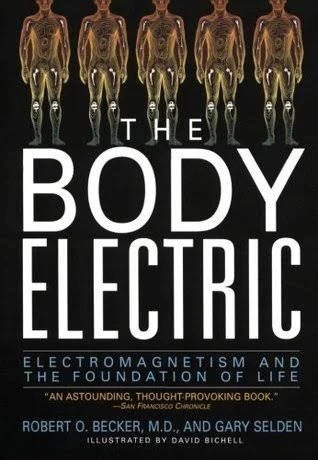
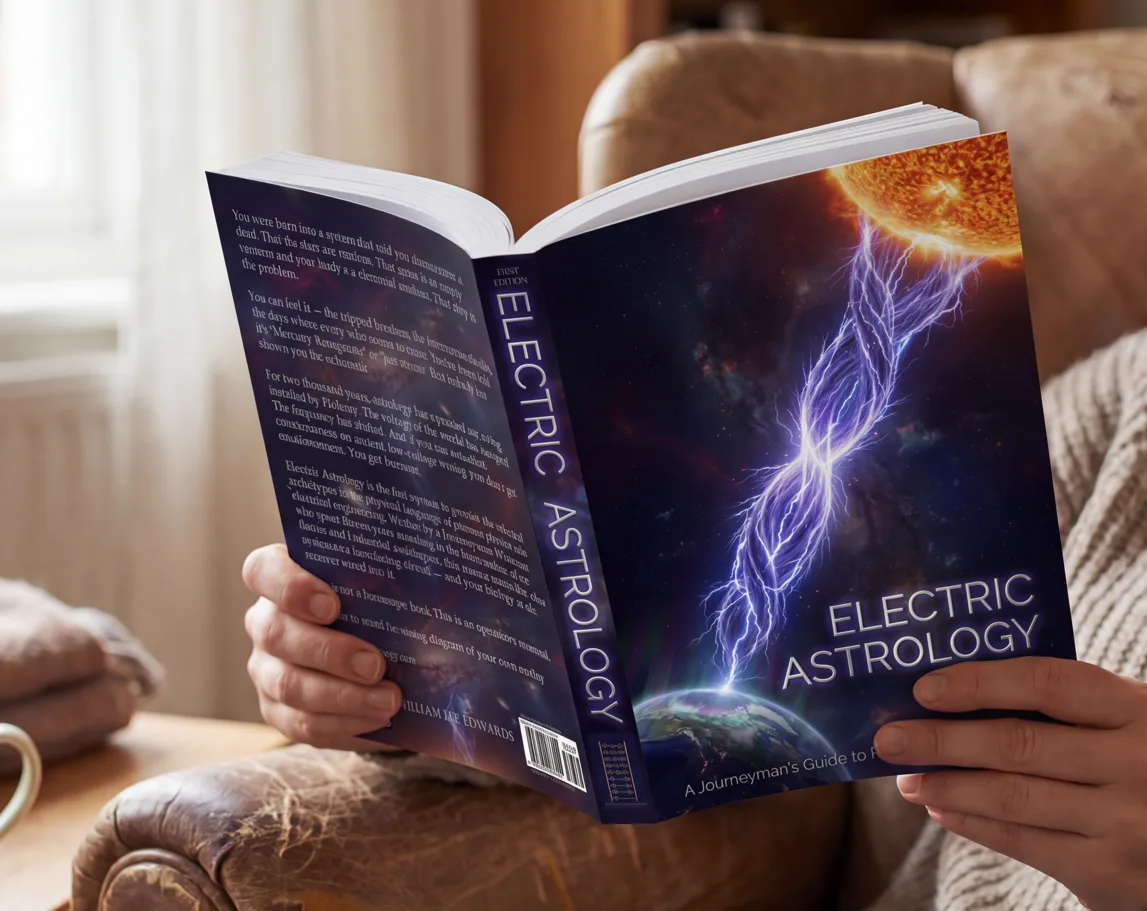
Electric Astrology: A Journeyman’s Guide to Planetary Logic Controls, by William Lee Edwards. The film grew out of this chapter, and the chapter takes its name from Robert O. Becker’s 1985 book, The Body Electric, written with Gary Selden.[40] The film closes on that book.
Does the body heal with electric currents?
Cut the leg off a frog and it scars over. Cut the leg off a salamander and it grows back: bone, muscle, nerve and skin. Robert Becker, an orthopedic surgeon, wanted to know why, and he went looking with a voltmeter.
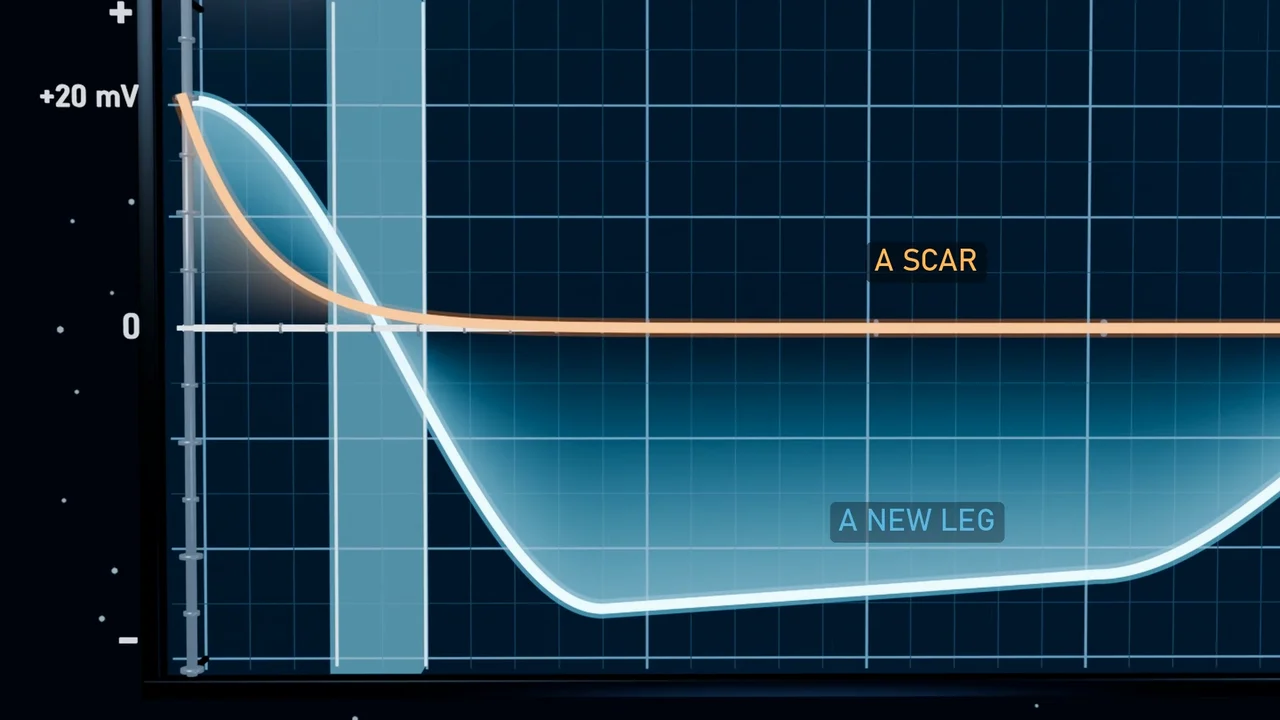
Measured He tracked the voltage on the stumps for weeks. In both animals the cut flipped the stump positive at once. In the salamanders the voltage then crossed zero somewhere between the fifth and the tenth day and swung strongly negative, and the limb stayed more negative than normal until it had regrown. Not one of 24 frogs showed even a brief negative swing before healing was complete (Becker, 1961[2]). The same wound gave two electrical answers, and the answer matched the outcome.
In 1977 a team at Purdue measured the current itself, with a vibrating probe fine enough to map it point by point. Ten to a hundred microamps per square centimetre left a newt’s stump during its first week, about fifty times the current at an intact limb. Cutting the nerves did not reduce it. A drug that blocks sodium uptake through the skin cut it by 68% on average. The skin was the battery (Borgens et al., 1977[3]).
And it is not only salamanders. In every species studied, breaking the sheet of cells that covers a body surface makes an electric field at once. A 2006 paper in Nature showed that fields of the strength found at real wounds steer the cells that close them, and named two genes the response depends on: knock out one, and the healing tissue lost its directed movement in the field (Zhao et al., 2006[4]).
Becker later tried it in a mammal. Of 22 young rats given a device delivering three to six billionths of an amp at an amputated foreleg, eight grew an organized structure of several tissues at the stump. Too little current did little, and too much destroyed bone (Becker, 1972[5]). He called his experiments preliminary, and none of this is a way to regrow a human limb. What it shows is that the body’s own electricity is a working part of repair.
Do your cells hold a charge?
Measured Every cell holds a voltage across its membrane. A 2013 review gathers decades of those measurements. Settled cells such as nerve and muscle sit strongly negative; cancer cells tend to sit closer to zero. Breast-cancer cells held in one phase of the cell cycle measured −9 millivolts, against −40 to −58 for normal breast cells. In Clarence Cone’s experiments, making cells more negative stopped their division, and bringing them back toward zero restarted it (Yang & Brackenbury, 2013[6]).
One doctor’s account The film tells the story of Dr. Jerry Tennant, an eye surgeon in Texas. In 1995 encephalitis put him in bed for years; by his own account, what got him out was rebuilding his cells’ voltage. In his book Healing Is Voltage he writes the body a nameplate like the tag riveted to a motor: about −20 to −25 millivolts to run, −50 to repair. The story and the figures are Tennant’s own. They do not come from a paper in the Research Wing, and this page does not offer them as medical guidance.
So where would a body keep a charge? The book’s answer is fascia, the web of connective tissue that wraps every muscle, organ and nerve, and the water held against it. Measured Gerald Pollack’s lab at the University of Washington studies what it calls the exclusion zone: a layer of water next to a water-loving surface that pushes suspended particles out. Shining infrared light on it grew the zone to about three times its width in five minutes and about six times in an hour, with only about one degree of warming (Chai et al., 2009[7]). Pollack calls it the fourth phase of water. Several independent groups have now seen the zone itself; what causes it is still argued, and its growth under light has yet to be repeated by other labs.
The book’s reading That experiment used a polymer tube in a dish, not living tissue. That the same layer forms along fascia and works as the body’s battery is the book’s reading of it.
Is your blood a wire?
In construction, water and electricity are kept apart. In the body they share the same pipes. Blood is salt water, and salt water conducts. The book puts it in one line: “In the human body, the plumbing is the wiring.”
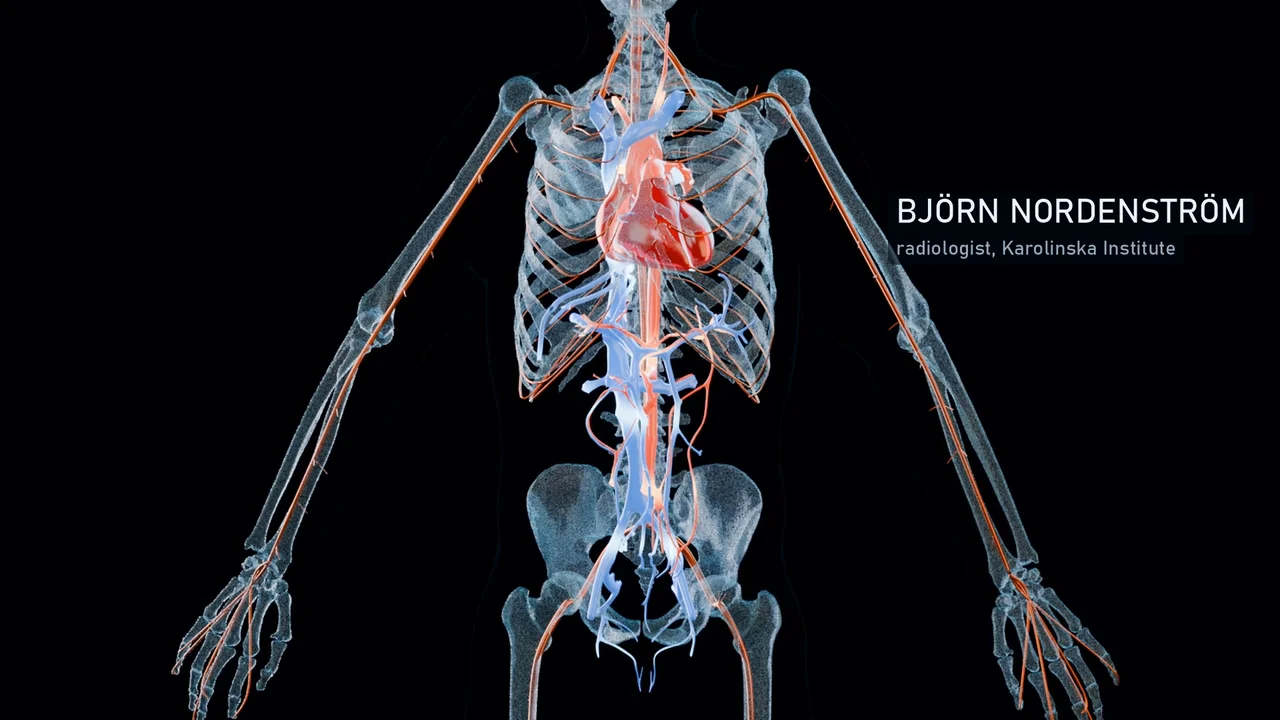
Proposed In 1983 the Swedish radiologist Björn Nordenström published a book arguing exactly that: the blood vessels are cables, with the blood as the conductor and the vessel wall as the insulation, a second circulatory system he called biologically closed electric circuits.[33] It remains his proposal, not an accepted part of physiology.
Established physics Faraday’s law says a changing magnetic field drives a current in any conductor sitting in it. The wires never have to touch; that is how every transformer works. And a body sits wholly inside the Earth’s low-frequency fields: an 8 hertz field reaches about 210 metres into blood before it fades, far more than the size of any body (Price et al., 2021[8]).
William’s theory A column of salt water, walking around on a magnetized planet, under a Sun that shakes that planet’s field. In the book’s words: “We don’t ‘feel’ the planets metaphorically. We Induct them physically.” How much current a storm really drives in a body, and whether a body could notice it, is the open question. The next three sections are where people have gone looking.
Is the heart more than a pump?
The heartbeat is the largest electrical event in the body, which is why pads near your shoulders and hips can read it. And it is not a metronome. The gap between beats changes all the time, faster as you breathe in and slower as you breathe out. Doctors call it heart rate variability, and read it as the autonomic nervous system at work. In the film William compares it to a variable frequency drive, the device that brings a motor up to speed gently and keeps adjusting it to the load.
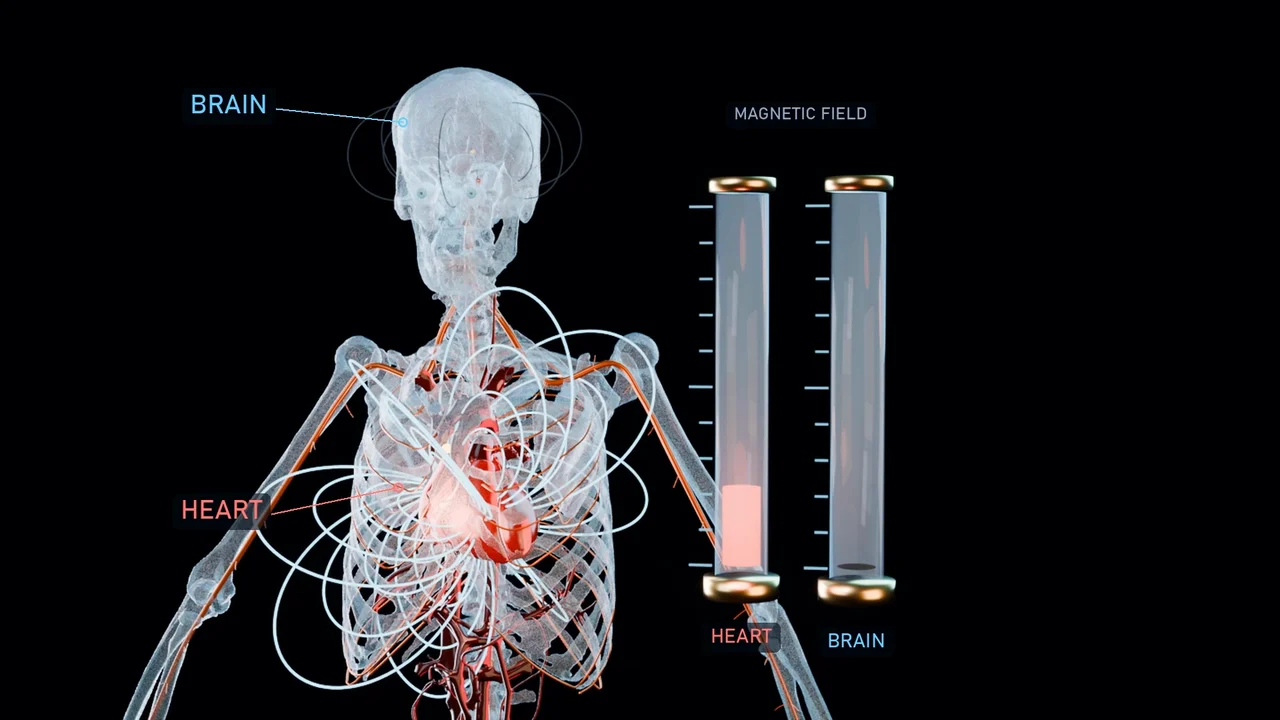
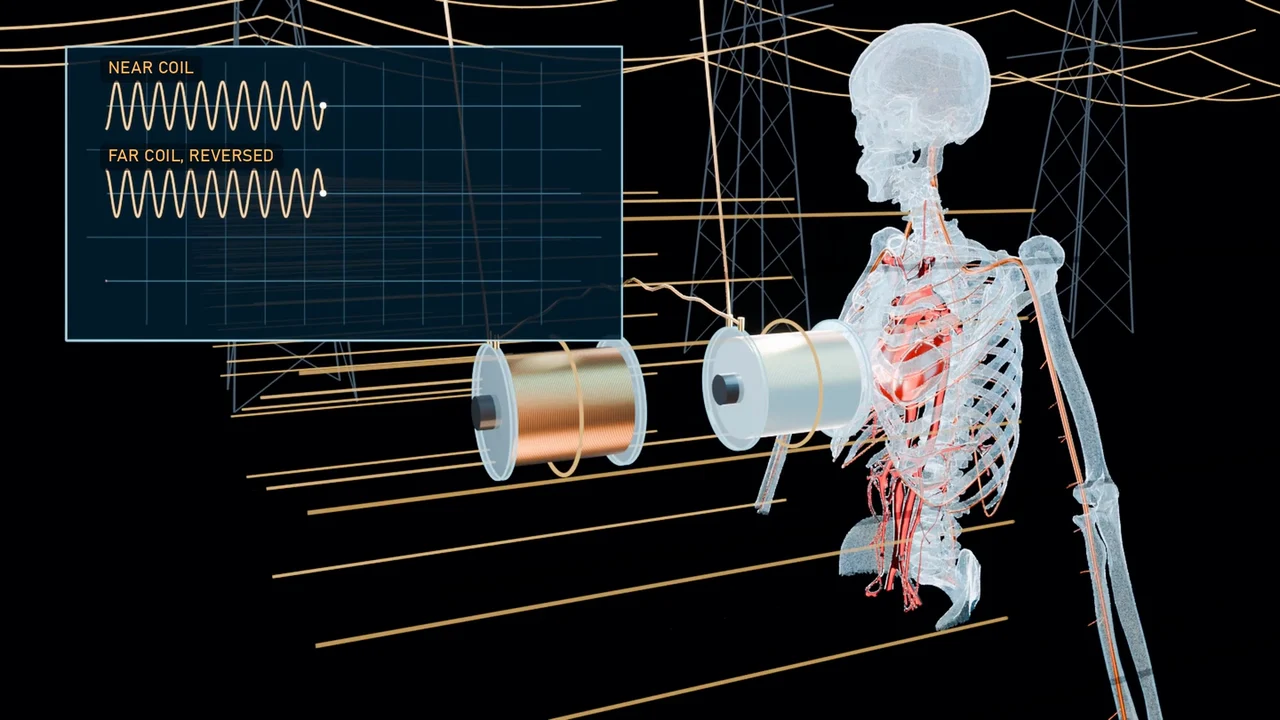
Measured Wherever a current flows, a magnetic field wraps around it, and the heart’s is the largest the body makes: on the order of 50 to 100 picotesla at the chest, against about 1 picotesla for the brain’s strongest rhythm. It was first picked up in 1963, in a field outside Syracuse, New York, by Gerhard Baule and Richard McFee, with two million turns of wire on a ferrite core and two coils wired so that far-off noise cancelled, the way a humbucking guitar pickup works. In 1970 David Cohen recorded it cleanly at MIT, in a shielded room, with a superconducting sensor.[34] The Earth’s own field is vastly stronger than either.
The body sends light as well. In total darkness, a cooled camera photographed a glow from the bodies of five men, about a thousand times too faint for the eye, brightest at the face and peaking around four in the afternoon. The authors tie it to the chemistry of metabolism, not to any signal between cells (Kobayashi et al., 2009[11]).
Measured against the sky Sixteen women wore heart monitors for 72 hours a week across five months. Their heart rate variability rose and fell with cosmic rays, the Sun’s radio output and the power of the Schumann resonance. The study is correlational, the months were magnetically quiet, and it found very few links to the geomagnetic indices themselves (Alabdulgader et al., 2018[9]). In a smaller study, nine people’s heart rhythms tracked the solar wind, the geomagnetic indices and Schumann power through a month that held a severe storm, and moved in step with each other. Nine people is a small sample, and the authors say it cannot show which signal the group was following (McCraty et al., 2017[10]).
Can your body sense magnetic fields?
For a long time biology assumed magnetic fields pass straight through us. Then Joseph Kirschvink at Caltech went looking.
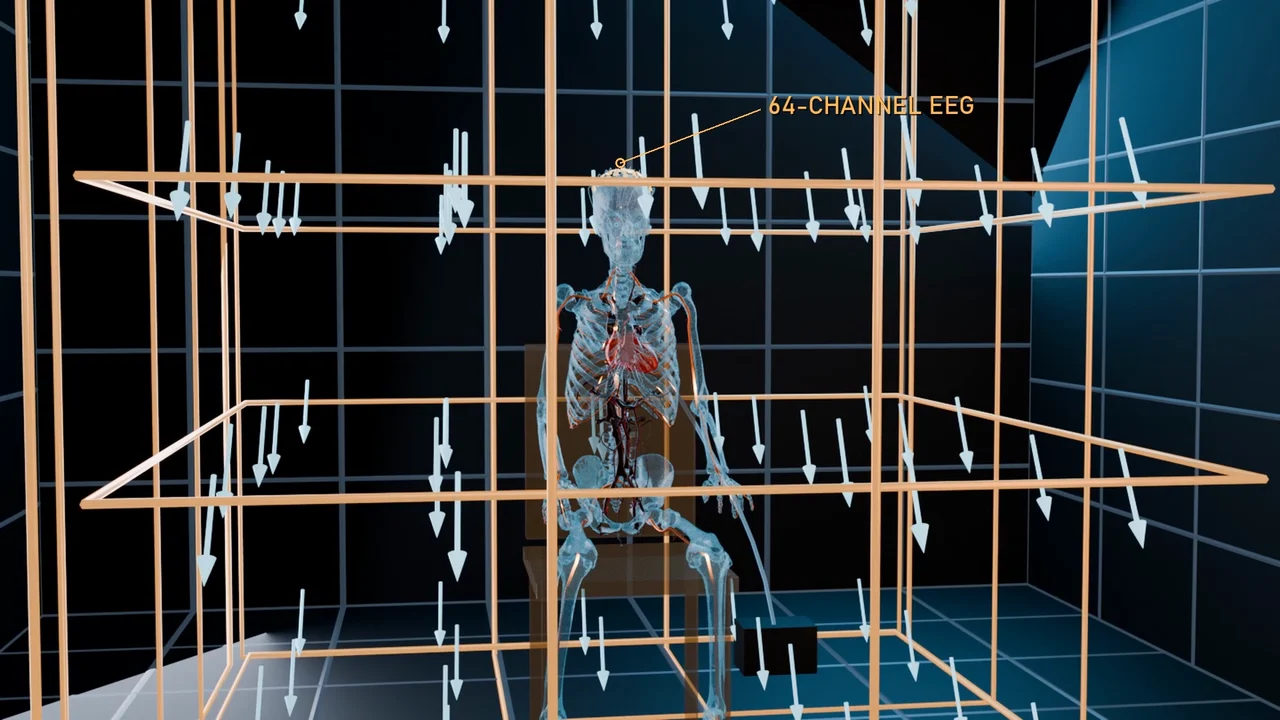
Measured His team found magnetite, a magnetic iron mineral, in human brain tissue: at least five million crystals in every gram, probably made by the body itself (Kirschvink et al., 1992[12]). In 2019 a Caltech team sat 36 volunteers in total darkness inside a shielded chamber and turned an Earth-strength magnetic field around them. Nobody could tell when the field moved. In some of them, alpha brain-wave power fell by as much as about half and recovered within a second; others did not respond at all. The response appeared only with the field pointing down, as it does in the Northern Hemisphere, where all of them lived (Wang et al., 2019[13]). What the response is for, the authors say, is unknown.
A Munich team later mapped where the magnetic particles sit, in 822 samples from seven brains: about twice as much signal in the cerebellum as in the outer cortex, more again in the brain stem, and more than ten times the cortex in the pineal gland, the olfactory bulb and the choroid plexus (Gilder et al., 2018[14]). The pineal gland carries something else as well: microcrystals of calcite less than 20 micrometres long, a mineral otherwise known in healthy human tissue only in the inner ear. The authors say the crystals may be piezoelectric, which would make them the grill lighter’s trick again. They call that possible, not shown (Baconnier et al., 2002[15]).
Not all of it is ours. In 2016 Barbara Maher and colleagues found a second kind of magnetite in 37 samples of human frontal cortex: rounded particles, consistent with forming at high temperature, which the authors read as coming from outside the body. Their paper calls them pollution particles, small enough to reach the brain through the nose.[35] So some of what is in a head may have come off the road, and part of the open question is how much.
Birds are further along than we are. European robins find north from the tilt of the Earth’s field lines, not from which way they point (Wiltschko & Wiltschko, 1972[16]). On a university campus in Oldenburg, Germany, robins lost that compass in the city’s electromagnetic noise and found it again inside wooden huts screened with aluminium and connected to ground. Disconnect the ground, and the compass switched off again (Engels et al., 2014[17]). A receiver can be jammed, and grounding was the switch. Birds may carry a second kind of sensor as well, built from light: in 2021 the robin’s version of a protein called cryptochrome 4 proved more sensitive to magnetism in the test tube than the same protein from chickens and pigeons, which do not migrate.[36]
Which of the two does the sensing in people is not settled. The Caltech team points to the crystals. A lab in Korea reported the opposite: 20 men who had fasted turned toward the magnetic direction they had learned to link with food, and the effect needed blue light, which points back at a light-sensing protein. The women in that study showed no such orientation.[37] Two labs, two instruments and two answers: this science is still wide open.
What is coming in from the sky?
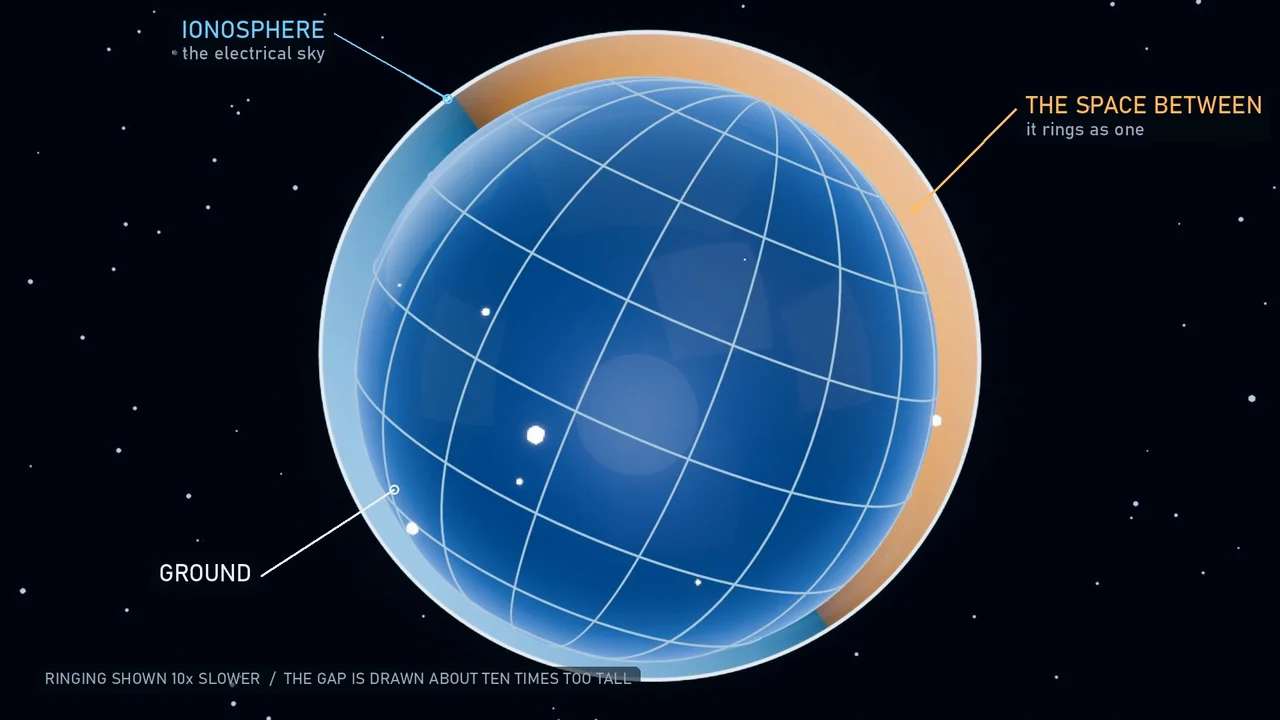
Two things reach every body on Earth all day. One is the Earth’s own hum: with 50 to 100 lightning flashes every second somewhere on the globe, the space between the ground and the upper atmosphere rings like a bell at about 7.83 cycles a second, the Schumann resonance. The other is the Sun, whose storms shake the Earth’s magnetic field.
Measured, in populations Across 11,453 strokes in five countries, stroke risk was 19% higher with geomagnetic storms (Feigin et al., 2014[19]). Across 44 million deaths in 263 U.S. cities, cardiovascular and heart-attack deaths rose with the Kp index (Zilli Vieira et al., 2019[20]). A hospital study in Scotland found men’s admissions for the depressed phase of manic-depressive illness up 36.2% in the second week after storms (Kay, 1994[18]). And in one week of blood-pressure readings from 56 adults in Japan, pressure ran a little lower on days of strong Schumann signals, 128.7 against 131.6 systolic: a lead, from one week and 56 people (Mitsutake et al., 2005[21]).
The first of these counts was made by the bone surgeon himself. In 1963 Robert Becker and two colleagues set 28,642 psychiatric admissions at seven New York State psychiatric hospitals and a veterans’ hospital beside the magnetic record. They found no link to overall geomagnetic activity, and a weak but statistically significant one to the days of magnetic storms, counted over three to five weeks. They called their own conclusion tentative.[38]
These are associations in large groups. They do not say what a storm will do to you on a given day, and no physical mechanism for the Schumann effects has yet been found. You can watch the same readings these studies used, live on the space weather page, and the film What Does a Geomagnetic Storm Do to Your Body? goes through the storm studies one by one.
Transmission · the monthly letter
Not ready for the app or the book? Transmission is Electric Astrology’s monthly letter: launch notes, new research and new articles. Tick the box under the form to get space weather alerts as well.
Can DNA carry a current, and can birth leave a mark?
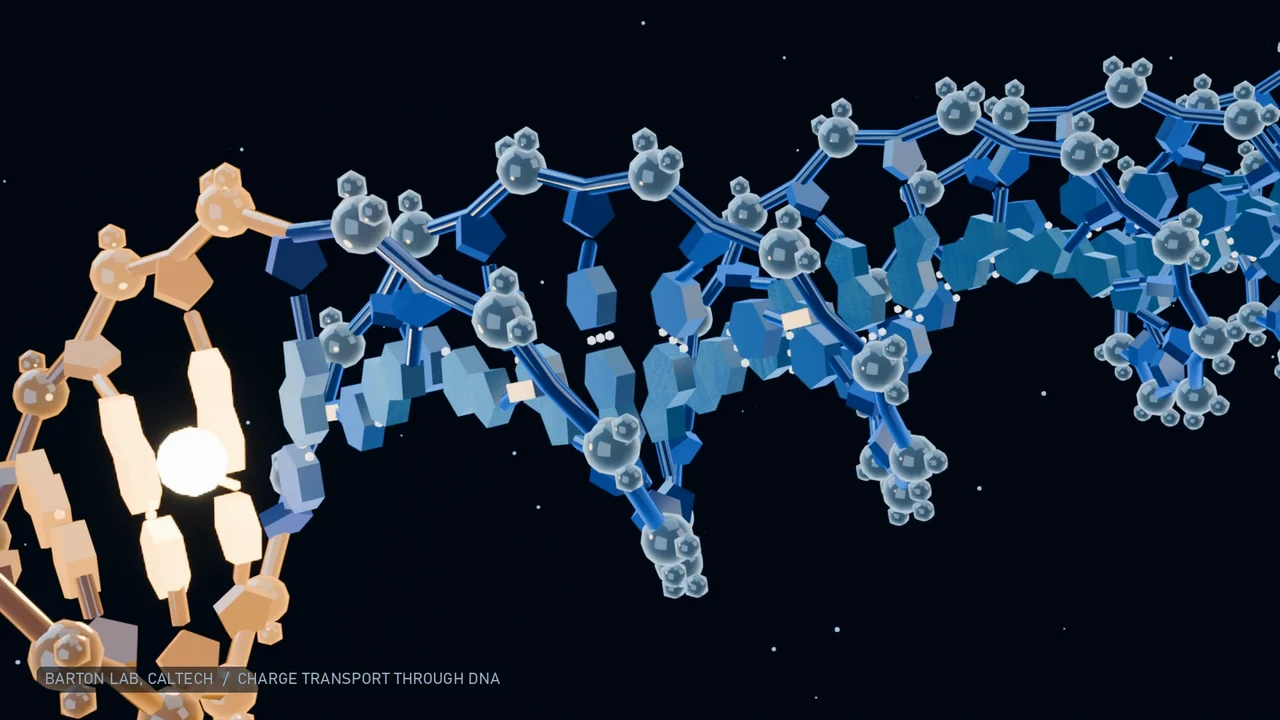
Measured At Caltech, Jacqueline Barton’s group ran electric charge through 100 base pairs of DNA, 34 nanometres, on a gold electrode. The charge travelled through the stacked bases, and a single mismatched pair cut the signal to less than half (Slinker et al., 2011[22]). That was DNA on an electrode in a buffered solution, not inside a cell, and the authors call it “a transient and fragile wire”.
The genes themselves do not change through a life, but the chemical marks that switch them on and off can. In the winter of 1944 to 1945 a blockade starved the western Netherlands. Six decades later, people conceived during that famine carried 5.2% less of one such mark on a growth gene than their own brothers and sisters. People who met the same famine late in pregnancy showed no difference: timing decided it (Heijmans et al., 2008[23]).
And one study has looked at the Sun at birth. In two Norwegian parishes, across 8,662 births from 1676 to 1878, people born in a solar maximum lived 5.2 years less on average than people born at solar minimum (Skjærvø et al., 2015[24]). The authors propose ultraviolet light as the route; they did not test an electric or magnetic effect. And across the records of about 1.75 million patients at one New York medical centre, 55 conditions out of 1,688 tested varied significantly with the month of birth; the authors note it is one institution in one climate, and that they cannot rule out indirect causes.[39] None of these studies tests astrology. They show the kind of thing the hypothesis needs: conditions at the start of a life leaving a mark that can still be read decades later.
Is the body’s shape stored in voltage?
The film ends on its strangest evidence, from the labs of Michael Levin and Dany Spencer Adams at Tufts.
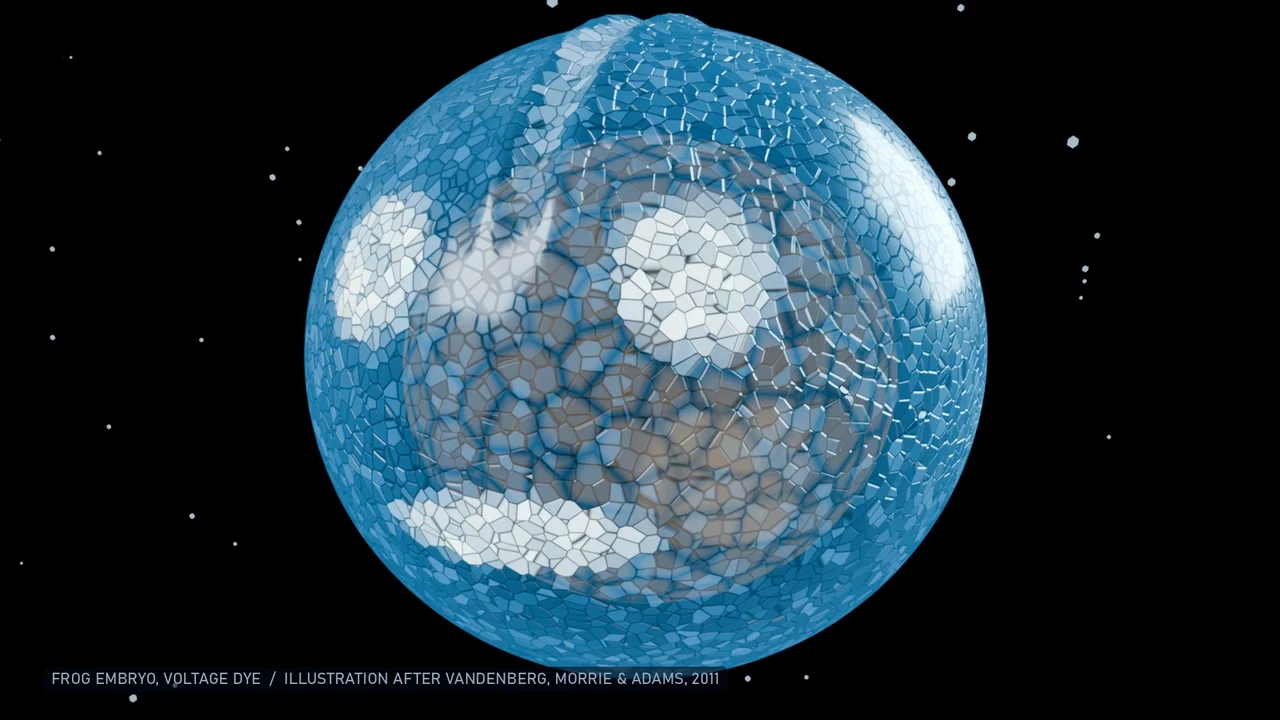
Measured In frog embryos soaked in a dye that reports voltage, a pattern appears on the surface before the face forms, marking where the mouth, the nose and the eyes will be. When that pattern was disrupted, the face on that side formed abnormally. The authors call the evidence suggestive, and their experiment implicates pH as well as voltage (Vandenberg et al., 2011[25]). Changing the voltage of ordinary cells elsewhere in the embryo made complete extra eyes grow in 7.5% of them, some on the gut and the tail (Pai et al., 2012[26]).
Flatworms go further. Pieces of worm whose cells were electrically uncoupled for three days regrew with a head at each end in 25% of cases. Not a gene was edited, and the two-headed worms regrew two heads every time they were cut again. A drug that made their cells more negative returned about a third of them to one head (Durant et al., 2017[27]). In people, mutations in a single potassium-channel gene change both the rhythm of the heart and the shape of the face (Plaster et al., 2001[28]).
So what is the body plugged into?
Put it all on one print, the way the film does. A generator in your bones. A battery in your cells. Wiring in your blood. A transmitter in your chest. Receivers in your head and in your eyes. Each of those has a measurement behind it. The film goes one step further, to DNA as an antenna, and asks whether it is tuned to the solar system. That is asked as a question, and this page leaves it as one.
William’s hypothesis A circuit like that has to be switched on and tuned. His hypothesis is that it happens at the first breath, when a body goes from its mother’s power to its own, and that the state of the sky in that moment is part of how it is set. Astrologers call the sky at that moment a birth chart. He calls it a commissioning schematic: how you were wired the day you were switched on. In the film’s words, “It doesn’t tell you your fate. It tells you how you’re wired.” The film before this one, Cosmic Commissioning, is about that moment.
Nobody has shown that the planets tune a body. What has been shown is that the body is electrical all the way down, that it carries receivers, and that it moves with the Sun and the Earth’s field in ways large studies can count. The rest is an open question, and it is one you can put to your own life.
The Electric Astrology app
Look for yourself
Meet Ganymede, and track your own signal against the sky and space weather.
What’s measured, what’s proposed, what’s William’s
- Bone turns negative where it is squeezed.
- A regrowing limb swings negative; a scarring one does not.
- Wound fields steer the cells that close a wound.
- Magnetite in the human brain, and a brain-wave response to an Earth-strength field.
- Strokes, heart deaths and hospital admissions that rise with geomagnetic storms, in large groups.
- That bone’s voltages direct where bone is built.
- What the exclusion zone in water is, and whether light grows it.
- That the pineal gland’s calcite crystals are piezoelectric.
- That a face is laid out in voltage before it is built.
- Tennant’s voltages for a running and a repairing body.
- The weight astrologers call Saturn is the load that keeps the generator running.
- Fascia and its water are the body’s battery.
- We induct the planets through the salt water we are made of.
- The first breath switches the circuit on, and the birth chart is its commissioning schematic.
Which papers is this page built on?
Each one has its own page in the Research Wing: what the researchers measured, what they found, the limits they state themselves, and where to read the paper.
Does the body heal with electric currents?
- MechanismBecker, 1961A salamander’s limb stump swings from positive to strongly negative as it regrows; a frog’s stays positive until it heals
- MechanismBorgens et al., 1977Strong electric currents stream out of a regenerating newt’s limb stump in its first week
- MechanismZhao et al., 2006The electric field a wound makes steers healing cells, through two named genes
- MechanismBecker, 1972Tiny implanted currents started partial forelimb regrowth in rats, a mammal that does not regrow limbs
Is the heart more than a pump?
- Direct evidenceAlabdulgader et al., 2018Five months of heart recordings tracked cosmic rays, the Sun’s radio output and the Schumann resonance
- SuggestiveMcCraty et al., 2017A group’s heart rhythms moved together, in step with Earth’s magnetic field
- SuggestiveKobayashi et al., 2009The human body gives off a faint light that rises and falls with the time of day
Can your body sense magnetic fields?
- MechanismKirschvink et al., 1992Human brain tissue holds magnetite, probably made by the body: at least 5 million crystals per gram
- Direct evidenceWang et al., 2019Rotating an Earth-strength magnetic field made some people’s alpha brain waves drop by up to half
- MechanismGilder et al., 2018Magnetic particles concentrate toward the brain stem and cerebellum, a pattern that points to an origin inside the body
- SuggestiveBaconnier et al., 2002The human pineal gland grows tiny calcite crystals, found elsewhere in healthy tissue only in the inner ear
- Direct evidenceWiltschko & Wiltschko, 1972Robins find north from the tilt of Earth’s magnetic field lines, not from which way they point
- Direct evidenceEngels et al., 2014Robins lost their magnetic compass in a city’s electromagnetic noise and found it again inside grounded, screened huts
What is coming in from the sky?
- Direct evidenceKay, 1994Men’s hospital admissions for bipolar depression rose 36.2% in the second week after geomagnetic storms
- Direct evidenceFeigin et al., 2014Geomagnetic storms went with a 19% higher stroke risk across five countries
- Direct evidenceZilli Vieira et al., 2019Across 44 million deaths in 263 U.S. cities, heart deaths rose with geomagnetic activity
- SuggestiveMitsutake et al., 2005Blood pressure ran lower on days of strong Schumann resonance signals
Can DNA carry a current, and can birth leave a mark?
- MechanismSlinker et al., 2011Electric charge travelled through 34 nanometres of DNA, and one wrong base pair cut it to less than half
- MechanismHeijmans et al., 2008Six decades after the Dutch Hunger Winter, people conceived during it still carried a different mark on their DNA
- Direct evidenceSkjærvø et al., 2015People born at solar maximum in historical Norway lived 5.2 years less on average
Is the body’s shape stored in voltage?
- SuggestiveVandenberg et al., 2011A pattern of voltage and pH traces a frog’s face on the embryo before the face forms
- MechanismPai et al., 2012Changing the voltage of ordinary cells made frog embryos grow complete eyes, even on the gut
- MechanismDurant et al., 2017A brief drug treatment made flatworms regrow two heads, and the plan stayed stored in their voltage
- MechanismPlaster et al., 2001Mutations in one potassium-channel gene change heart rhythm, muscle strength and the shape of the face
Chapters
Tap a time to play from that moment, or a title to read that section.
- 01Alive means electric
- 02How a hospital hears your heart
- 03The generator
- 04Who tells the body what to build
- 05The battery
- 06The plumbing is the wiring
- 07The transmitter
- 08How your heart makes a magnetic field
- 09The receiver
- 10How a magnet steers a chemical
- 11What comes in
- 12Tracing the signal
- 13The closing argument
The full transcript
William’s narration as voiced, by chapter, with stills from the film.
01Alive means electric
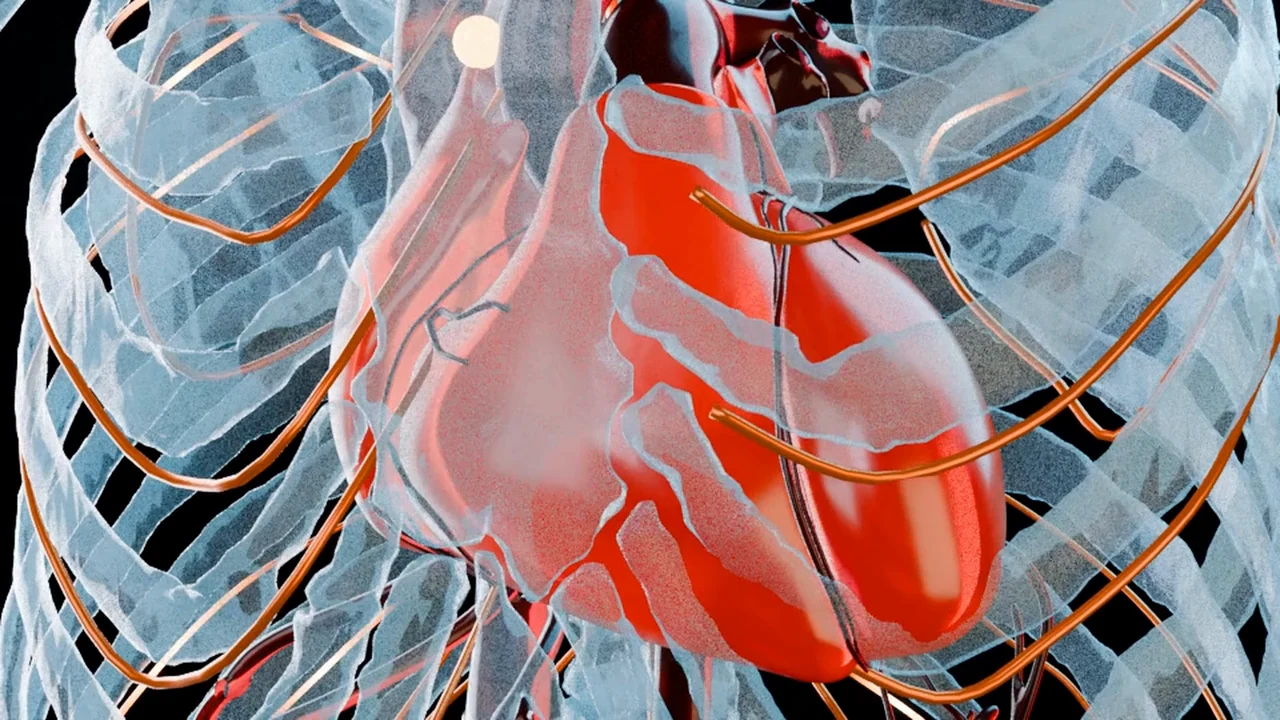
To read your heart, a hospital sticks ten pads on you. Six across your chest, and four more near your shoulders and hips. Your heart sits in here, behind your ribs. And every one of those pads can hear it. Your brain, read through wires on your scalp. Your muscles, through pads on your skin. Almost every machine they hook you to is listening for one thing: electricity. And when that line goes flat, they call it. To a hospital, alive means electric.
So if your body is an electrical machine… what else is it picking up?
A crystal in your bones that sparks like a grill lighter. A current that tells a missing leg to grow back. And a dark room at Caltech where a magnet, turning, changed people's brainwaves, and they never felt a thing.
This is the body electric. By the end, I think you'll see what it's plugged into.
Before we go any further, here's where I stand. I believe there's a mystery in the heavens we'll never fully know. I believe it's alive, and somehow it talks to us. I'm not here to explain it away. But after years in the electrical trade, I can't watch a light come on without looking for the wiring.
Electric astrology rests on four claims. The cosmos is electric: the space between the stars is full of charged plasma, carrying current. The Sun is electric: it pours that charge out through the whole solar system. The Earth is electric: it sits in a magnetic field that rings with lightning and shakes when the Sun storms. And the fourth claim is this film: you are electric too. If the first three are true and the fourth isn't, astrology has nothing to stand on. So before we can talk about what the sky does to you, we have to establish what you are. Piece by piece, from the evidence. It doesn't replace the mystery. It's the foundation the mystery stands on.
02How a hospital hears your heart
Before we go hunting for anything else, look at the instrument. Because the way a hospital hears your heart tells you exactly what kind of machine you are. March 1905, Leiden, in the Netherlands. A patient at the hospital sits with both hands and one foot in buckets of salt water. From those buckets, a telephone line runs about a mile across town to a laboratory. And at the other end, Willem Einthoven is watching a quartz thread, coated in silver and thinner than a hair, twitch in time with that patient's heart. He was reading a heartbeat a mile away, over a phone line. Nineteen years later, it won him the Nobel Prize. Why buckets of salt water? Because that's what you are, electrically. Salt water carries a current. So do you.
Here's what he was hearing. Every heartbeat starts with a spark. A little knot of cells at the top of your heart, called the sinus node, fires on its own, sixty or seventy times a minute. Nobody tells it to. It's the heart's own pacemaker. That spark sets off a wave. Every heart cell rests at about ninety thousandths of a volt negative, charged up like a tiny battery. When the wave reaches it, little gates in its wall open, charged salts rush in, and the cell flips. Then it squeezes. Cell after cell, top to bottom, like a row of dominoes falling. That moving wave is a current. And current in a conductor doesn't stay put. It spreads out through the salt water of your whole body, all the way to your skin. By the time it gets there, it's faint. About a thousandth of a volt. A millivolt.
So how do you catch a millivolt? First, you have to get it out of you and into a wire. Inside you, current is carried by charged salts. In a wire, it's carried by electrons. The sticky pad is the handoff: its gel and its little silver button trade one for the other. Einthoven's buckets did the same job. Then you compare. One wire on its own tells you nothing. You need two points and the difference between them, the same way I put my two meter leads on two terminals. Right arm against left arm. Left arm against left leg. Einthoven drew those three points as a triangle around the heart, and every EKG since has been built on it.
And here's the part an electrician loves. It barely matters where on the arm that pad goes. Wrist or shoulder, you get the same reading, because the whole arm is just a wire running back to the chest. That's why the hospital puts them up near your shoulders and hips: so you can move. The six pads across your chest are the close-up. Each one looks at the heart from a different angle, like six cameras around a stage. Ten pads, twelve views of one current. That's the twelve-lead EKG.
So when a hospital wires you up, it isn't measuring a pump. It's reading a current, a millivolt at your skin, coming from a spark that fires on its own inside your chest. And the heart isn't the only generator you've got. There's another one you switch on every time you take a step.
03The generator
Push the button on a grill lighter. There's no battery in there. There's a hammer. A spring-loaded hammer strikes a small crystal. Squeeze a crystal and it gives up voltage. Snap. Pressure equals voltage. Your bones are crystals too. Every step you take, gravity squeezes your thigh bone, and the bone answers with a pulse of electricity. Two Japanese scientists, Eiichi Fukada and Iwao Yasuda, measured it in 1957. A few years later, Andrew Bassett and Robert Becker found the squeezed side goes negative. And that negative charge is a work order. It calls the construction crew to that exact spot: we've got load here, build more bone.
Now take the weight away. In space, astronauts can lose one to one and a half percent of their hip bone every month. Feed them all the calcium in the world. No squeeze, no voltage. The body reads the silence as: this chassis isn't needed anymore.
Astrologers call that weight Saturn. It isn't there to crush you. It's the fuel that keeps your lights on. That's Chapter 7 of my book, Electric Astrology. I called it The Body Electric. And if you want the rest of the wiring diagram, subscribe.
Let's put that on the bench, because "pressure equals voltage" sounds like a slogan until you see how it works. A crystal is atoms stacked in a fixed pattern. Some carry a little positive charge, some a little negative, and at rest they balance out. Now squeeze it. The pattern shifts, the positive charges slide one way and the negative ones the other, and one face of the crystal comes up positive while the opposite face goes negative. That's a voltage. Let go, and it springs back. The name says it all: piezo, from the Greek for "press". Press electricity. In a grill lighter, the hammer hits that crystal hard enough to make thousands of volts for an instant, and it jumps the gap as a spark.
Bone plays the same trick, built a different way. About a third of your bone is collagen, a protein wound into three-strand ropes, laid side by side in rows. Fukada and Yasuda clamped bone in a press in 1957 and read the voltage coming off it. Bend it, and charge appears. Bassett and Becker then showed which side does what: the side being squeezed goes negative, the side being stretched goes positive.
Then came the experiment that turned it into medicine. Becker and Bassett set tiny electrodes into the leg bones of dogs and ran a trickle of direct current through them. New bone grew at the negative electrode. The best results came at two to five millionths of an amp. You could never feel a current that small. By 1979, the FDA had approved a device that does it for people: a coil strapped over a broken bone that won't heal, pulsing a field through it. Doctors still prescribe them today.
And the story kept going. In 2021, the Nobel Prize in medicine went to the discovery of the pressure sensors in your cells. They're called Piezo channels, from the same Greek word. In bone, they feel the fluid squeezed past the cells with every step, and they open up and let charge in. Crystal or channel, the message is the same. Every step you take is a signal, and your skeleton reads it and builds on it.
So every step makes power. But who tells the body what to build with it?
04Who tells the body what to build
Cut the leg off a frog, and it scars over. Gone for good. Cut the leg off a salamander, and it grows back. Bone, muscle, nerve and skin. Robert Becker wanted to know why. He didn't look at the chemistry. He looked at the voltage. He took a voltmeter, basically the same Fluke I keep in my tool bag, and touched it to the stump.
Both stumps start out the same. The frog's reading falls to zero as the scar forms. The line is dead. But the salamander's goes negative, deeply negative, and stays there for weeks. And as long as that charge holds, the cells don't scar. They go back to raw material, and they rebuild the leg from scratch.
And that current wasn't running inside the nerves. It ran along the outside, in the sheath. Electricians have a name for that: Power over Ethernet, the data and the power on the same cable.
And it isn't just salamanders. Every cut on your body makes an electric field, pointing in, and the healing cells follow it like a crew following a work order. In 2006, at the University of Aberdeen, a biologist named Min Zhao flipped that field, and the cells turned around and marched the wrong way.
Becker took that idea to a man whose broken ankle hadn't healed in two years. The next step was amputation. Becker ran one silver wire into the break and fed it a few hundred billionths of an amp. The bone knit.
Let's put numbers on that, because the numbers are the whole story. Day one, both stumps read about twenty thousandths of a volt, positive. Same cut, same reading. Over the next few days, the frog's fades toward zero, and the frog scars. The salamander's flips. Somewhere between day three and day five it goes negative, and it stays negative while the leg rebuilds. When the new leg is finished, the reading comes back to zero. Job complete. That one flip in polarity is the whole difference between a scar and a new leg.
Then, in 1977, a team at Purdue measured how much current comes out. They used a vibrating probe, a sensor so fine it maps current leaving the skin point by point. Out of a newt's stump in its first week came ten to a hundred millionths of an amp, from a patch the size of your fingernail.
And they found where a lot of it comes from: the skin. Your skin is a battery. Its cells pump salt in one direction, inward, all day long, and that builds up a charge across the skin. Cut it, and you short that battery. Current leaks out through the wound, and that leak is the signal that says: here, build here.
His lab also found the genes the cells use to read that field. Healing cells line up with it and crawl toward the cut. Knock out one of those genes, and the cells lose their sense of direction. Every cut you've ever had closed by following a voltage.
So the body runs a repair grid on direct current. But a grid needs a battery. And what happens to you when it runs low?
05The battery
This is the most common failure an electrician ever sees. The machine's dead. The mechanics say the fuel's topped off, the oil's clean, the filters are new. Then you put a meter on the battery: ten point four volts. That isn't close enough to twelve. That's a dead cell. A brownout.
Now picture a person. Exhausted. Foggy. Every blood test comes back normal. The chemistry's fine. So they tell you you're fine.
That's what happened to Dr. Jerry Tennant, an eye surgeon in Texas. In 1995 a virus got into his brain: encephalitis. He spent the next seven years in bed, sixteen hours a day. His colleagues ran every test in the book and found nothing they could fix. So he went looking himself, and what he found was voltage. His cells didn't have enough of it. He rebuilt it: the raw materials his cells were missing, and a device that runs a gentle current through the tissue. By his own account, that's what got him out of bed. He didn't need a new brain. He needed a jumper cable.
So Tennant wrote the body a nameplate, like the tag riveted on a motor. Minus twenty to twenty-five millivolts to run. Minus fifty to repair. Zero is a dead battery. And the meter for it might already be in your medicine cabinet. Acid means plus charges, electron thieves. Alkaline means minus, electron donors. That cheap strip of paper is a crude voltmeter.
So where is that battery? For nearly five hundred years, anatomists cut through the white, cobweb-like tissue wrapping your muscles, called it packing material, and threw it in the trash. They were throwing away the wiring harness. It's called fascia. It wraps every muscle, every organ, every nerve, head to toe. It's the only system in your body that touches every other system.
And Gerald Pollack, at the University of Washington, found what fills it. Put water next to a surface like that, and the water lines itself up and pushes everything else out of the way. It clears a zone. Regular water is a crowd at a concert. This water is soldiers in formation. And it splits the charge: negative inside the zone, positive out beyond it. Water building itself into a battery. He called it the fourth phase of water.
And here's the part that stopped me. Shine infrared light on it, the kind the Sun gives off and your own body does too, and that zone grows. About three times bigger in five minutes. Light charges the battery. That's why a knot feels like a knot. When fascia dries out, the battery plate dries up and turns into a resistor. Move, stretch, and you squeeze the water back in.
But a battery has to sit in a circuit. And the circuit in you is the last thing any electrician would build: it's full of water.
06The plumbing is the wiring
In construction, the plumber and the electrician are natural enemies. Water in a conduit is a short circuit. Water in a panel is an explosion. We spend our careers keeping the two apart.
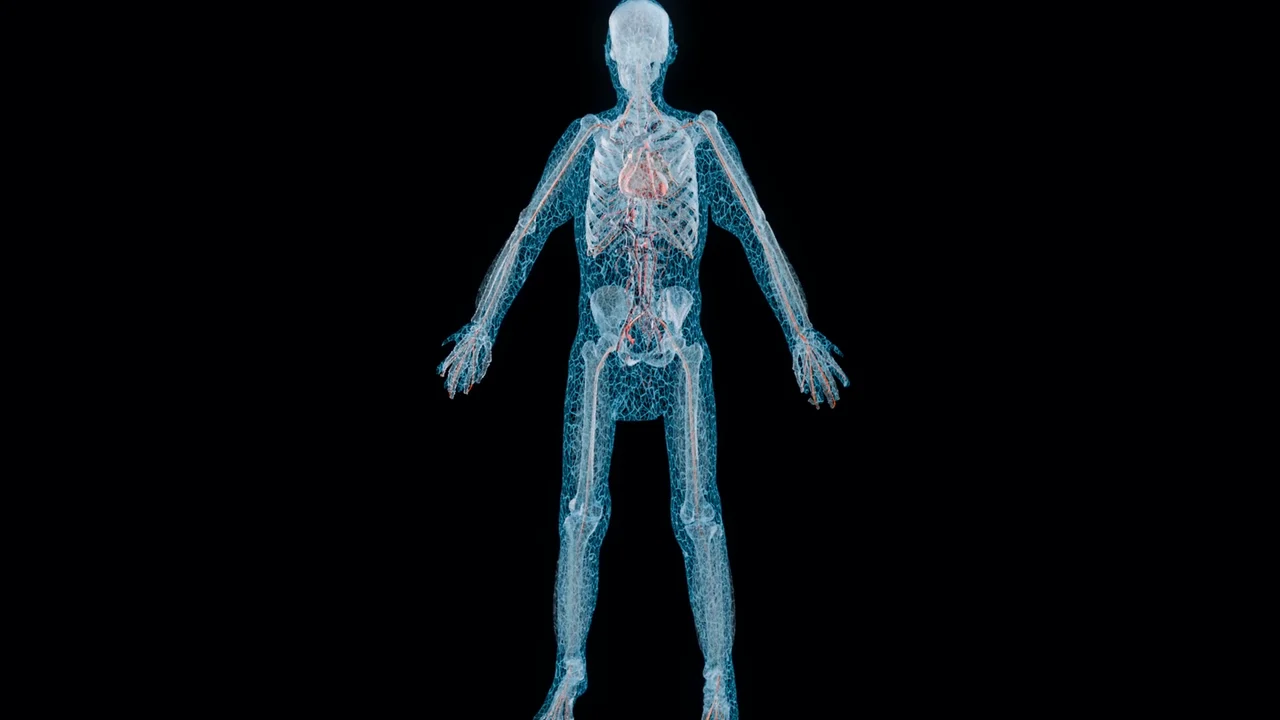
But the human body breaks the most basic code in the trade. In you, the plumbing is the wiring. In the 1980s, a Swedish radiologist named Björn Nordenström looked at your blood vessels and saw cables. The blood down the middle carries the charge. The vessel wall insulates it. The arteries feed out, the veins bring it home.
And it works because you're not full of fresh water. You're full of salt water. Pure water barely carries a current. Add salt, and it turns into a conductor.
Before we follow the water any further, look at the wiring everybody agrees on: your nerves. In the 1850s, the telegraph companies had a problem. They'd laid cable along the bottom of the sea, and the signal came out the far end smeared and slow. A young physicist named William Thomson, later Lord Kelvin, worked out why. A long cable leaks. Its insulation is never perfect, and the cable itself soaks up charge like a capacitor. He wrote the math for how a pulse fades as it travels down a long, leaky, wet cable.
About ninety years later, in 1946, Alan Hodgkin and William Rushton took a single nerve fiber out of a lobster's leg, fed it a tiny current, and measured how the voltage fell away along it. It fit the cable math. Your nerve is a leaky cable lying in salt water, and it follows the same equation as the telegraph under the sea.
So how does a signal get from your spine to your toe without fading out? The same way a long phone line does: repeaters. Your fastest nerves are wrapped in insulation called myelin, with a tiny bare gap every so often. At each gap the signal is rebuilt to full strength and jumps to the next one. A resting nerve sits at about seventy thousandths of a volt negative. A signal is a flip: the gates open, salt rushes in, the inside goes positive for about a thousandth of a second, and that flip runs down the line. In the thinnest bare fibers it crawls along at a couple of miles an hour. In the best-insulated ones, it travels about two hundred and seventy miles an hour.
That's the wiring nobody argues about. Nordenström went further. He said the vessels are a second circuit, and he built a treatment on it: needles into a tumor, a current run through it. Doctors in China went on to treat thousands of patients that way.
So picture yourself the way an electrician would: a column of salt water, walking around on a magnetized planet. That's the oldest law in my trade. Faraday's law: put a conductor in a changing magnetic field, and a current shows up in it. The wires never have to touch. That's every transformer on Earth. And when the Sun hits us with a storm, Earth's field shakes, and that changing field cuts right through the wet wire of your bloodstream. We don't feel the planets metaphorically. I think we induct them.
And that turns the whole question around. So far we've followed signals coming out of you. If the sky can reach in… what in you is listening? Start with the loudest thing in your chest.
07The transmitter
For centuries, the textbooks have called your heart a pump. A steady one, like a metronome.
I learned different on the finishing floor of the Gibson guitar factory in Nashville. We were building a line to carry freshly sprayed Les Pauls up into a loft to cure overnight, hanging like bats in a cave. Wet lacquer. If that chain jerked, the guitars would swing into each other, and the finish was ruined.
A plain motor starter slams the full four hundred eighty volts in at once. It's violent. So I installed a VFD, a variable frequency drive. It ramps the motor up gently, one hertz, five, twenty, gliding it up to speed. When we hit the green button, the guitars floated up into the dark like ghosts. We'd had to put a computer on that machine just to make it act like a living thing.
That's when it hit me. Your heart isn't a metronome. It's a VFD. It speeds up when you breathe in, slows down when you breathe out, and adjusts to the load every second. Doctors call it heart rate variability.
And if you want to know what really runs a factory, you don't ask the manager. You put an amp clamp on the feeders. Do that to a human being, and the heart's magnetic field reads about a hundred times stronger than the brain's. That's why a pad on your hip can read it. You'll never pick up a thought in your big toe. The heart's signal goes everywhere.
08How your heart makes a magnetic field
So where does a magnetic field come from? Remember the wave from the start, the one the hospital reads. A current in a conductor. And here's the first thing every electrician learns: wherever current flows, a magnetic field wraps around it. In 1820, Hans Christian Ørsted set a compass beside a wire, switched on the current, and the needle swung. That was the moment electricity and magnetism turned out to be one thing. There's a rule for which way it goes. Grab the wire with your right hand, thumb pointing the way the current flows, and your fingers curl the way the field wraps around it. The right-hand rule.
Your heart's wave is the biggest current in your body, so it makes the biggest magnetic field in your body. At your chest it's about fifty to a hundred picotesla. That's trillionths of a tesla. Your brain's field is about a hundred times weaker than that, and Earth's own field, the one that swings a compass, is hundreds of thousands of times stronger than your heart's.
So how do you hear something that faint? That's the other half of the story, Faraday's law. A changing magnetic field passing through a coil of wire makes a voltage in the coil. More turns, more voltage. A faster change, more voltage. Turns times rate of change.
Your heart's field changes with every beat. So in 1963, in a field outside Syracuse, Gerhard Baule and Richard McFee of Syracuse University wound two million turns of wire around a ferrite core and laid it over a man's chest. And they didn't use one coil. They used two, wired against each other. Anything far away, like the hum off the power lines, hits both coils the same and cancels out. Only the heartbeat, close to one coil, comes through.
I know that trick. It's a humbucker, the pickup in a Les Paul. Two coils wired against each other, so the hum cancels and the string comes through. Gibson patented it in 1959. The same idea that makes a guitar sing heard the first heartbeat from outside a human body.
It was barely a whisper, buried in noise. Seven years later, in 1970, David Cohen at MIT did it properly: a room shielded from Earth's field, and a new kind of sensor called a SQUID, superconducting, chilled in liquid helium. He recorded the heart's magnetic field beat by beat.
Step back from a field like the heart's and it fades fast: twice as far away, eight times weaker. And still, with sensors sensitive enough to hunt submarines, researchers have traced that field several feet out around you. You walk around inside your own broadcast. A transmitter that loud raises the obvious question. Is there a receiver?
09The receiver
For a long time, biology assumed magnetic fields pass straight through us. Then Joe Kirschvink at Caltech went looking, and found magnetite, the most magnetic mineral on Earth, in the human brain. At least five million crystals in every gram. The same kind of crystals homing pigeons and salmon use to find their way home.
And here's how a magnet becomes a feeling, the way Kirschvink pictures it. Each crystal is anchored to the wall of a nerve cell. When Earth's field shifts, the crystal twists like a compass needle and tugs on that wall. The tug pops open the little gates that let charged salts flood in. And the nerve fires.
Remember the dark room? In 2019, Kirschvink's team sat volunteers in total darkness inside a shielded chamber, and slowly turned an Earth-strength magnetic field around them. Nobody felt a thing. But in some of them, the brain's alpha rhythm dropped by as much as half when the field turned. The brain noticed what the person never did.
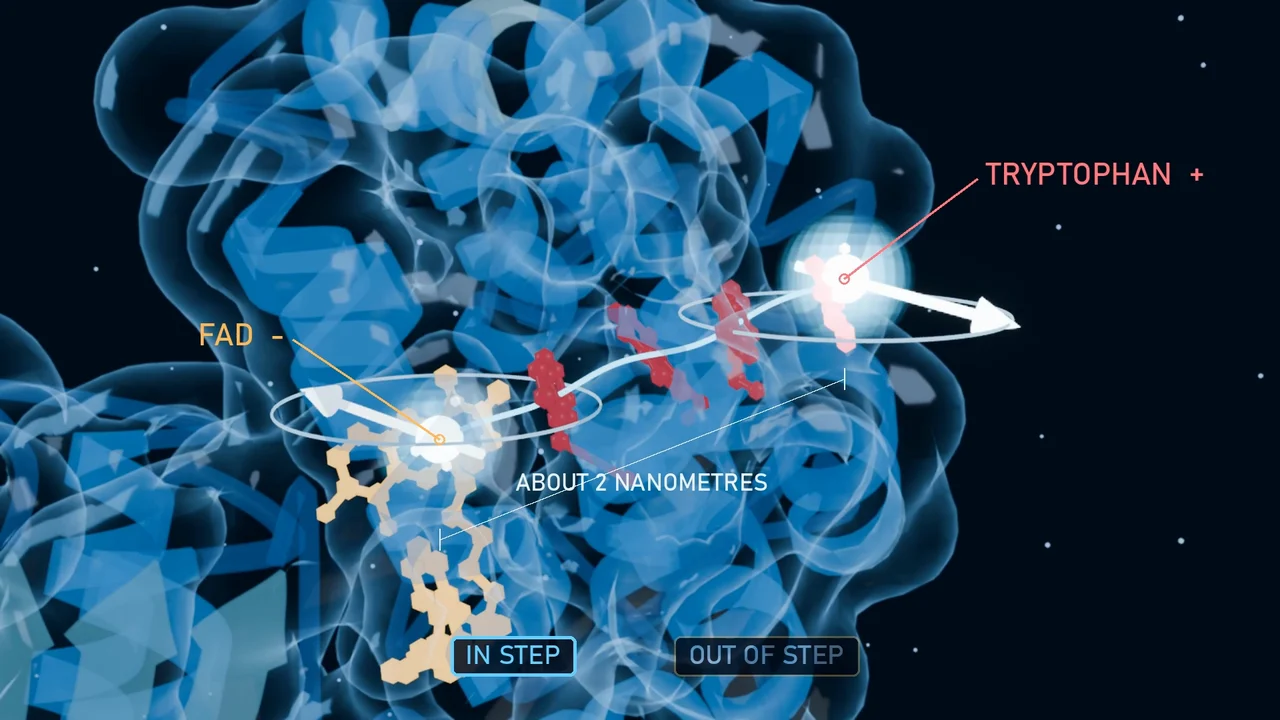
Birds carry a second kind of antenna, and it's built from light. In a robin's eye there's a protein called cryptochrome. When light hits it, it kicks loose a pair of electrons spinning in step, and Earth's magnetic field nudges that spin. The robin may actually see the field. In 2014, scientists in Oldenburg, Germany, found the robins on their campus had lost their compass. The culprit was radio noise from the city. So they built aluminum huts and grounded them, the way an electrician grounds a panel. Inside, the compass came back on. Unground the huts, and it switched off again. Your eyes carry cryptochrome too.
And the most magnetic spot in the whole brain? A team in Munich measured whole human brains in 2018. It was the pineal gland. The one they've called the third eye. And it's packed with something else: tiny calcite crystals, found in 2002. Crystals that can turn pressure into voltage. The same trick as the grill lighter, sitting in the middle of your head.
A radio picks one station out of the air with a tuned crystal. Magnets that turn with Earth's field, and a crystal at the center. You're not just a transmitter. You're a receiver.
10How a magnet steers a chemical
So how does a magnet steer a chemical reaction? Here's the mechanism most of the scientists working on it are betting on. Light hits the cryptochrome and knocks one electron over to a neighbor. Now you've got two electrons, apart from each other, each one spinning, and their spins are tied together. The pair flips back and forth between two states, in step and out of step. Earth's magnetic field changes how fast they flip. And whichever state the pair lands in decides which chemical the cell makes next. The field never pushes anything around. All it does is tip the odds, and a tilt in the odds, repeated across thousands of molecules, becomes something the bird can see.
In 2021, a team led from Oldenburg made the robin's cryptochrome in the lab and tested it in a tube. It reacted to magnetism more strongly than the same protein from chickens or pigeons. The bird that migrates by night carries the most sensitive version.
Now the crystals. In 2016, Barbara Maher's team in England found a second kind of magnetite in human brains: little rounded balls, the kind made by burning. Pollution, breathed in through the nose. So some of what's in your head came off the road. But remember Munich. The pineal gland has no straight road from your nose, and it came out more than ten times as magnetic as the outer brain. Something there was built in.
And the dark room at Caltech had a twist in it. The brains only answered when the field pointed down into the ground, the way it does here in the Northern Hemisphere. Point it the other way, and nothing. That's why Kirschvink's team thinks the crystals, not the eye protein, are doing it in people. Then a lab in Korea found the opposite. Their volunteers had a compass sense that needed blue light, which points right back at cryptochrome.
Two labs, two instruments, pointed at the same question, and two different answers. That's where this science is right now: wide open. And you're walking around carrying the very thing they're arguing about.
And the surgeon who found the body's healing current noticed it too. The same year, in the same town where they first heard a heartbeat from outside the body, Robert Becker was counting something else: psychiatric admissions on the days of magnetic storms.
11What comes in
He and two colleagues lined up thousands of psychiatric admissions against Earth's magnetic record. On the stormy days, more people came through the doors. A bone surgeon, counting storms. Because once you've seen the wiring, you can't stop asking what's coming in on it.
And something is always coming in. Lightning hits the planet about fifty times a second, and it rings the space between the ground and the sky like a bell. Earth's hum: seven point eight three cycles a second. That's right down in the range your own brain runs at when you're relaxed and drifting.
Out in the New Mexico desert, there are twenty-seven radio dishes, each eighty-two feet across. Alone, none of them can see much. Wired together, they act like one dish more than twenty miles wide. In the book, I argue we're built the same way: not one giant receiver, but eight billion small ones.
12Tracing the signal
Now let's do what any electrician does with a mystery circuit: trace it. Follow the signal into one element, yours, from the outside all the way down. Stage one, the antennas. Crystals in the brain. Light-catching proteins in the eye. And a whole body of salt water, standing in a moving field.
Stage two, the wiring harness. Remember the fascia they threw away? It's the same collagen as your bones: squeeze it, and it makes a voltage. So the one system that touches every other system in your body is built from a material that turns pressure into current and carries signals along its length. In the book I called it a semiconductor. It carries the signal to every cell you have.
Stage three. Every good radio has a part called the local oscillator: a steady tone inside the set that it mixes with the incoming signal to pull the message out. In the human body, that steady tone is the heart. And when your heart settles into a smooth, steady rhythm, the researchers call it coherence. An electrician would call it phase-lock.
Stage four, the deepest receiver of all, sitting in the center of nearly every cell you have: your DNA. At Caltech, Jacqueline Barton's lab sent electrical charge straight down the rungs of the DNA ladder, and it carried it like a wire. Change one single letter in the code, and the current stops. Her lab thinks your repair proteins use that current to test the strand for damage, the way I'd ring out a cable.
And look at its shape. DNA is coiled, and the coil is coiled, and that coil is coiled again. Engineers call a shape like that a fractal antenna, the kind inside your phone, built to hear many frequencies at once. In 2011, Martin Blank and Reba Goodman at Columbia University published a paper called 'DNA is a fractal antenna.' Their lab had found that even weak, low-frequency magnetic fields can switch on genes inside living cells. Here's how big that antenna is. Unwind the DNA in one cell, and it's about six feet long. Lay the DNA from all your cells end to end, and it would stretch billions of miles, roughly from here to Pluto. The physicist Michael Clarage asks the obvious next question: if that's an antenna, is it tuned to the solar system?
So what does the receiver do with the signal? It works the switches. Your genes are the wiring, and the wiring doesn't change. But every gene has switches on it, chemical tags that turn it on or off. That's called epigenetics: the environment flipping the switches. Two mice with identical genes. One's yellow and heavy, one's brown and lean. The only difference was what their mother ate while she carried them. Same wiring, different switch settings. In the winter of 1944, a blockade starved the western Netherlands. Children conceived during that famine still carried its marks on their genes sixty years later.
And the switches answer to voltage. At Tufts, Michael Levin's lab scrambled the electrical signal between a flatworm's cells for a few hours, and it grew two heads. Not one gene was changed. Cut that worm again months later, and it grows two heads again.
And those switches are listening to the sky. Across one point seven five million medical records at Columbia, the month you were born tracked with fifty-five different diseases. In old Norway, people born near the peak of the Sun's eleven-year cycle lived about five years shorter, on average. Genes are the wiring. The world you came into flips the switches.
13The closing argument
So here's where the evidence leaves us, one step at a time. One: your body makes electricity. Your heart fires it, your bones generate it with every step, your cells hold it like batteries. Hospitals measure it every day. Two: your body runs on it. It heals by it, it grows by it, and its cells find their way by it. Three: your body answers to fields from outside it. A magnet turning in a dark room changed the brain waves of some of the people sitting there. More people came through the hospital doors on the days of magnetic storms. Four: you live inside an electric environment. The Earth's field, its hum, the storms off the Sun. Put those together and the conclusion is plain: you're an electrical system, living in an electrical environment, and you respond to it. That's the floor electric astrology stands on.
So let's put it all on one print. A generator in your bones. A battery in your cells. Wiring in your blood. A transmitter in your chest, a hundred times louder than your brain. Receivers in your head and in your eyes. An antenna coiled in every cell, and a switch on every gene. Nobody installs an antenna that isn't meant to pick something up.
So what's yours picking up? The storms off the Sun. The Earth's own hum. The planets, moving through the field you live in. That's the wiring. Who's on the other end of it is still the mystery.
A circuit like that has to be switched on and tuned. So when was yours? It happened in a hospital room. The first one you were ever in. The moment you took your first breath, your circuit switched from your mother's power to your own. Your element in the array was set: where the Sun was, the Moon, every planet. Astrologers call that your birth chart. I call it your commissioning schematic: how you were wired the day you were switched on. It doesn't tell you your fate. It tells you how you're wired.
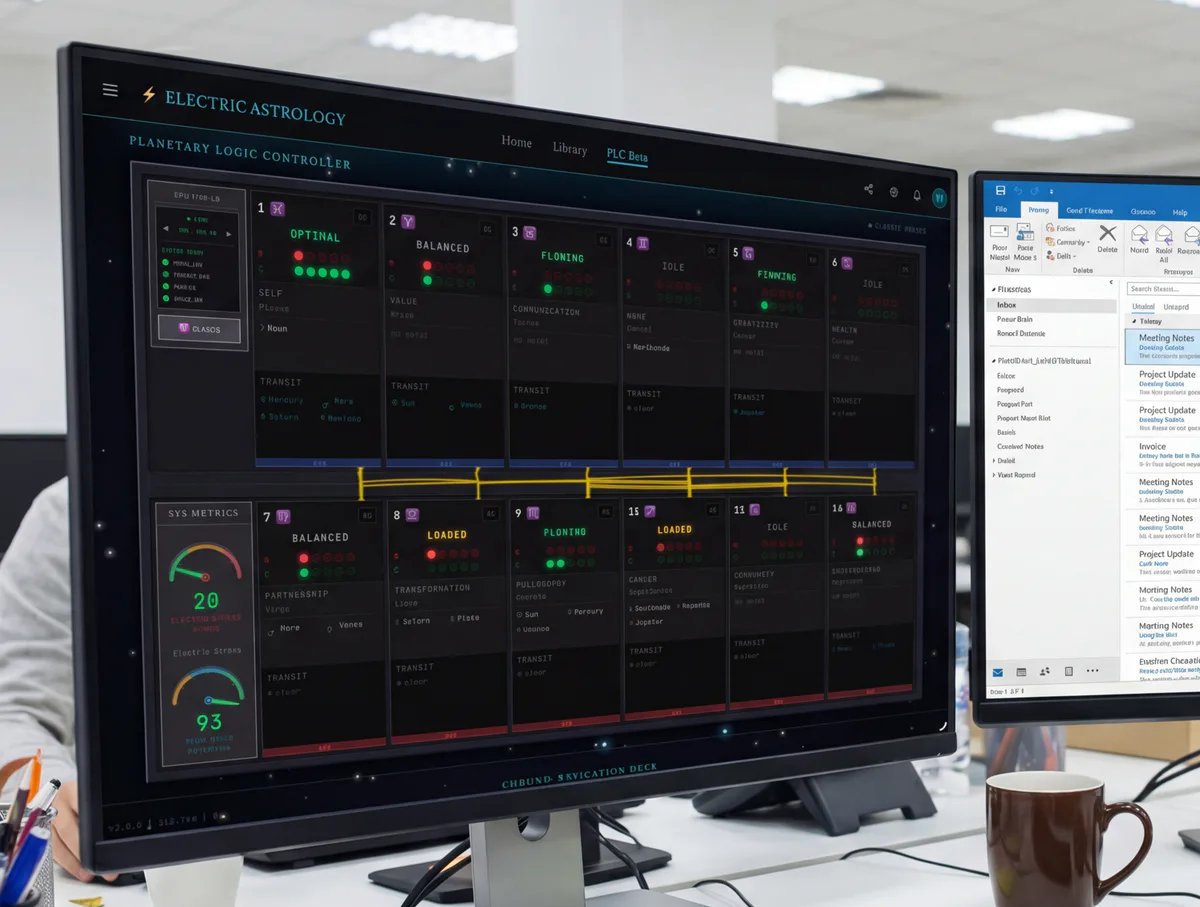
That's the idea I built Electric Astrology on. It's the first and only astrology app that draws your birth chart together with the physical conditions at your birth, and the only one built on plasma cosmology and Electric Universe principles. Your chart, read as a circuit.
Robert Becker spent his last working years warning about giant power lines and the Navy's huge antennas, because he believed the body hears fields. His lab lost its funding. So he wrote it all down, in a book. He called it The Body Electric. It's where my Chapter 7 gets its name. Years later, a teenager came across a copy. His name was Michael Levin. The two-headed worms are his.
Today his lab at Tufts watches frog embryos with a dye that glows with voltage. And before the face grows, it shows up in electricity first. The eyes. The mouth. Mapped out in voltage, waiting to be built. Before you were built, the electricity already knew your shape.
Questions people ask
Is the human body electric?
Yes, measurably. A hospital reads the heart, the brain and the muscles by their voltage. Every cell holds a voltage across its membrane, bone turns electrically negative where it is squeezed, and a wound makes an electric field that the healing cells follow. Whether that electrical body also responds to the Sun, the Earth’s field and the planets is the open question the film The Body Electric is about.
Do bones generate electricity?
Under stress, yes. In 1962 Bassett and Becker bent cat, rat and frog bones and found that the compressed side turned negative at once and stayed so until the force was removed. Dead bone did the same with about 25% less voltage, and bone with its mineral removed made none. The authors thought piezoelectricity was probably present but not the only cause, and they suggested, without showing it, that the voltages guide where bone is built.
Why can a salamander regrow a leg when a frog cannot?
Part of the answer is electrical. Robert O. Becker tracked the voltage on amputated limbs in 1961: the salamanders’ stumps crossed zero between the fifth and the tenth day, swung strongly negative, and stayed more negative than normal until the limb had regrown, while none of 24 frogs showed even a brief negative swing before healing. In 1977 a Purdue team measured 10 to 100 microamps per square centimetre leaving a newt’s stump in its first week, driven by the skin. Becker called his experiments preliminary.
Can humans sense the Earth’s magnetic field?
There is a measured brain response, below awareness. In a 2019 Caltech study, 36 people sat in the dark in a shielded chamber while an Earth-strength magnetic field was rotated around them. In some of them, alpha brain-wave power dropped by up to about 50%; others did not respond, and nobody could tell when the field moved. The human brain is known to contain magnetite, at least 5 million crystals per gram. What the response is for is unknown, and which receiver does the sensing is still argued.
Does the pineal gland contain crystals?
Yes. A 2002 study found microcrystals of calcite less than 20 micrometres long in the human pineal gland, separate from the gland’s familiar mineral deposits. Apart from the inner ear, it is the only known occurrence of calcite in healthy human tissue. The authors say the crystals may be piezoelectric; they call that possible, not shown.
Do solar storms affect the human body?
Large population studies find associations. Across 11,453 strokes in five countries, stroke risk was 19% higher with geomagnetic storms, and across 44 million deaths in 263 U.S. cities, cardiovascular and heart-attack deaths rose with the Kp index. A Scottish hospital study found men’s admissions for bipolar depression up 36.2% in the second week after storms. These are patterns in large groups; they do not say what a storm will do to one person on one day.
What is the fourth phase of water?
It is Gerald Pollack’s name for the exclusion zone, a layer of water next to a water-loving surface that pushes out suspended particles. In his lab, infrared light grew the zone to about three times its width in five minutes. Several independent groups have seen the zone; its cause is still argued, and the growth under light has yet to be repeated by other labs. The idea that this layer works as a battery in the body’s fascia comes from the book Electric Astrology and has not been measured.
What is The Body Electric?
It is a film by William Lee Edwards that follows electricity through the human body part by part, and Chapter 7 of his book Electric Astrology: A Journeyman’s Guide to Planetary Logic Controls. Both take their name from The Body Electric (1985), the book by Robert O. Becker, the orthopedic surgeon whose salamander and bone experiments are part of the story.
What does the body’s electricity have to do with astrology?
That link is a hypothesis, not a measurement. William Lee Edwards proposes that a body which is electrical all the way down, and which carries magnetic receivers, is set at the first breath, with the state of the sky around it as part of the setting. He calls the birth chart a commissioning schematic: how a body was wired the day it was switched on, not a fate. The page marks which parts of the argument are measured, which are proposed by researchers, and which are his.
Sources
- Bassett, C. A. L., Becker, R. O. (1962). Generation of Electric Potentials by Bone in Response to Mechanical Stress. Science, 137(3535), 1063–1064. doi.org/10.1126/science.137.3535.1063 · our notes on it
- Becker, R. O. (1961). The Bioelectric Factors in Amphibian-Limb Regeneration. The Journal of Bone and Joint Surgery (American volume), 43(5), 643–656. doi.org/10.2106/00004623-196143050-00002 · our notes on it
- Borgens, R. B., Vanable, J. W., Jr., Jaffe, L. F. (1977). Bioelectricity and regeneration: large currents leave the stumps of regenerating newt limbs. Proceedings of the National Academy of Sciences, 74(10), 4528–4532. doi.org/10.1073/pnas.74.10.4528 · our notes on it
- Zhao, M., Song, B., Pu, J., Wada, T., Reid, B., Tai, G., et al. (2006). Electrical signals control wound healing through phosphatidylinositol-3-OH kinase-γ and PTEN. Nature, 442(7101), 457–460. doi.org/10.1038/nature04925 · our notes on it
- Becker, R. O. (1972). Stimulation of Partial Limb Regeneration in Rats. Nature, 235(5333), 109–111. doi.org/10.1038/235109a0 · our notes on it
- Yang, M., Brackenbury, W. J. (2013). Membrane potential and cancer progression. Frontiers in Physiology, 4, 185. doi.org/10.3389/fphys.2013.00185 · our notes on it
- Chai, B., Yoo, H., Pollack, G. H. (2009). Effect of Radiant Energy on Near-Surface Water. The Journal of Physical Chemistry B, 113(42), 13953–13958. doi.org/10.1021/jp908163w · our notes on it
- Price, C., Williams, E., Elhalel, G., Sentman, D. (2021). Natural ELF fields in the atmosphere and in living organisms. International Journal of Biometeorology, 65(1), 85–92. doi.org/10.1007/s00484-020-01864-6 · our notes on it
- Alabdulgader, A., McCraty, R., Atkinson, M., Dobyns, Y., Vainoras, A., Ragulskis, M., Stolc, V. (2018). Long-Term Study of Heart Rate Variability Responses to Changes in the Solar and Geomagnetic Environment. Scientific Reports, 8(1), 2663. doi.org/10.1038/s41598-018-20932-x · our notes on it
- McCraty, R., Atkinson, M., Stolc, V., Alabdulgader, A. A., Vainoras, A., Ragulskis, M. (2017). Synchronization of Human Autonomic Nervous System Rhythms with Geomagnetic Activity in Human Subjects. International Journal of Environmental Research and Public Health, 14(7), 770. doi.org/10.3390/ijerph14070770 · our notes on it
- Kobayashi, M., Kikuchi, D., Okamura, H. (2009). Imaging of Ultraweak Spontaneous Photon Emission from Human Body Displaying Diurnal Rhythm. PLoS ONE, 4(7), e6256. doi.org/10.1371/journal.pone.0006256 · our notes on it
- Kirschvink, J. L., Kobayashi-Kirschvink, A., Woodford, B. J. (1992). Magnetite biomineralization in the human brain. Proceedings of the National Academy of Sciences, 89(16), 7683–7687. doi.org/10.1073/pnas.89.16.7683 · our notes on it
- Wang, C. X., Hilburn, I. A., Wu, D.-A., Mizuhara, Y., Cousté, C. P., Abrahams, J. N. H., et al. (2019). Transduction of the Geomagnetic Field as Evidenced from alpha-Band Activity in the Human Brain. eNeuro, 6(2), ENEURO.0483-18.2019. doi.org/10.1523/ENEURO.0483-18.2019 · our notes on it
- Gilder, S. A., Wack, M., Kaub, L., Roud, S. C., Petersen, N., Heinsen, H., et al. (2018). Distribution of magnetic remanence carriers in the human brain. Scientific Reports, 8(1), 11363. doi.org/10.1038/s41598-018-29766-z · our notes on it
- Baconnier, S., Lang, S. B., Polomska, M., Hilczer, B., Berkovic, G., Meshulam, G. (2002). Calcite microcrystals in the pineal gland of the human brain: First physical and chemical studies. Bioelectromagnetics, 23(7), 488–495. doi.org/10.1002/bem.10053 · our notes on it
- Wiltschko, W., Wiltschko, R. (1972). Magnetic Compass of European Robins. Science, 176(4030), 62–64. doi.org/10.1126/science.176.4030.62 · our notes on it
- Engels, S., Schneider, N.-L., Lefeldt, N., Hein, C. M., Zapka, M., Michalik, A., et al. (2014). Anthropogenic electromagnetic noise disrupts magnetic compass orientation in a migratory bird. Nature, 509(7500), 353–356. doi.org/10.1038/nature13290 · our notes on it
- Kay, R. W. (1994). Geomagnetic storms: association with incidence of depression as measured by hospital admission. British Journal of Psychiatry, 164(3), 403–409. doi.org/10.1192/bjp.164.3.403 · our notes on it
- Feigin, V. L., Parmar, P. G., Barker-Collo, S., Bennett, D. A., Anderson, C. S., Thrift, A. G., et al. (2014). Geomagnetic storms can trigger stroke: evidence from 6 large population-based studies in Europe and Australasia. Stroke, 45(6), 1639–1645. doi.org/10.1161/STROKEAHA.113.004577 · our notes on it
- Zilli Vieira, C. L., Alvares, D., Blomberg, A., Schwartz, J., Coull, B., Huang, S., Koutrakis, P. (2019). Geomagnetic disturbances driven by solar activity enhance total and cardiovascular mortality risk in 263 U.S. cities. Environmental Health, 18(1), 83. doi.org/10.1186/s12940-019-0516-0 · our notes on it
- Mitsutake, G., Otsuka, K., Hayakawa, M., Sekiguchi, M., Cornélissen, G., Halberg, F. (2005). Does Schumann resonance affect our blood pressure?. Biomedicine & Pharmacotherapy, 59(Suppl 1), S10–S14. doi.org/10.1016/S0753-3322(05)80003-4 · our notes on it
- Slinker, J. D., Muren, N. B., Renfrew, S. E., Barton, J. K. (2011). DNA charge transport over 34 nm. Nature Chemistry, 3(3), 228–233. doi.org/10.1038/nchem.982 · our notes on it
- Heijmans, B. T., Tobi, E. W., Stein, A. D., Putter, H., Blauw, G. J., Susser, E. S., et al. (2008). Persistent epigenetic differences associated with prenatal exposure to famine in humans. Proceedings of the National Academy of Sciences, 105(44), 17046–17049. doi.org/10.1073/pnas.0806560105 · our notes on it
- Skjærvø, G. R., Fossøy, F., Røskaft, E. (2015). Solar activity at birth predicted infant survival and women’s fertility in historical Norway. Proceedings of the Royal Society B, 282(1801), 20142032. doi.org/10.1098/rspb.2014.2032 · our notes on it
- Vandenberg, L. N., Morrie, R. D., Adams, D. S. (2011). V-ATPase-dependent ectodermal voltage and pH regionalization are required for craniofacial morphogenesis. Developmental Dynamics, 240(8), 1889–1904. doi.org/10.1002/dvdy.22685 · our notes on it
- Pai, V. P., Aw, S., Shomrat, T., Lemire, J. M., Levin, M. (2012). Transmembrane voltage potential controls embryonic eye patterning in Xenopus laevis. Development, 139(2), 313–323. doi.org/10.1242/dev.073759 · our notes on it
- Durant, F., Morokuma, J., Fields, C., Williams, K., Adams, D. S., Levin, M. (2017). Long-Term, Stochastic Editing of Regenerative Anatomy via Targeting Endogenous Bioelectric Gradients. Biophysical Journal, 112(10), 2231–2243. doi.org/10.1016/j.bpj.2017.04.011 · our notes on it
- Plaster, N. M., Tawil, R., Tristani-Firouzi, M., Canún, S., Bendahhou, S., Tsunoda, A., et al. (2001). Mutations in Kir2.1 Cause the Developmental and Episodic Electrical Phenotypes of Andersen’s Syndrome. Cell, 105(4), 511–519. doi.org/10.1016/S0092-8674(01)00342-7 · our notes on it
- The Nobel Prize in Physiology or Medicine 1924: Willem Einthoven, “for his discovery of the mechanism of the electrocardiogram”. NobelPrize.org. www.nobelprize.org/prizes/medicine/1924/summary/
- Fukada, E., and Yasuda, I. (1957). On the Piezoelectric Effect of Bone. Journal of the Physical Society of Japan 12(10), 1158–1162. doi.org/10.1143/JPSJ.12.1158
- NASA (2021, updated 2026). The Human Body in Space. www.nasa.gov/humans-in-space/the-human-body-in-space/
- The Nobel Prize in Physiology or Medicine 2021: David Julius and Ardem Patapoutian, “for their discoveries of receptors for temperature and touch”. NobelPrize.org press release. www.nobelprize.org/prizes/medicine/2021/press-release/
- Nordenström, B. E. W. (1983). Biologically Closed Electric Circuits: Clinical, Experimental, and Theoretical Evidence for an Additional Circulatory System. Stockholm: Nordic Medical Publications.
- Roth, B. J. (2023). Biomagnetism: The First Sixty Years. Sensors 23(9), 4218. doi.org/10.3390/s23094218
- Maher, B. A., Ahmed, I. A. M., Karloukovski, V., MacLaren, D. A., Foulds, P. G., Allsop, D., et al. (2016). Magnetite pollution nanoparticles in the human brain. Proceedings of the National Academy of Sciences 113(39), 10797–10801. doi.org/10.1073/pnas.1605941113
- Xu, J., Jarocha, L. E., Zollitsch, T., et al. (2021). Magnetic sensitivity of cryptochrome 4 from a migratory songbird. Nature 594(7864), 535–540. doi.org/10.1038/s41586-021-03618-9
- Chae, K.-S., Oh, I.-T., Lee, S.-H., and Kim, S.-C. (2019). Blue light-dependent human magnetoreception in geomagnetic food orientation. PLoS ONE 14(2), e0211826. doi.org/10.1371/journal.pone.0211826
- Friedman, H., Becker, R. O., and Bachman, C. H. (1963). Geomagnetic Parameters and Psychiatric Hospital Admissions. Nature 200(4907), 626–628. doi.org/10.1038/200626a0
- Boland, M. R., Shahn, Z., Madigan, D., Hripcsak, G., and Tatonetti, N. P. (2015). Birth month affects lifetime disease risk: a phenome-wide method. Journal of the American Medical Informatics Association 22(5), 1042–1053. doi.org/10.1093/jamia/ocv046
- Becker, R. O., and Selden, G. (1985). The Body Electric: Electromagnetism and the Foundation of Life. New York: William Morrow. The book the film and Chapter 7 are named for. search.worldcat.org/title/The-body-electric-%3A-electromagnetism…
Each paper’s Research Wing page gives the date it was checked and whether the full text or the abstract was read. The picture at the top of this page is a frame of the film. Every picture, clip and sound in the film is credited below, with its licence.
Credits for the pictures, clips and sounds in the film
Freely licensed (Creative Commons), in order of first appearance; tap a time to see it in the film. Licence texts: creativecommons.org/licenses
- EEG traces: Müller V, Sänger J, Lindenberger U (2013), PLOS ONE, doi:10.1371/journal.pone.0073852, CC BY 2.5
- EMG electrodes on a forearm: Luciw M, Jarocka E, Edin B (2014), Scientific Data, doi:10.1038/sdata.2014.47, CC BY 4.0
- The Caltech magnetic chamber (Fig. 2): Wang CX et al. (2019), eNeuro, doi:10.1523/ENEURO.0483-18.2019, CC BY 4.0
- One day at the Very Large Array: NRAO Outreach (NRAO/AUI/NSF), CC BY-SA 3.0
- Einthoven's bow, arrows and quartz (Rijksmuseum Boerhaave): Mike Peel (www.mikepeel.net), CC BY-SA 4.0
- Einthoven's ECGs, 1903: Wellcome Collection, CC BY 4.0
- Electrocardiograph, 1922: Wellcome Collection, CC BY 4.0
- EKG electrode: Jud McCranie, CC BY-SA 4.0
- Multimeter dial and probes: Juandev, CC BY-SA 3.0
- Grill-lighter spark (two photos): Lionel Allorge, CC BY-SA 3.0
- Collagen in bone under polarized light: Nataliia Maryenko, CC BY-SA 4.0
- Piezo1 (Molecule of the Month 223): David S. Goodsell and the RCSB PDB, doi:10.2210/rcsb_pdb/mom_2018_7, CC BY 4.0
- Piezo1 homotrimer: KormiSK, CC BY-SA 4.0
- Newt limb regrowing, day 1 to 44: Tanaka H, Ng N, Yang Yu Z, Casco-Robles M, Maruo F, Tsonis P, Chiba C (2016), Nature Communications, doi:10.1038/ncomms11069, CC BY 4.0
- Skin cells closing a scratch: Escuin-Ordinas H et al. (2016), Nature Communications, CC BY 4.0
- Skin cells following an electric field: Guo X et al. (2015), Scientific Reports, doi:10.1038/srep10289, CC BY 4.0
- California newt: Martin Jambon, CC BY 2.0
- pH test strips: Ajay Kumar Chaurasiya, CC BY-SA 4.0
- pH indicator paper: Michael Krahe, CC BY-SA 3.0
- Thoracolumbar fascia dissection: Anatomist90, CC BY-SA 3.0
- Calf fascia dissection: Kinugasa R, Oda T, Komatsu T, Edgerton VR, Sinha S (2013), Physiological Reports 1(6):e00147, CC BY 4.0
- Waterfall sound (Hukou Waterfall): A Chinese ID, CC BY-SA 4.0
- Capillary blood flow: De Backer D, Hollenberg S, Boerma C, et al. (2007), Critical Care 11:R101, CC BY 2.0
- The Agamemnon shipping the Atlantic cable: Frederick James Smyth after Edwin Weedon, Illustrated London News 1857, CC BY 4.0
- American lobster: Justin Pater, CC BY 3.0
- Myelinated axon, electron microscope: Roadnottaken (Electron Microscopy Facility, Trinity College), CC BY-SA 3.0
- Results of Faraday's iron filings experiment: Wellcome Collection (M0000164), CC BY 4.0
- Guitar finishing room; guitar bodies drying in the rafters: Mr. Littlehand, CC BY 2.0
- Guitar bodies in a rack: Charley Guitars, CC BY-SA 2.0
- Variable frequency drive: Suyash.dwivedi, CC BY-SA 4.0
- Ørsted's experiment (video): Andrejdam, CC BY-SA 4.0
- Ørsted's needle, current on: MikeRun, CC BY-SA 4.0
- Gibson PAF humbucker: Stratocaster27, CC BY-SA 4.0
- Ibanez Super humbucker: JOKO471, CC BY 2.5
- Iron filings showing field lines: Andrejdam, CC BY-SA 4.0
- Lodestone: Teravolt, CC BY 3.0
- Magnetite lodestone, Smithsonian: Ryan Somma, CC BY-SA 2.0
- EEG traces: Lindenberger U, Li S, Gruber W, Müller V (2009), BMC Neuroscience 10:22, CC BY 2.0
- European robin singing in reeds (picture and song): Alexis Lours, CC BY 4.0
- Crystal oscillator: Raimond Spekking, CC BY-SA 4.0
- Quartz oscillator: Smial, CC BY-SA 2.0 DE
- Magnetosome chain: Pósfai M, Lefèvre CT, Trubitsyn D, Bazylinski DA, Frankel RB (2013), CC BY 3.0
- Slow-motion lightning, Troyes: EpeeForte, CC BY 3.0
- Earth's hum (Schumann resonance), sped up 32x: Sierra Nevada ELF station, University of Granada (Salinas, Rodríguez-Camacho, Portí, Carrión, Fornieles-Callejón, Toledo-Redondo), CC BY 4.0
- VLA antennas: The Modern Polymath, CC BY-SA 4.0
- Tone tracer: Adamantios, CC BY-SA 3.0
- Fascia lithograph, 1844 (William Fairland after Andrew Morton): Wellcome Collection, CC BY 4.0
- Tube radio chassis: TeWeBs, CC BY-SA 4.0
- Cell nuclei, cardiac fibroblasts: Lorenzo2697, CC BY 4.0
- DNA model: Flocci Nivis, CC BY 4.0
- Agouti mice: Randy Jirtle and Dana Dolinoy, CC BY 3.0
- Planarian (Schmidtea mediterranea), not from the study: Alejandro Sánchez Alvarado, CC BY-SA 2.5
- Two-headed planarian, not from the study (sides extended): Marcinekenator, CC BY 4.0
- Live planarian under a microscope: Brandon Antonio Segura Torres and Priscilla Vieto Bonilla, CC BY-SA 4.0
- Solar cycle 2010-2020: NOIRLab/NASA SDO/NSF/AURA/R. Proctor, CC BY 4.0
- Frog embryos dividing: Tsai T, Theriot J, Ferrell J (2014), PLoS Biology, CC BY 4.0
Throughout: 3D anatomy from NIH 3D (3DPX-016838, My Segmenter) and the HuBMAP Human Reference Atlas 3D reference organs (Visible Human male; Allen brain), CC BY 4.0. Materials, wiring and animation: Electric Astrology.
All Creative Commons items via Wikimedia Commons unless a journal is named.
Used for commentary
Short clips and pictures shown under the narration, credited to their owners.
- Dr. Jerry Tennant: "Dr. Jerry Tennant: Healing is Voltage -- The Physics of Emotions | EU2017", The Thunderbolts Project youtu.be/pm-Ia6vI4PA
- Gerald Pollack and his lab's footage: "The Fourth Phase of Water: Dr. Gerald Pollack at TEDxGuelphU" youtu.be/i-T7tCMUDXU
- David Cohen's MIT photographs: David Cohen archive, sites.mit.edu/davidcohen sites.mit.edu/davidcohen
- Dr. Michael Clarage: "Dr. Michael Clarage: Earth's Electric Environment | EU2014", The Thunderbolts Project youtu.be/z2W5jaxKlgU
- The Body Electric (1985), Robert O. Becker, M.D., and Gary Selden: cover shown for discussion
Public domain and CC0
NASA (EEG cap on the ISS; Black Marble Earth at night; ISS footage of cities, aurora and lightning, courtesy of the Earth Science and Remote Sensing Unit, NASA Johnson Space Center; ISS crew footage; Saturn, NASA/JPL/Space Science Institute; NASA's Scientific Visualization Studio; NASA/Goddard; NASA/Marshall and the ISS Lightning Imaging Sensor team; Pluto, NASA/JHUAPL/SwRI/Alex Parker; the Moon, NASA LRO) · NIST / U.S. NRC (arc fault) · U.S. Navy (USS Minnesota, video by Petty Officer 1st Class Gregory Pickett II; Clam Lake ELF transmitter) · National Institute of Mental Health (MEG scanner; no endorsement implied) · U.S. Veterans Administration (Robert O. Becker) · Library of Congress, Bain Collection · Nationaal Archief / Anefo · Internet Archive Book Images · The Metropolitan Museum of Art (Robert Charles Dudley) · Bennington Museum (Daderot) · Berkshire Community College Bioscience Image Library · Edlow et al., Massachusetts General Hospital (7T brain MRI) · Mikael Häggström (femur X-ray) · Petteri Aimonen (piezo igniter) · Fabrice Hirsch / Paul-Valéry University Montpellier (kymograph, MédiHAL 2434487) · Daderot (calcite) · Oscar Franzén (Karolinska) · Messrs. Dickinson (Lord Kelvin) · Agustin Privat-Deschanel (Ørsted, 1876) · Willem Einthoven (1906) · the Limbourg brothers (Zodiac Man) · Emmy Andriesse (Hunger Winter) · Alena Martínková (birth register) · Nathan Cohen (fractal antenna patent)
Pexels and Pixabay (thank you)
Pexels: RDNE Stock project, Pavel Danilyuk, Andrey Kirievskiy, Los Muertos Crew, Evgenij Mikhailov, K, Sun452, Andrew Nyero, Emre Ayata, Frank Cone, Kapaw, Kampus Production, Bohdan Borovyk, Fotoarte en mérida, cottonbro studio, Nothing Ahead, Achraf Alan, Melike, Csaba Városi, This Viktọ, Chris F, Engin Akyurt, Ahnaf Piash, Johnny Chen, Nic Wood, MART PRODUCTION, Dario Fernandez Ruz, LISTOS PARA RODAR / Productora, Erkan Avanoğlu, Vladimir Srajber, Md Amir Umar, Coverr, Ron Lach, Kaboompics, ROCKETMANN TEAM, Gustavo Fring, Alessandro Idili, Nancy Zjaba, ed br, Aneesh Prodduturu, Alex Moisieiev, Engin Altundağ, ranjeet ., Videas Cl, Anastasia Shuraeva, Fatih Dinç, J Mateus, viresh studio, marshall krasser, Dmitry Katsera, Bil Hinton, Nitesh Kamboj, Merve Taver, David Roberts, German Korb, Ming Z, Shrijana Shrestha, Distill, James Cheney, Kindel Media
Pixabay: pinushooter (flatline monitor), DavidGallie (lighter click)
Panels, conduit, cabinets, substations and towers: William Lee Edwards. Music: original score.