“The soul of the newly born child is not just a passive observer; it is a musical instrument tuned to the heavens. It bears within it the geometry of the sky, and when the planets form their sacred angles, the soul vibrates in sympathy with the cosmic harmony.”
— Johannes Kepler, 1571–1630
For three thousand years, astrology has had one fatal weakness, and every skeptic knows exactly where it is.
No mechanism.
The planets are too far away. Gravity is too weak. Mars barely moves in the ten minutes between one birth and the next—so why would 10:05 AM produce a different chart than 10:15? The skeptics have been driving a truck through that hole for centuries, and honestly? They were right to. Nobody ever answered the question. Astrologers pointed at tradition. Scientists pointed at the math. And the argument died in the same ditch it always dies in.
But here's the thing about that math. The skeptics ran the numbers on gravity—the weakest force in the universe. Nobody ran them on the force that is 1039 times stronger. The one your entire nervous system runs on. The one a refrigerator magnet uses to defeat the gravitational pull of the entire planet Earth every time it lifts a paperclip.
Electricity.
I'm a journeyman electrician. I spent my career elbow-deep in the guts of industrial machines, reading the burns in electric rooms, tracing faults nobody else could find. And I'm going to show you the moment I realized that the answer to astrology's three-thousand-year-old problem was sitting in the settings menu of a piece of equipment I'd commissioned a hundred times.
The Motor ID Run
In the industrial world there is a profound difference between installing a machine and commissioning one. Installation is the brute-force labor—pulling copper, bolting steel, torquing lugs. You can install a machine with surgical perfection and it will still vibrate itself into scrap metal if you never commission it.
I spent years in the underworld of package distribution facilities—the dark pits beneath the conveyor lines where the sun never reaches. The motors down there are caked in a decade of grease, and half the time the factory nameplate that tells you their specs is wedged upside down where no human eye can reach it. It doesn't matter. A motor that's been running hot and dirty for ten years doesn't match its factory specs anymore anyway. Heat has changed its windings. Friction has changed its bearings. It has a lived experience the factory never predicted.
So instead of crawling into the grease to find a ghost of a number, you turn to the Auto-Tune function on the Variable Frequency Drive. You trigger the sequence, and the facility goes quiet as the drive sends test pulses down the line.
Hummmmm-click. Measuring resistance. Whine-click. Measuring inductance. Thump. Measuring saturation.
In those few seconds, the drive isn't reading a spec sheet. It is measuring the actual, physical reality of that motor in that specific moment. And then—this is the critical part—it locks the parameters. It writes a file to memory that says: I don't care what the factory planned for you ten years ago. This is who you are today. I will run you according to this reality for the rest of your operational life.
Hold that thought, because you did the same thing once. You were in a delivery room.
Island Mode
For nine months, you were on shore power.
Your mother was the utility company. She regulated your temperature, filtered your toxins, oxygenated your blood, set your rhythm. Her body formed a shield around you, damping the electrical noise of the outside world. In trade terms: you were a sub-panel fed from her main distribution board, through a single service line called the umbilical cord.
Then a doctor hands your father a pair of scissors.
To the family, cutting the cord is a ceremony. To an electrician, it is severing the main feeder—and every electrician instinctively holds his breath at that moment, because he knows what happens when you cut power to a live system. The fuel line stops, yes. But something more dangerous happens too: the ground is lifted. The baby loses its electrical reference point. In the trade we call that a floating neutral — an unanchored system whose internal voltage swings wildly, searching for a reference that isn't there.
This is Island Mode: the breathless microsecond after the utility line goes dead, before the local generator catches the load. The room goes silent. The baby turns purple. The parents are praying. The doctors are waiting. But the journeyman knows what's actually happening in those seconds—the internal generator is shuddering, trying to catch the load, and the system must find something new to ground itself to or the lights go out before the show begins.
There is only one thing left to plug into.
The atmosphere.
The diaphragm drops. The chest cavity pulls a vacuum. And the sky rushes in—the dry, charged, electric air of planet Earth flooding into a massive surface of wet, conductive lung tissue that has never touched the outside world. The circuit closes. The system stabilizes. The first scream is the sound of a generator catching its load.
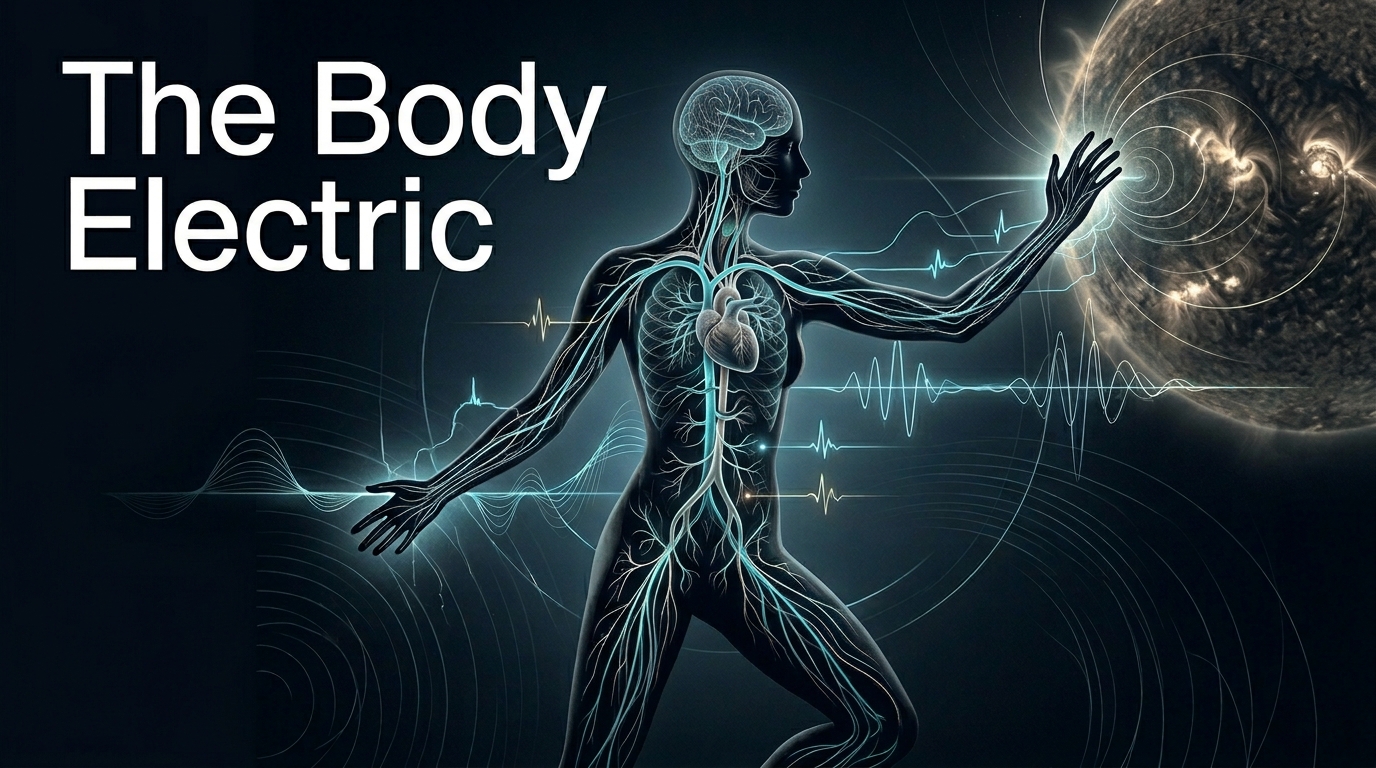
And in that instant—that first breath—your heart performed its Motor ID Run. It reached out with its own magnetic field and took its first independent measurement of the environment: the state of the solar wind, the disturbance level of Earth's magnetic field, the electromagnetic weather of the entire heliosphere at that specific minute.
And it locked the parameters.
This is not a metaphor. In the ethmoid bone of your skull you carry millions of microscopic ferrous crystals called biogenic magnetite—the same crystals birds navigate by. For nine months they floated behind your mother's shield. At birth, the shield drops, the raw field of the solar system hits them, and they physically torque into alignment. Simultaneously, the shock of the transition triggers DNA methylation—your body chemically tagging genes on or off based on the environment it just entered. Reading the room. Setting the switches. Saving the file.
That file is your natal chart.
This is the answer to the question that has embarrassed astrology for three millennia. Why does the exact minute matter? Because commissioning happens once. The parameter file locks at first breath, and the system runs on that calibration for the rest of its operational life. Not because Mars reached across space and touched you. Because you took a measurement of the entire electromagnetic environment—and wrote it down.
Your Commissioning Voltage
Now here is where this stops being philosophy and becomes something you can check.
If birth is an electrical commissioning, then the two most important numbers in your chart aren't symbols. They are measurements. And both were being recorded the day you were born.
The first is your solar cycle phase—where in the Sun's 11-year rhythm of storm and quiet your first breath landed. The second is your natal Kp baseline—the geomagnetic disturbance level of Earth's field around your birth date. Together, Electric Astrology computes them into your commissioning voltage: the electromagnetic weather your system was calibrated against when it locked its parameters.
- Tier 1 — Solar minimum, quiet field. A system tuned to low current.
- Tier 2 — Moderate activity, average field conditions.
- Tier 3 — Active phase, elevated field.
- Tier 4 — Solar maximum or storm conditions. A system tuned under peak load.
And the theory makes a prediction that no horoscope ever made—a specific, falsifiable, engineering-grade prediction. It does not say storms are bad for everyone. It says your system responds most acutely to conditions that deviate from its own calibration point. A Tier 1 nervous system, tuned in the quiet, should feel the storm hardest. A Tier 4 system, tuned in the fire, should feel the silence. Same sky. Different commissioning. Different response.
Your numbers are not lost. They are sitting in archives maintained by the Royal Observatory of Belgium (SILSO, sunspot records back to 1818) and the GFZ research centre in Potsdam (Kp records back to 1932). The charts below are those archives—the raw records, not interpretations. Drag the handles at the bottom of each chart and zoom to the year you were born.
Historical Field Records — Source Data
The Data Behind Your Commissioning Voltage
This is the actual archive — not a summary, not a chart generated from internal assumptions. SILSO sunspot records back to 1818. GFZ Potsdam Kp readings back to 1932. Your commissioning voltage was pulled directly from these datasets. Drag the handles at the bottom of each chart to zoom in.
Solar Activity — International Sunspot Number (SSN)
SILSO · Royal Observatory of Belgium · 1818–present
LOADING ARCHIVE…
Geomagnetic Activity — Kp Index (Daily Average)
GFZ Potsdam · Helmholtz Centre · 1932–present
LOADING ARCHIVE…
SSN v2.0 — SILSO, Royal Observatory of Belgium (1818–present) · Kp 3-hourly definitive — GFZ Potsdam / Helmholtz Centre (1932–present) · Data bundled locally; no third-party requests.
Find your birth year. See where you fell on the solar cycle. See whether the field was storming or quiet when you took your first breath. Those are your commissioning conditions. They have been sitting in those archives your entire life, and nobody ever told you to look—because until now, nobody had a reason to ask.
A Year of My Own Body Against the Theory
A theory that can't be tested is just a story. So I tested it on the only subject I had full access to: myself.
My Apple Watch has been collecting my biometrics continuously for years. I didn't track anything manually—the wearable did it in the background: heart rate variability, resting heart rate, sleep, steps, all of it, every day, silently accumulating in HealthKit.
In parallel, I was building everything else. The theory. The commissioning voltage model. The PLC platform that tracks live Kp readings, solar activity, lunar phase, and planetary transit and natal chart activation scores. And the mobile app that would eventually be able to pull the HealthKit data and actually run the correlations.
That last piece was the bottleneck. The data existed. The theory existed. The question was whether I could build the pipeline to connect them. When the mobile app finally matured enough to ingest and parse the HealthKit archive, that is when the science became possible. Not before.
What you are reading is the result of that convergence—the first time the body data and the sky data and the theory were ever in the same room. 357 days of my biometrics against over a hundred tracked variables per day. Then I did the thing you're supposed to do and almost nobody does: I ran an independent statistical check against my own analysis, specifically to try to kill my own findings. You should never be the only one grading your own test—especially when you want the answer to come out a certain way.
This is not a clinical study. It is a first N=1 signal hunt, with all the humility that phrase requires. Here is what survived.
Most of it was flat. Raw Kp correlated with my HRV at r ≈ 0.002. That is statistically indistinguishable from noise. The popular claim—“space weather stresses your body”—is not supported by this dataset when you ignore the natal calibration layer. Without the commissioning baseline, I found almost nothing.
That is where I almost asked the wrong question.
The theory does not predict that my body should hate all geomagnetic activity. I was not born into a quiet field. My commissioning conditions were Solar Cycle 21, descending phase, approximately 47 months after the December 1979 cycle maximum. Birth Kp average: 4.0—active, but not storming. Birth-day Kp maximum: 5.33. Smoothed sunspot number: 89.7. That is my calibration point. The electromagnetic weather my system came online inside.
So the better test is not: does high Kp lower my HRV? The better test is: what happens when the field moves meaningfully away from my own commissioning baseline? In this first dataset, the most interesting bucket was the small set of days where Kp maximum rose more than one full point above my birth-day maximum—genuine G2-and-above territory, above the active field I was born under.
Exploratory Signal — N=1 Study, 357 Days
≈4-5 ms lower HRV
on the small set of days Kp rose more than 1.0 above my birth-day maximum
Suggestive, not confirmatory; needs replication
That is not proof. The sample is small, the sleep controls are imperfect, and I tested many possible variables. A p-value from an exploratory pass should not be treated like a verdict from a preregistered trial. But it is the right shape of a finding. Not a generic storm-to-stress correlation. A deviation-from-commissioning-baseline response—exactly the kind of pattern the theory says should matter, and exactly the kind of pattern that disappears when you look at raw Kp alone without the natal calibration layer.
The outer-planet transit score also looked directionally interesting in the unadjusted data: lower-pressure windows tended to sit above my rolling HRV baseline, while higher-pressure windows tended to sit below it. But that relationship weakened under controls, so I do not want to overbuild on it yet. For now, I treat it as a secondary hypothesis to keep tracking, not a headline result.
The solar layer remains an open hypothesis. Nearly every day in my biometric window sits above my natal SSN of 89.7. We are in Solar Cycle 25, near maximum. The quiet-sun adversity prediction cannot be tested until solar minimum arrives. That data is years away.
The Question the Astrology Debate Keeps Missing
Here is the problem with every study that asks whether geomagnetic activity affects human health.
They treat every human system as identically calibrated from birth.
They are not. Averaging across everyone without accounting for natal baseline is like measuring how 200 different amplifiers respond to the same input signal without noting that each was tuned to a different gain setting. You will find weak, inconsistent results—not because the signal isn't there, but because you never accounted for each instrument's zero line.
The testable question is not “does geomagnetic activity affect HRV?”
The testable question is: “does geomagnetic activity that deviates from a person's natal commissioning baseline affect their HRV?”
Those are different experiments. Only the second one treats the birth moment as the reference parameter. Without it, you are attempting to detect a signal without knowing where each person's zero line sits.
This is the mechanism the “why does birth time matter?” question has always needed. Not mysticism. Not tradition. A calibration point—one that has been sitting in the historical archives the whole time.
The Instrument Needs More Nodes
One person is not a study. One person is a prototype.
Here is what happens next, and this is the part I have been building toward for years. The apparent signal needs to replicate across different people, different commissioning tiers, different birth environments. If the theory holds, a Tier 1 birth (solar minimum, quiet field) should show a measurably different physiological signature under G2 storm conditions than a Tier 4 birth (solar maximum, active field). Same storm. Different calibrations. Different bodies. Different responses. That prediction cannot be tested by one man and one watch. It needs an array.
In radio astronomy, when a single antenna isn't sensitive enough to resolve a faint signal, you don't build a bigger antenna. You build a phased array—hundreds of small antennas whose signals combine into an instrument more powerful than any single dish could ever be. That is exactly what this project is building, except the antennas are people. Your wearable is already collecting the data—silently, passively, right now, the same way mine was. The Biological Phased Array is the citizen-science instrument that connects it: your biometrics, your natal chart, and your commissioning conditions, aggregated across the network into the experiment no laboratory has ever run.
The mobile app that made my own analysis possible is the same app that will make yours possible. It is in development now, and it is close. When it ships, you will be able to do exactly what I did—hold your own body's data up against the sky and look—except you won't have to build the pipeline first. I already did that part.
My first year of data says the signal is not where the simple version of the theory predicted. But it is somewhere. And finding it is not going to be the work of one node.
The Moment You Powered On
Go back up to those charts and find your birth year.
See where you landed on the solar cycle. See whether the field was storming or quiet the day your parameters locked. You are not reading a horoscope when you do that. You are reading the site conditions from the day your system was commissioned—the same way I'd read the as-built drawings on a job that was finished before I ever walked in the door. The record is there. It was always there.
Somewhere in a delivery room, decades ago, a cord was cut, a ground was lifted, a tiny generator shuddered in Island Mode—and then caught. You took your first measurement of the universe and you wrote it down in crystal and chromatin. You have been carrying that file your whole life.
The birth chart is not a sentence. It is not a cage. It is not a personality meme. It is the parameter file that was saved the moment you were commissioned—the field conditions at first breath, the baseline against which everything else is measured. That is why the birth minute matters. Not because the sky decided who you are. Because you measured the sky, once, perfectly, and never stopped running on what you found.
Enter the Electric Astrology platform and find your commissioning conditions.