Robins lost their magnetic compass in a city’s electromagnetic noise and found it again inside grounded, screened huts
In double-blinded tests, migratory robins on a university campus could not use their magnetic compass in the background electromagnetic noise, and could again once that noise was screened out.
The short version
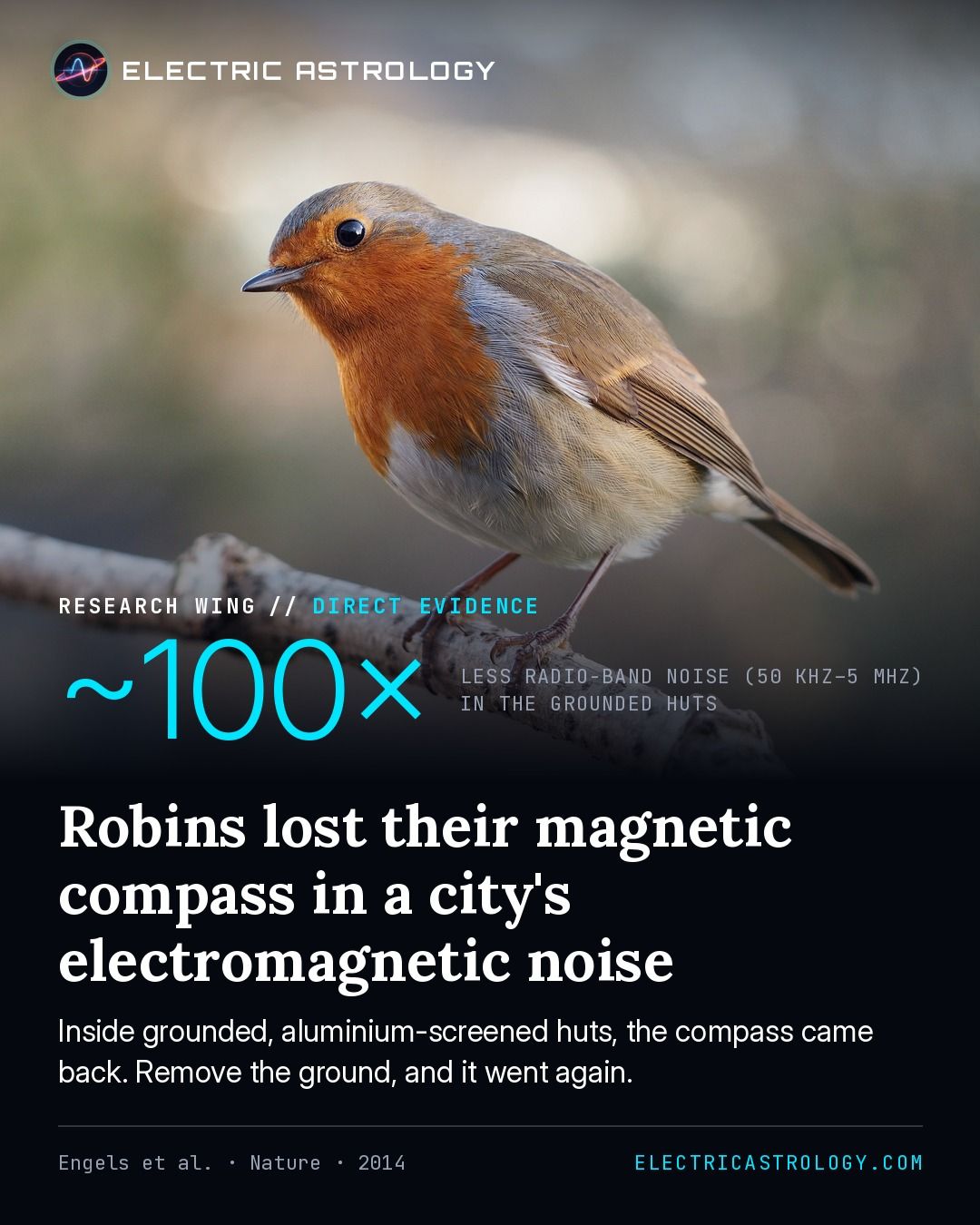
Migratory robins tested on a university campus in Oldenburg, Germany could not orient with their magnetic compass. Inside wooden huts screened with grounded aluminium, which cut the background electromagnetic noise about a hundredfold, they could.
Disconnecting the ground, or adding noise inside the screened huts, took the compass away again. Robins tested in the countryside needed no screen at all.
~100×
Cut in electromagnetic noise from 50 kHz to 5 MHz inside the grounded, aluminium-screened huts: “approximately two orders of magnitude”.
The paper
Anthropogenic electromagnetic noise disrupts magnetic compass orientation in a migratory bird
Engels, S., Schneider, N.-L., Lefeldt, N., Hein, C. M., Zapka, M., Michalik, A., et al. (2014). Anthropogenic electromagnetic noise disrupts magnetic compass orientation in a migratory bird. Nature, 509(7500), 353–356.
Checked against the paper’s abstract on November 13, 2026.
What they measured
Migratory European robins (Erithacus rubecula) were tested for magnetic compass orientation in wooden huts on the University of Oldenburg campus in Germany, with and without electrically grounded aluminium screening, which cut electromagnetic noise between 50 kHz and 5 MHz by about two orders of magnitude.
The team also removed the grounding, deliberately generated broadband electromagnetic noise inside the screened huts, and tested birds at a rural site. The tests were fully double-blinded.
What they found
In the unscreened huts the robins could not orient using their magnetic compass. Inside the grounded, screened huts their magnetic orientation came back.
When the grounding was removed, or broadband noise was generated inside the screened huts, the birds lost their magnetic orientation again. The effect was not confined to a narrow frequency band.
Birds tested far from sources of electromagnetic noise oriented with their magnetic compass without any screening.
The authors conclude the tests document a reproducible effect of human-made electromagnetic noise on the behaviour of an intact vertebrate.
How it bears on the hypothesis
Direct evidenceMeasures the body (or a living thing) changing with the Sun, the sky or Earth’s field.
Electric Astrology treats the body as a receiver tuned to Earth’s field. A receiver can be jammed, and this paper shows both halves in a living animal: a compass that reads Earth’s field, lost in everyday electromagnetic noise and restored when the noise is screened out.
Grounding was the switch. Connecting and disconnecting the screen’s ground turned the birds’ magnetic orientation on and off.