Human brain tissue holds magnetite, probably made by the body: at least 5 million crystals per gram
With an ultra-sensitive magnetometer in a clean lab, the authors found magnetite crystals in human brain tissue, probably made by the body, and far more in the membranes around the brain.
The short version
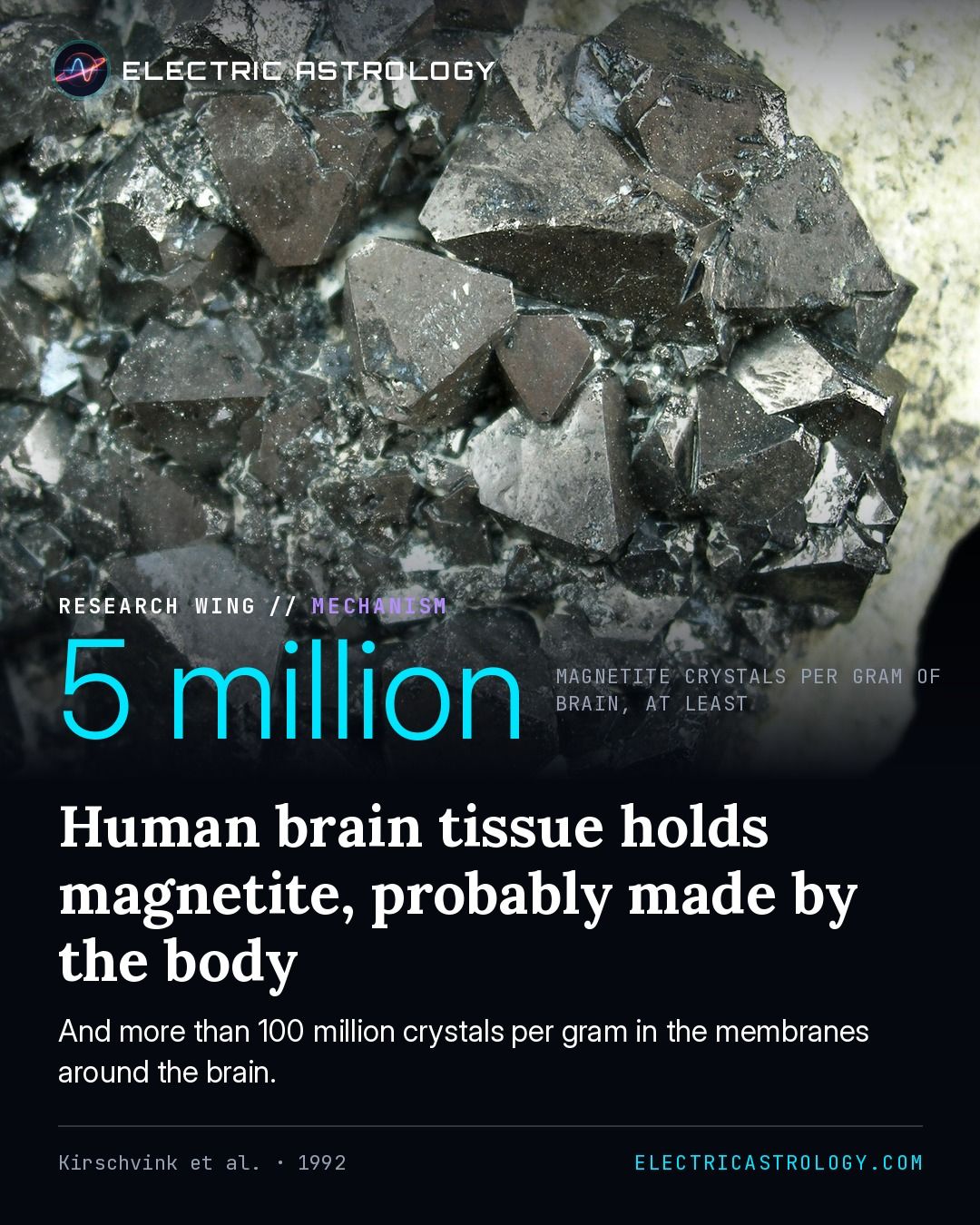
Using an ultra-sensitive magnetometer in a clean lab, researchers found magnetite, a magnetic iron oxide, in human brain tissue: at least 5 million crystals per gram, and more than 100 million per gram in the membranes around the brain.
Their shapes closely matched crystals made by bacteria and fish, and they lacked the titanium-bearing oxides usual in magnetite formed in rock, so they are probably made by the body. What they do there is still unknown.
5 million
Minimum magnetite crystals per gram of brain tissue, in 50,000 to 100,000 clusters. The meninges hold more than 100 million per gram.
The paper
Magnetite biomineralization in the human brain
Kirschvink, J. L., Kobayashi-Kirschvink, A., Woodford, B. J. (1992). Magnetite biomineralization in the human brain. Proceedings of the National Academy of Sciences, 89(16), 7683–7687.
Checked against the paper’s full text on November 9, 2026.
What they measured
Brain tissue from seven people (average age 65, range 48 to 88) was obtained 12 to 24 hours after death from the Alzheimer’s Disease Research Center Consortium of Southern California. Samples were measured with a SQUID (superconducting quantum interference device) magnetometer in a magnetically shielded, dust-free clean lab, with blank and spiked control samples run alongside.
Magnetic extracts were then examined by transmission electron microscopy, and 70 crystals were measured for size.
What they found
Brain tissue held the equivalent of about 4 ng of magnetite per gram; the meninges, the membranes around the brain, held nearly 20 times more, about 70 ng/g. The lab’s background was about 0.5 ng/g.
Most crystals (62 of the 70) were 10 to 70 nm across, averaging 33.4 nm. The authors estimate at least 5 million crystals per gram of brain tissue and at least 100 million per gram in the meninges.
The crystals lacked the iron-titanium oxides usually present in magnetite formed in rock, so they probably form inside the body by a biologically controlled process. They are spread through the cerebral lobes, cerebellum, basal ganglia and midbrain, and the larger crystals (up to 600 nm) have a magnetic orientation energy in Earth’s field 20 to 150 times the background thermal energy.
How it bears on the hypothesis
MechanismShows a working part of the circuit: a receiver in the body, a current in space, a field that couples them.
A field can only act on a body that has something for it to act on. This paper found a ferromagnetic material in the human brain, probably made by the body, with its larger crystals’ energy in Earth’s field 20 to 150 times the thermal noise. It is the hardware the human-antenna idea rests on.
The authors suggest the particles may account for some of the biological effects of low-frequency magnetic fields.
The authors’ own caution: The authors note that extracting the particles destroyed the cells around them, so where they sit and what they do could not be seen.