Magnetic particles concentrate toward the brain stem and cerebellum, a pattern that points to an origin inside the body
Measuring 822 pieces of seven human brains in a shielded room, the team found magnetic particles in all seven, concentrated toward the cerebellum and brain stem.
The short version
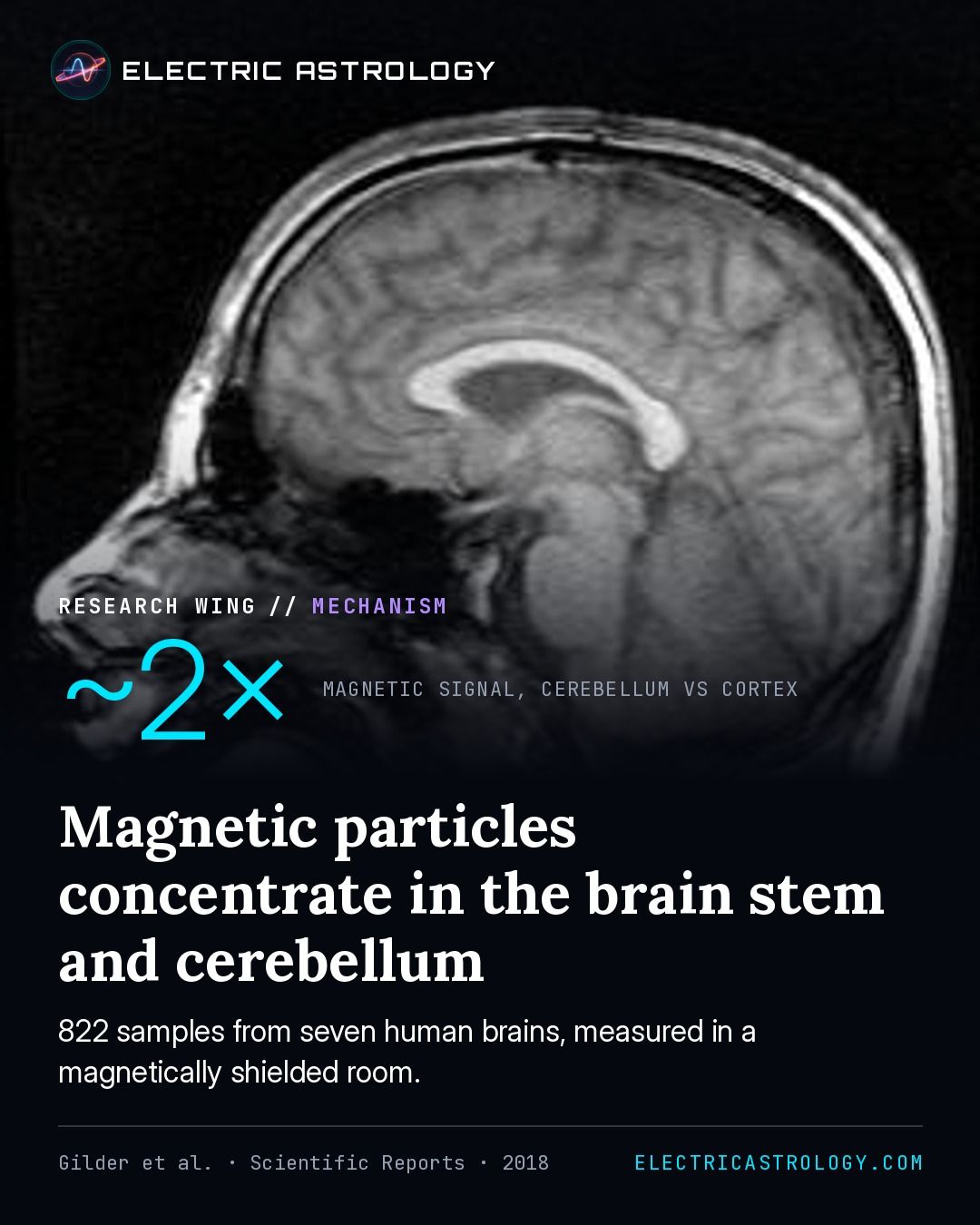
A team measured 822 pieces of seven human brains in a magnetically shielded room. All seven held magnetic particles: about twice as much in the cerebellum as in the cerebral cortex, and more still in the brain stem.
The authors say the pattern seems to support a mostly internal origin for the particles, and that what magnetite does in humans is still unclear.
~2×
Magnetic remanence in the cerebellum against the cerebral cortex, in all seven brains (p = 0.016).
The paper
Distribution of magnetic remanence carriers in the human brain
Gilder, S. A., Wack, M., Kaub, L., Roud, S. C., Petersen, N., Heinsen, H., et al. (2018). Distribution of magnetic remanence carriers in the human brain. Scientific Reports, 8(1), 11363.
Checked against the paper’s full text on November 9, 2026.
What they measured
The team measured 822 specimens from seven whole human brains (three women and four men, aged 54 to 87), collected between 1991 and 1995 in Germany. Each specimen was given a brief 0.8 tesla pulse, and its remanent magnetization was measured with a superconducting magnetometer in a magnetically shielded room in a forest northeast of Munich.
Remanent magnetization comes from ferromagnetic particles such as magnetite, so mapping it maps where those particles sit.
What they found
Median saturation remanence in the cerebellum was about twice that of the cerebral cortex in all seven brains (p = 0.016). The brain stem was higher still: 4.23 times the cortex using all the data, 2.38 times after a quality cut-off.
The olfactory bulb, pineal gland and choroid plexus measured more than ten times the cortex. No measurable remanence was found in the blood vessels.
The authors estimate about one part per billion of single-domain magnetite in brain tissue, on the order of a billion grains per kilogram, and say the pattern seems to support a predominantly internal origin.
How it bears on the hypothesis
MechanismShows a working part of the circuit: a receiver in the body, a current in space, a field that couples them.
Where the receiver sits matters. The brain stem and cerebellum run the body’s automatic systems, heartbeat, breathing and balance, below conscious thought. Magnetic material concentrated there, and in the pineal gland that times the body’s night, fits a body that responds to its magnetic environment without noticing, as the storm studies in this wing suggest.
The authors’ own caution: The authors note the brains were formalin-fixed, that cutting through the skull could have added magnetic contamination, and that what magnetite does in humans is still unclear.