Rotating an Earth-strength magnetic field made some people’s alpha brain waves drop by up to half
In a shielded chamber, rotating an Earth-strength magnetic field around people sitting in the dark made alpha brain waves drop sharply in some participants, though none of them could tell when it happened.
The short version
In a shielded, dark chamber, researchers rotated an Earth-strength magnetic field around people while recording their brain waves. In some participants, alpha waves dropped by about half within a second of certain rotations, then recovered. Others didn't respond. Afterwards, none of them could tell when, or if, the field had moved.
Four participants whose responses were significant on their own were tested again weeks or months later. Each one responded again.
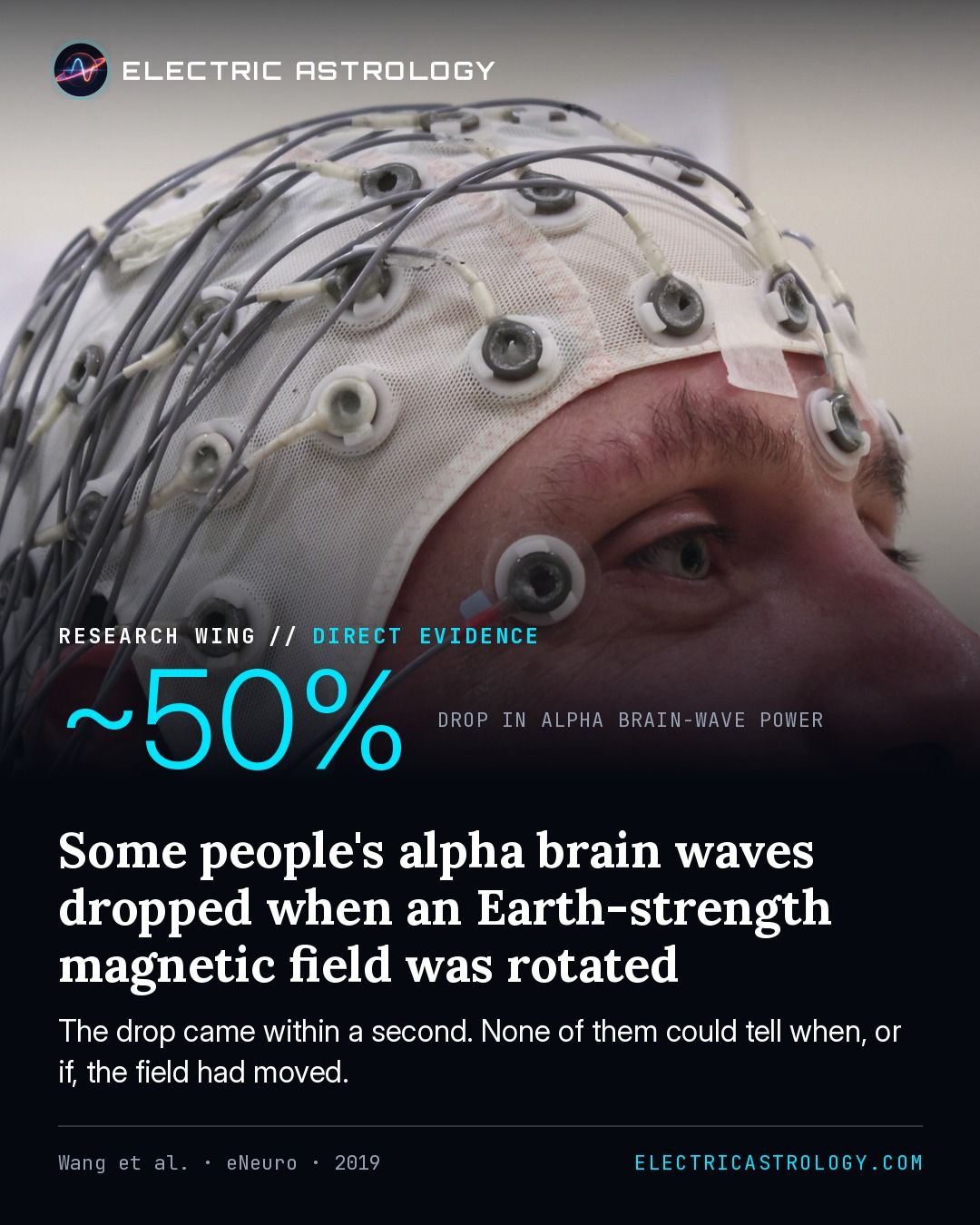
~50%
Drop of up to about 50% in alpha brain-wave power after the field rotated, starting about 100 milliseconds in and recovering within about a second.
The paper
Transduction of the Geomagnetic Field as Evidenced from alpha-Band Activity in the Human Brain
Wang, C. X., Hilburn, I. A., Wu, D.-A., Mizuhara, Y., Cousté, C. P., Abrahams, J. N. H., et al. (2019). Transduction of the Geomagnetic Field as Evidenced from alpha-Band Activity in the Human Brain. eNeuro, 6(2), ENEURO.0483-18.2019.
Checked against the paper’s full text on November 9, 2026.
What they measured
Thirty-six adult volunteers from the Caltech community, aged 18 to 68, sat with eyes closed in total darkness inside a radio-frequency-shielded chamber wrapped in three sets of coils. The coils rotated the magnetic field between two directions, holding it near the lab’s ambient strength (about 35 µT), while 64 EEG electrodes recorded brain activity.
Participants did not know when the field moved, or whether the coils were active or in a sham mode that ran the same currents with no field outside. A cantaloupe and a bucket of salt water stood in for a head as further controls.
What they found
After certain rotations, alpha-band power began to fall about 100 ms after the stimulus, by as much as about 50% over several hundred milliseconds, then recovered within about one second. Some participants dropped by up to about 60%; others did not respond.
Rotations of the field’s inclination produced a response about twice the background, and counter-clockwise rotations about three times the clockwise ones (p < 0.001). The sham runs, the cantaloupe and the salt-water bucket showed no such response.
In the 16 people tested with the field pointing upward, as it does in the Southern Hemisphere, the same rotations produced no response; all lived in the Northern Hemisphere. Four participants with individually significant responses were retested weeks or months later, and each repeated the response. The authors conclude that at least some modern humans transduce changes in Earth-strength magnetic fields into an active neural response.
How it bears on the hypothesis
Direct evidenceMeasures the body (or a living thing) changing with the Sun, the sky or Earth’s field.
The hypothesis needs a receiver: something in the body that registers Earth’s field. This is the most direct evidence yet that the human brain registers it, below awareness, at the strength we live in every day.
The authors point to a ferromagnetic receiver, magnetite, which the human brain is known to contain (see Kirschvink 1992 and Gilder 2018 in this wing).
The authors’ own caution: The authors note participants could not tell when the field changed, and that the function of the brain response is still unknown.