Mutations in one potassium-channel gene change heart rhythm, muscle strength and the shape of the face
Mapping a rare syndrome of periodic paralysis, heart rhythm problems and distinctive facial features, the team found its cause in a gene for a potassium channel.
The short version
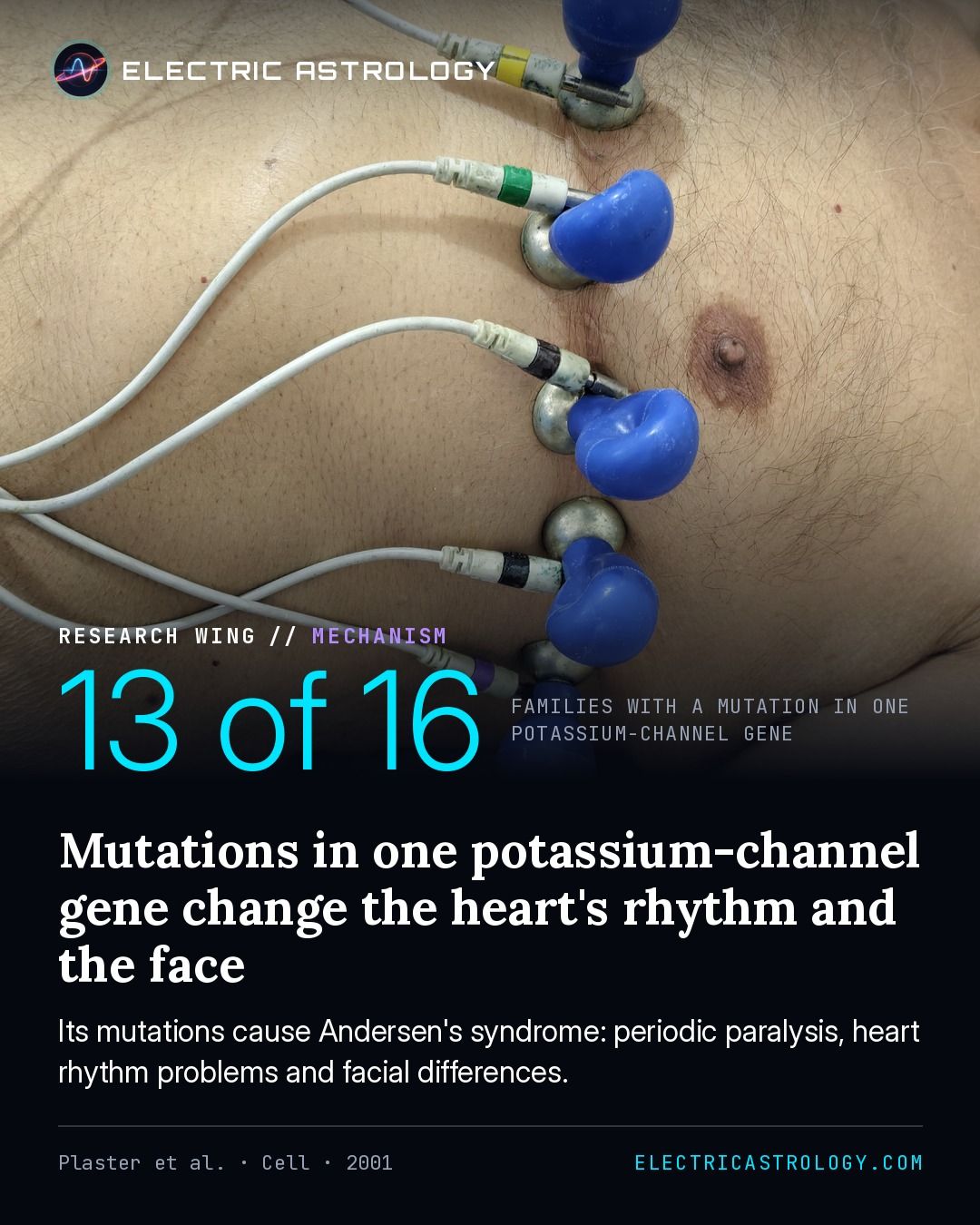
Andersen's syndrome brings episodes of muscle weakness, heart rhythm problems and distinctive features such as wide-set eyes, low-set ears and a small chin. In 2001 researchers traced it to KCNJ2, the gene for a potassium channel that helps set the electrical state of heart and muscle cells. They found mutations in 13 of 16 families.
The authors suggest the channel has an important role in development as well as in the heartbeat.
13 of 16
Families with Andersen’s syndrome in which the team found a mutation in KCNJ2 (9 different mutations).
The paper
Mutations in Kir2.1 Cause the Developmental and Episodic Electrical Phenotypes of Andersen’s Syndrome
Plaster, N. M., Tawil, R., Tristani-Firouzi, M., Canún, S., Bendahhou, S., Tsunoda, A., et al. (2001). Mutations in Kir2.1 Cause the Developmental and Episodic Electrical Phenotypes of Andersen’s Syndrome. Cell, 105(4), 511–519.
Checked against the paper’s full text on November 13, 2026.
What they measured
The team studied 16 unrelated families with Andersen’s syndrome, a rare disorder of episodes of muscle weakness, heart rhythm problems and developmental features such as short stature, wide-set eyes, low-set ears and a small chin. A clinician blinded to the genetic results classified who was affected.
They mapped the disease in one large family with about 400 genetic markers, then searched the candidate gene KCNJ2 in the other families. Two of the mutations were tested in frog eggs to measure the channel’s current.
What they found
The syndrome mapped to chromosome 17q23, near KCNJ2, the gene for the inward-rectifier potassium channel Kir2.1. A mutation, D71V, was in every affected member of the first family and in no unaffected member or in 100 unrelated controls.
In all, nine mutations were found in 13 of the 16 families; at least three arose new in the patient.
In frog eggs, normal channels passed −4.61 µA at −150 mV; with the D71V mutant added, current fell to −0.26 µA, suggesting one mutant subunit is enough to knock out the channel.
The authors conclude that Kir2.1 mutations cause Andersen’s syndrome, and suggest that the channel plays an important role in developmental signalling as well as in the excitability of heart and muscle.
How it bears on the hypothesis
MechanismShows a working part of the circuit: a receiver in the body, a current in space, a field that couples them.
The same electrical part that helps set the rhythm of the heart is also involved in shaping the face. In people, a fault in one potassium channel shows up both in the body’s electrical timing and in its form.
The paper does not show how the channel shapes the face; later frog-embryo work traced voltage patterns of the face itself (see Vandenberg 2011 in this wing).
The authors’ own caution: The authors say whether Kir2.1 is expressed early enough to shape the face and bones was still being investigated, and that the syndrome is probably heterogeneous: three families had no mutation in the gene.
On Electric Astrology
More on: Is the body’s shape stored in voltage?
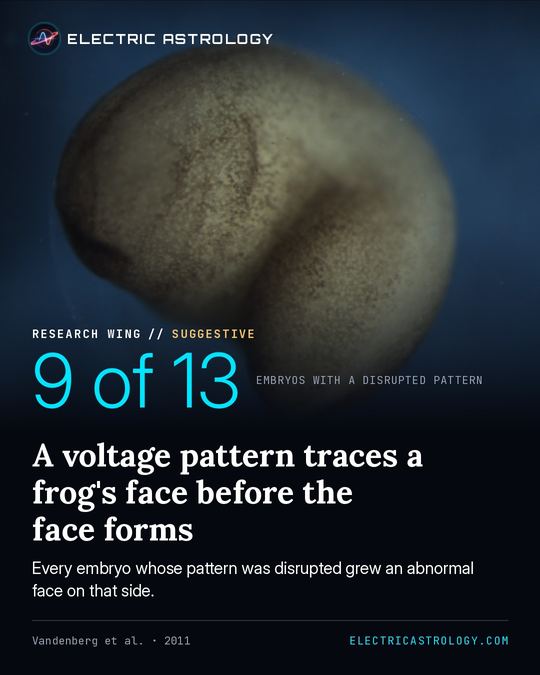 A voltage pattern traces a frog's face before the face formsVandenberg et al. · 2011 · Developmental Dynamics
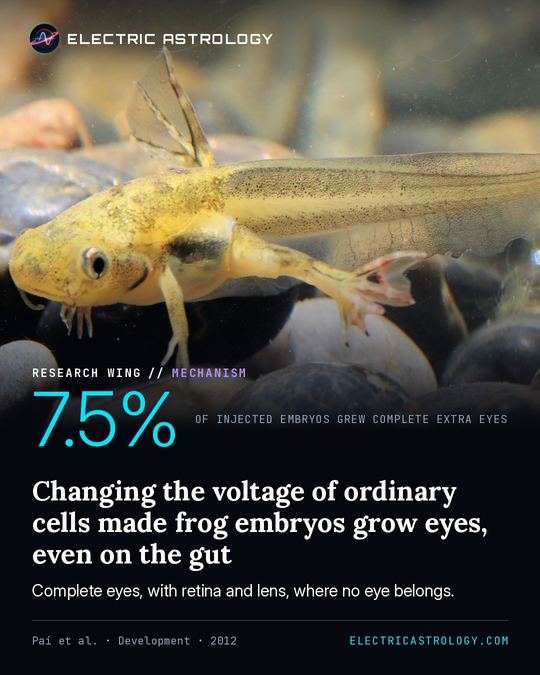 Changing the voltage of ordinary cells made frog embryos grow eyes, even on the gutPai et al. · 2012 · Development
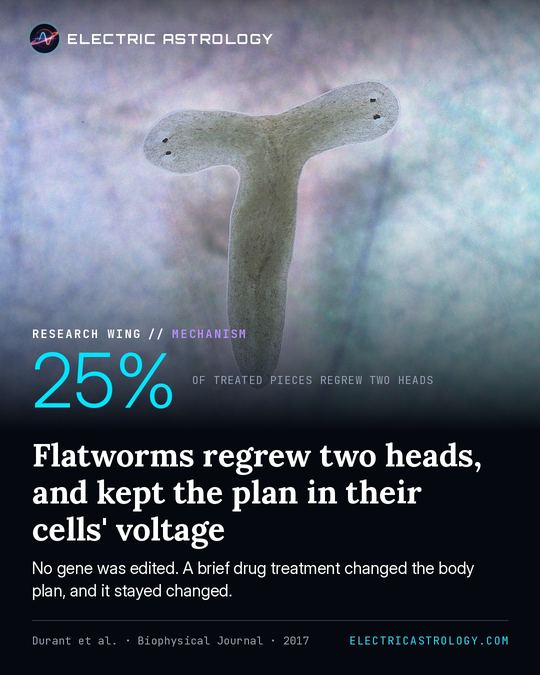 Flatworms regrew two heads, and kept the plan in their cells' voltageDurant et al. · 2017 · Biophysical Journal