A pattern of voltage and pH traces a frog’s face on the embryo before the face forms
Filming frog embryos with voltage-reporting dyes, a Tufts team saw patterns of membrane voltage and pH that mark where the face will form, before it does.
The short version
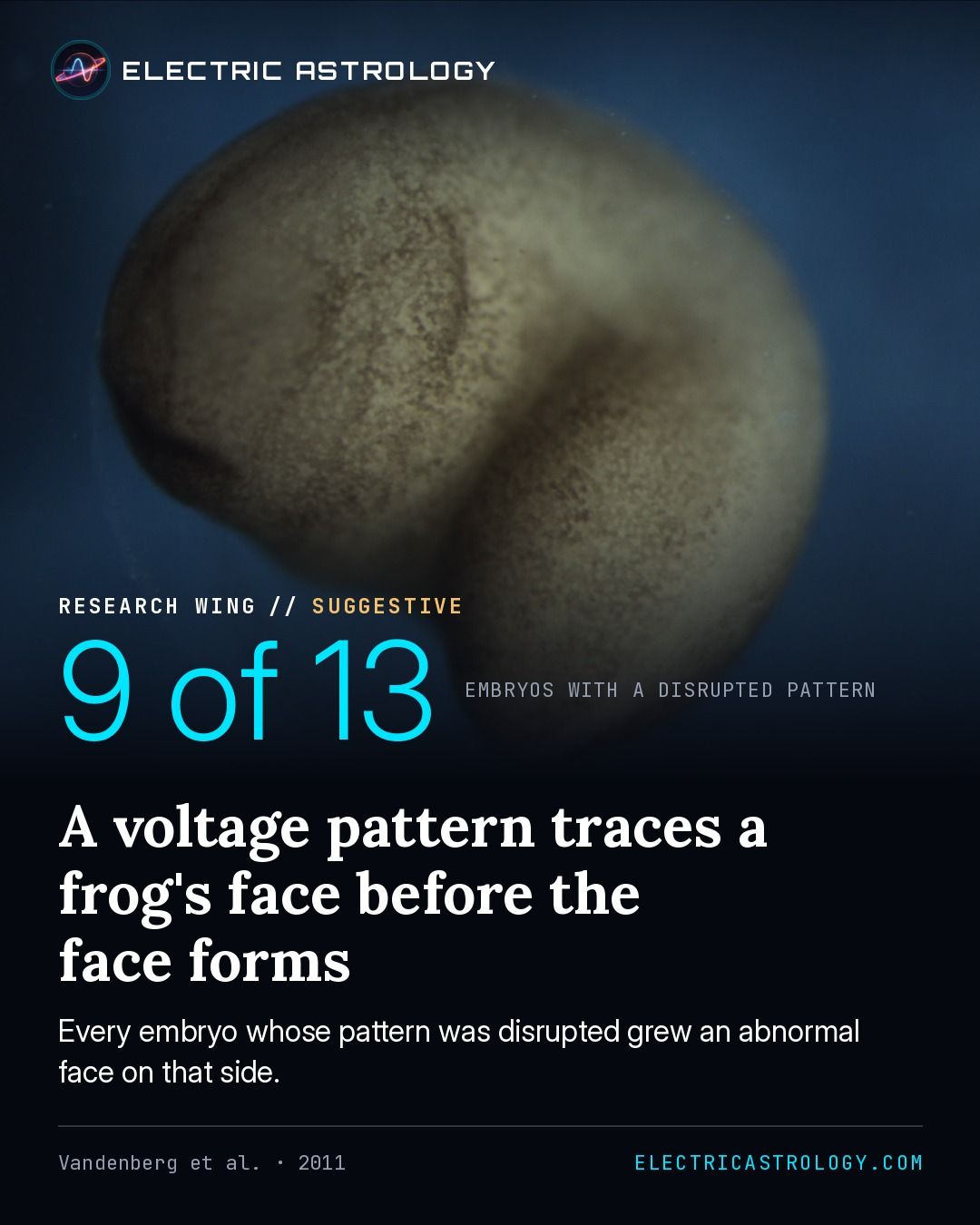
Researchers filmed frog embryos with voltage-reporting dyes. Before the face formed, patterns of voltage and pH appeared on the embryo's surface, marking where the mouth, nose and eyes would develop.
When they blocked a proton pump, the patterns were disrupted in 9 of 13 embryos, and every embryo with a disrupted pattern grew an abnormal face on that side.
9 of 13
Embryos whose voltage and pH patterns were disrupted. Every one developed an abnormal face on the disrupted side.
The paper
V-ATPase-dependent ectodermal voltage and pH regionalization are required for craniofacial morphogenesis
Vandenberg, L. N., Morrie, R. D., Adams, D. S. (2011). V-ATPase-dependent ectodermal voltage and pH regionalization are required for craniofacial morphogenesis. Developmental Dynamics, 240(8), 1889–1904.
Checked against the paper’s full text on November 13, 2026.
What they measured
Laura Vandenberg, Ryan Morrie and Dany Spencer Adams soaked embryos of the frog Xenopus laevis in a pair of voltage-reporting dyes and filmed the surface layer through development, in time-lapses up to 18 hours long.
They then blocked the proton pump H+-V-ATPase, with a mutant pump protein injected as mRNA or the inhibitor concanamycin, and scored the tadpoles for 14 kinds of face defect.
What they found
Patterns appeared that match the shape changes and gene-expression domains of the developing face. More negative (hyperpolarized) regions marked the future mouth, the nose (olfactory placode), the first pharyngeal fold and the eye field, before those tissues folded.
Blocking the pump caused face abnormalities: 28% of embryos injected with the mutant pump protein against 3% of controls (P < 0.001). It also disrupted the voltage patterns and the expression of head-patterning genes including pax6, sox9 and otx2.
In 9 of 13 injected embryos examined, the voltage and pH patterns were disrupted, and in every embryo with a disrupted pattern, that side later developed an abnormal face. The drug caused face defects when given between stages 13 and 16, as the neural plate and folds form.
The authors conclude this bioelectric signal has a role in development of the face.
How it bears on the hypothesis
SuggestivePoints the same way, from a smaller study or a proposed mechanism still being tested.
Before a single facial feature forms, its outline is there as a pattern of charge on the embryo’s surface, and breaking that pattern breaks the face. It suggests the body’s form is laid out electrically before it is built in tissue.
The authors’ own caution: The authors call the evidence that these voltage compartments guide the shape changes suggestive. A protein that changes pH but not voltage caused the same face defects, so pH is implicated as well as voltage.
On Electric Astrology
More on: Is the body’s shape stored in voltage?
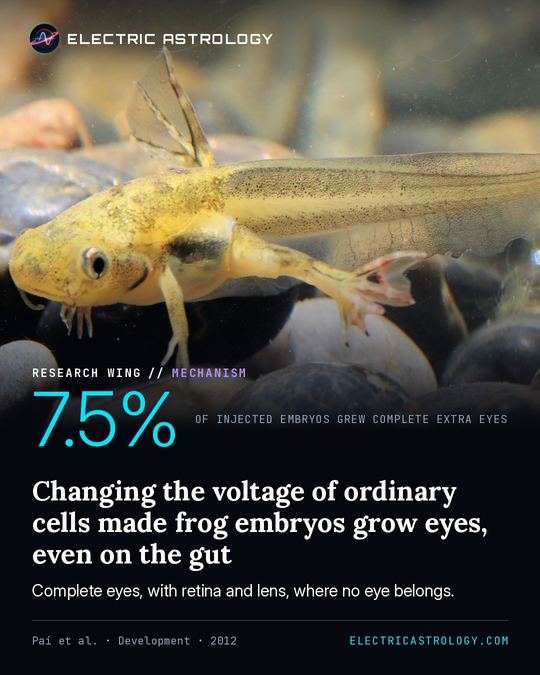 Changing the voltage of ordinary cells made frog embryos grow eyes, even on the gutPai et al. · 2012 · Development
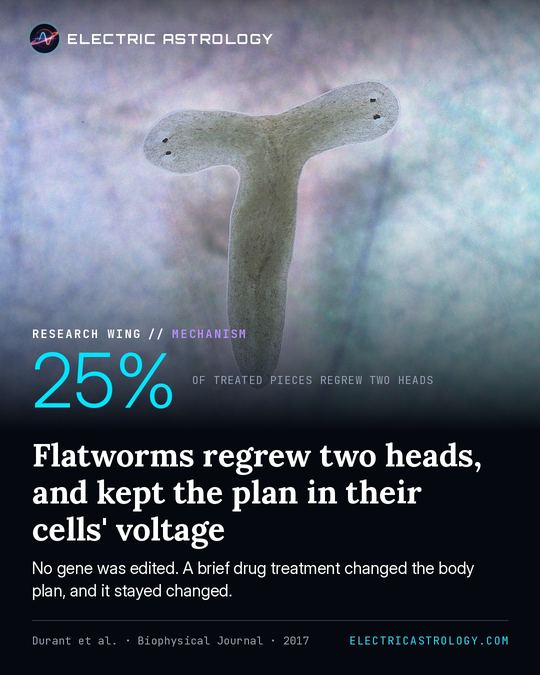 Flatworms regrew two heads, and kept the plan in their cells' voltageDurant et al. · 2017 · Biophysical Journal
 Mutations in one potassium-channel gene change the heart's rhythm and the facePlaster et al. · 2001 · Cell