A brief drug treatment made flatworms regrow two heads, and the plan stayed stored in their voltage
Briefly blocking the electrical links between a flatworm’s cells changed the body plan its pieces regrow to, and the change persisted, stored in the pattern of cell voltages.
The short version
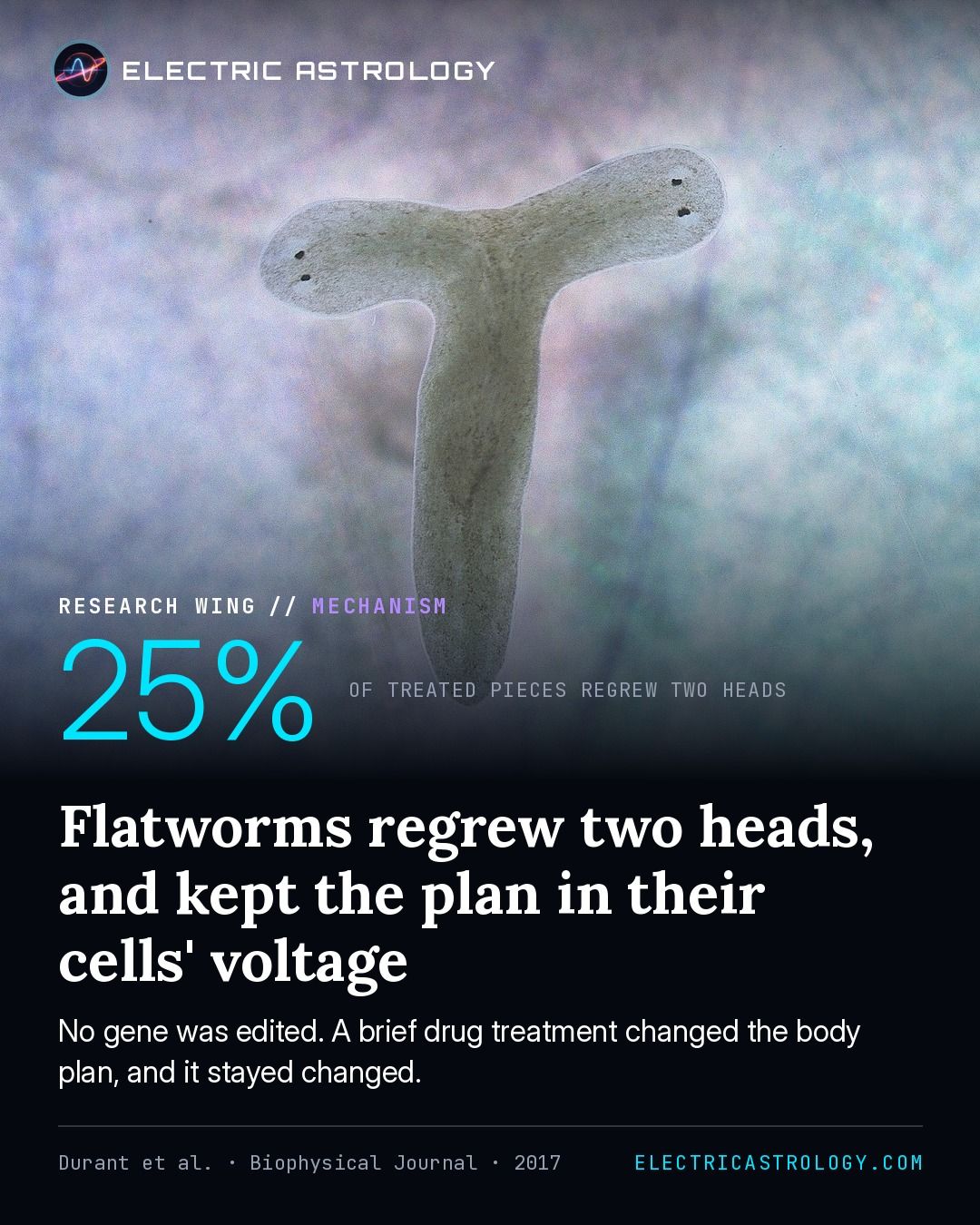
Researchers cut flatworms and briefly blocked the electrical links between their cells. A quarter of the pieces regrew with a head at each end, and kept regrowing two heads every time they were cut again.
Most of the rest looked normal. Cut again weeks later, nearly a quarter of those grew two heads: the plan had been held in the voltage of their cells. Making their cells more negative returned a third of the two-headed worms to one head.
25%
Trunk fragments that regrew two heads after octanol, a gap-junction blocker (N = 573). 72% looked normal; cut again, 23% of those regrew two heads.
The paper
Long-Term, Stochastic Editing of Regenerative Anatomy via Targeting Endogenous Bioelectric Gradients
Durant, F., Morokuma, J., Fields, C., Williams, K., Adams, D. S., Levin, M. (2017). Long-Term, Stochastic Editing of Regenerative Anatomy via Targeting Endogenous Bioelectric Gradients. Biophysical Journal, 112(10), 2231–2243.
Checked against the paper’s full text on November 13, 2026.
What they measured
Fallon Durant and colleagues in Michael Levin’s lab cut planarian flatworms (Dugesia japonica) and, within 30 minutes, put the middle fragments in octanol, a drug that blocks gap junctions, the channels that link neighbouring cells electrically, replacing it daily for the first three days. Octanol washes out of worm tissue within 24 hours. The worms were scored at day 21 and cut again over later weeks.
Resting membrane voltage was mapped with a voltage-reporting dye, and a second drug, SCH-28080, was used to make the cells more negative.
What they found
Of the treated fragments, 25% regrew with a head at each end, 72% looked normal, and the rest formed eyeless shapes (Fig. 1A, N = 573). The two-headed form was permanent: cut again in plain water, two-headed worms regrew two heads every time (100%, N = 100).
The normal-looking worms carried a hidden plan. Cut again in plain water up to eight weeks later, 23% of them (N = 155) regrew as two-headed worms, though they showed no head-marker expression at the tail and their stem-cell density did not differ significantly from untreated worms.
Those hidden-plan worms that went on to grow two heads had all shown a region of relative depolarization at the tail end (p = 0.025).
Making two-headed worms’ cells more negative with SCH-28080 returned 34% of them (N = 102) to normal one-headed regrowth, persisting through at least four rounds of cutting. The authors conclude that bioelectric properties can stably override the body plan set by the genome.
How it bears on the hypothesis
MechanismShows a working part of the circuit: a receiver in the body, a current in space, a field that couples them.
The worms’ DNA was not edited, yet their body plan changed and stayed changed, and the new plan could be read in the voltage of their cells before any second head appeared.
That is the strongest version of the idea that form is held in an electrical pattern: a plan written in voltage, kept in memory, and rewritten by changing the voltage again.
The authors’ own caution: The authors note their voltage maps reach only the outer surface tissue, so which cells store the bioelectric state is still to be found, and that future studies might yet find gene differences they could not.
On Electric Astrology
More on: Is the body’s shape stored in voltage?
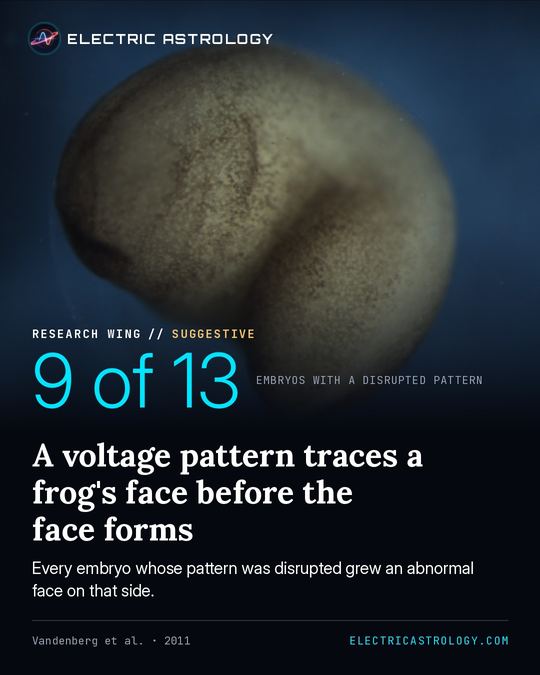 A voltage pattern traces a frog's face before the face formsVandenberg et al. · 2011 · Developmental Dynamics
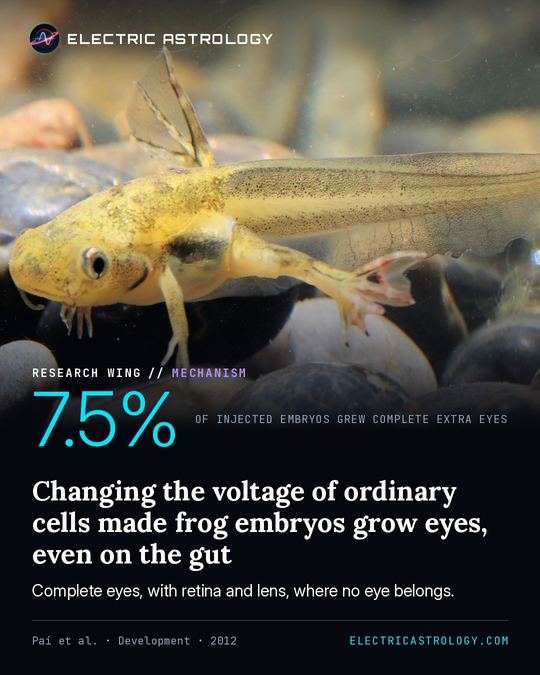 Changing the voltage of ordinary cells made frog embryos grow eyes, even on the gutPai et al. · 2012 · Development
 Mutations in one potassium-channel gene change the heart's rhythm and the facePlaster et al. · 2001 · Cell