Five months of heart recordings tracked cosmic rays, the Sun’s radio output and the Schumann resonance
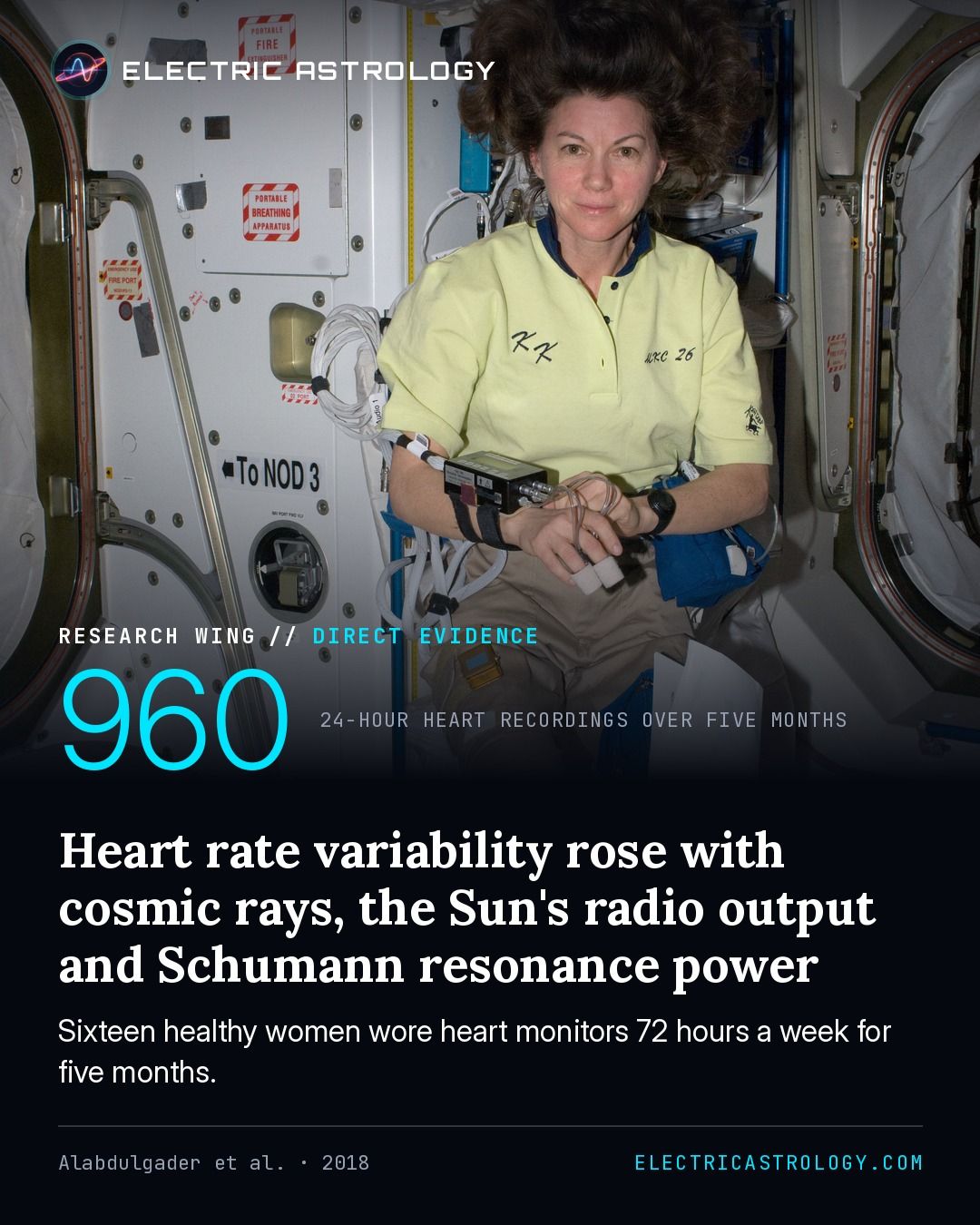
Sixteen healthy women wore heart monitors 72 hours a week for five months; their nervous-system rhythms rose and fell with cosmic rays, the Sun’s radio output and Schumann resonance power.
The short version
Sixteen healthy women wore heart monitors 72 hours a week for five months, and their heart rate variability was compared hour by hour with the space weather record. When cosmic rays, the Sun's radio output and Schumann resonance power rose, heart rate variability and rest-and-digest activity rose with them.
The authors note it is a correlation, and that different people respond differently.
960
Twenty-four-hour heart rate variability recordings, compared hour by hour with solar, cosmic-ray and geomagnetic measurements.
The paper
Long-Term Study of Heart Rate Variability Responses to Changes in the Solar and Geomagnetic Environment
Alabdulgader, A., McCraty, R., Atkinson, M., Dobyns, Y., Vainoras, A., Ragulskis, M., Stolc, V. (2018). Long-Term Study of Heart Rate Variability Responses to Changes in the Solar and Geomagnetic Environment. Scientific Reports, 8(1), 2663.
Checked against the paper’s full text on November 9, 2026.
What they measured
Sixteen healthy women on the staff of the Prince Sultan Cardiac Center in Hofuf, Saudi Arabia, aged 24 to 49, wore heart monitors for 72 consecutive hours each week from April 1 to August 31, 2012: 960 twenty-four-hour recordings of heart rate variability (HRV), the beat-to-beat variation that reflects the autonomic nervous system.
The team compared them with the solar wind, the Kp and Ap indices, solar radio flux (F10.7), cosmic-ray counts and, from a magnetometer in Boulder Creek, California, Schumann resonance power and ultra-low-frequency magnetic power. They removed daily rhythms from both sides, tested time lags from zero to 40 hours, and corrected for all 2,214 comparisons (Bonferroni).
What they found
Rises in cosmic rays, solar radio flux and Schumann resonance power were all associated with higher HRV and more parasympathetic (rest-and-digest) activity. Total HRV power and its low- and high-frequency bands responded quickly to cosmic rays and stayed correlated across the whole 40-hour window.
The strongest single result had p = 1.4 × 10⁻³², or 3.1 × 10⁻²⁹ after the correction for multiple comparisons.
The authors note relatively few magnetic disturbances in the five months, and HRV showed very few correlations with the geomagnetic indices: none with Kp, and the Ap index correlated with total, very-low- and low-frequency HRV power only at a nine-hour lag.
How it bears on the hypothesis
Direct evidenceMeasures the body (or a living thing) changing with the Sun, the sky or Earth’s field.
This is the body measured directly, 72 hours a week for five months, against the space environment. The autonomic nervous system responded to inputs that come from the Sun and from beyond it, and to the Schumann resonance, Earth’s own ringing cavity.
In the authors’ words, daily autonomic nervous system activity responds to changes in geomagnetic and solar activity.
The authors’ own caution: The authors note the study is correlational, and that different people respond differently to the same change in the environment.
On Electric Astrology
More on: Do geomagnetic storms affect the heart and circulation?
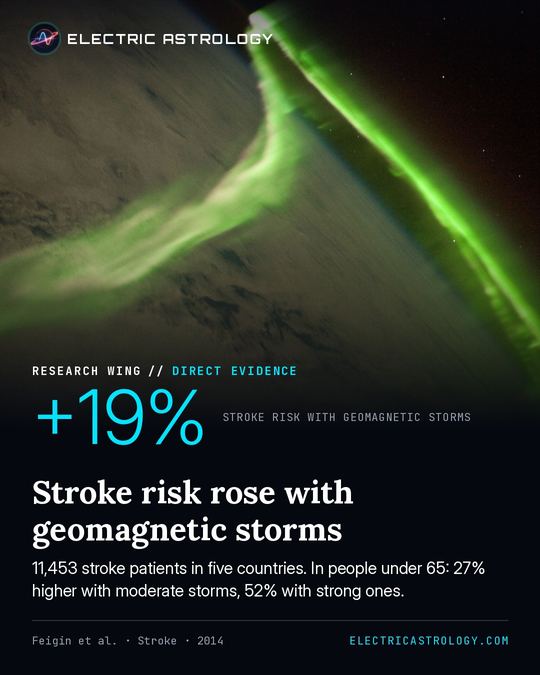 Stroke risk rose with geomagnetic stormsFeigin et al. · 2014 · Stroke
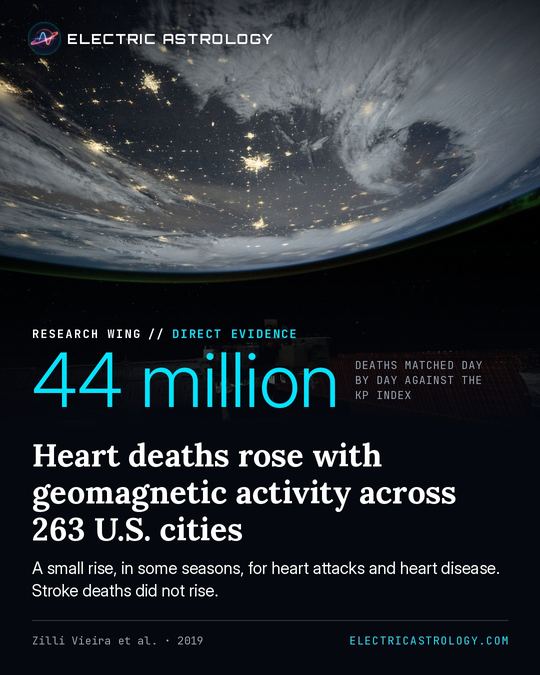 Heart deaths rose with geomagnetic activity across 263 U.S. citiesZilli Vieira et al. · 2019 · Environmental Health
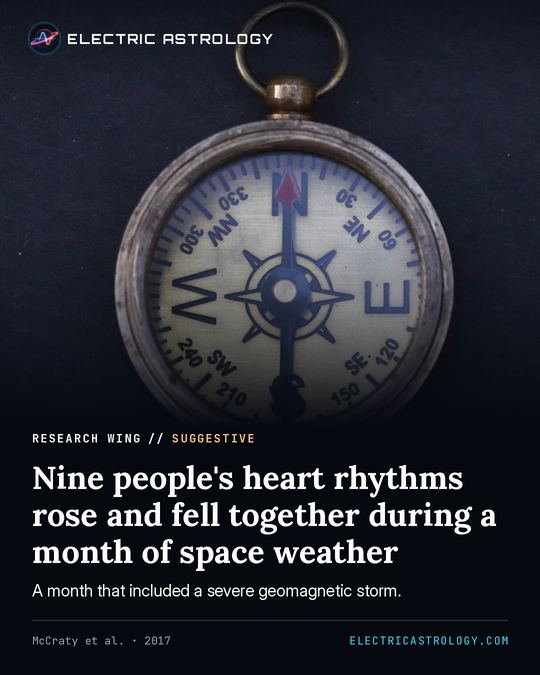 Nine people's heart rhythms rose and fell together during a month of space weatherMcCraty et al. · 2017 · International Journal of Environmental Research and Public Health