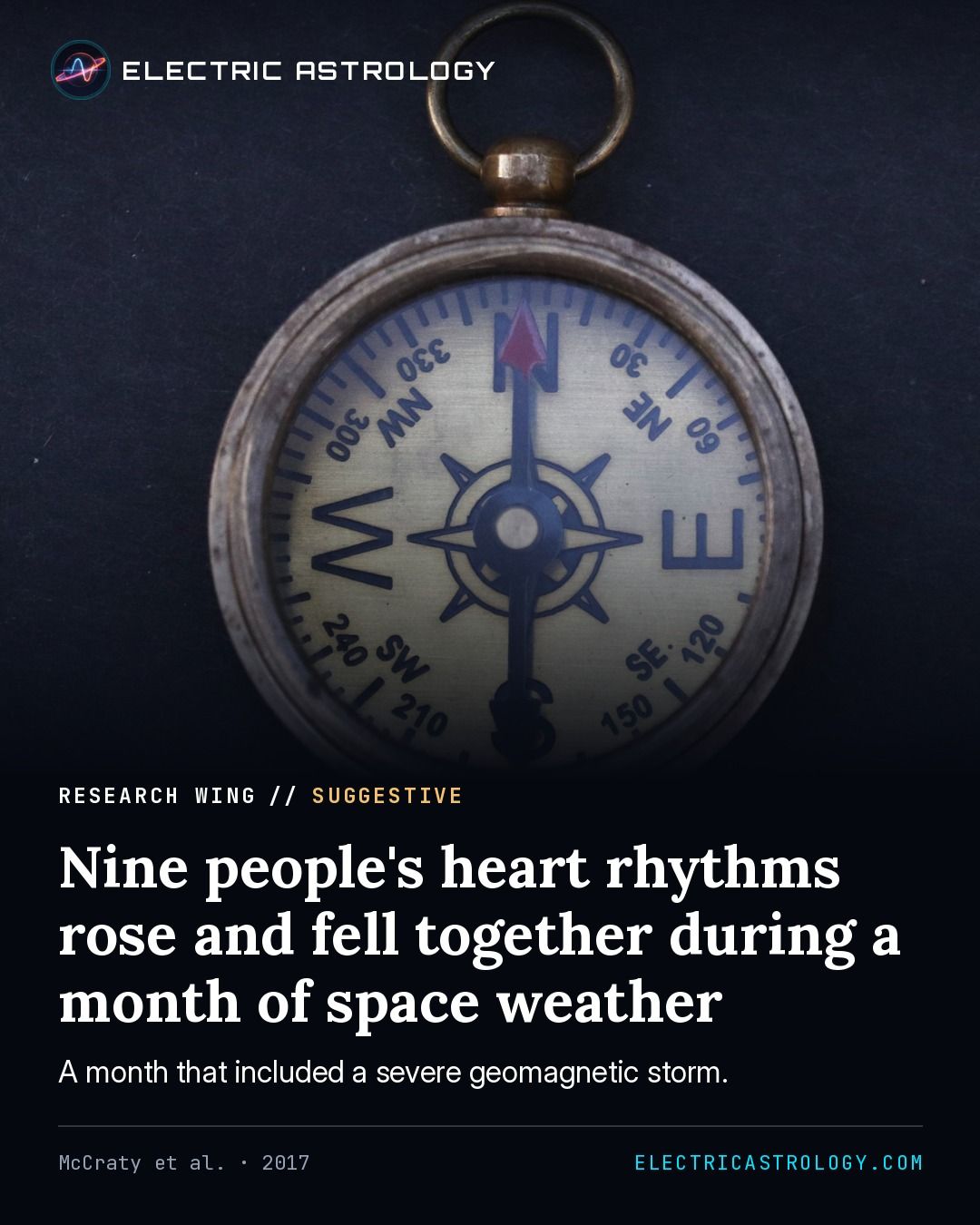
A group’s heart rhythms moved together, in step with Earth’s magnetic field
Through a month that included a severe geomagnetic storm, nine people’s heart rate variability tracked the solar wind, the geomagnetic indices, Schumann resonance power and, surprisingly, each other.
The short version
Through a month that included a severe geomagnetic storm, the group's average heart rate variability correlated with the solar wind, the geomagnetic indices and Schumann resonance power, in ways that shifted as the month went on. Their rhythms also moved with each other: in the first half of the month the group's heart rate variability rose and fell together, in a cycle of about two and a half days.
A small study, as the authors say, and it can't tell which signal they were in step with.
67 h
The shared rhythm in the group’s heart rate variability in the first half of the month: about two and a half days.
The paper
Synchronization of Human Autonomic Nervous System Rhythms with Geomagnetic Activity in Human Subjects
McCraty, R., Atkinson, M., Stolc, V., Alabdulgader, A. A., Vainoras, A., Ragulskis, M. (2017). Synchronization of Human Autonomic Nervous System Rhythms with Geomagnetic Activity in Human Subjects. International Journal of Environmental Research and Public Health, 14(7), 770.
Checked against the paper’s full text on November 9, 2026.
What they measured
Ten healthy adults aged 34 to 65 (eight women, two men), six of them HeartMath Institute staff, volunteered from separate locations across California, and nine completed the study. Each wore a heart monitor 24 hours a day for 31 days, from September 6 to October 7, 2011: 253 daily recordings.
Over the same month the team logged solar wind speed, the Kp and Ap indices, solar radio flux, cosmic rays, Schumann resonance power and the total variation of the local magnetic field from a magnetometer at the HeartMath Institute in Boulder Creek. The month included a severe geomagnetic storm (Kp 8) beginning September 26. Daily rhythms were removed with a 25-hour moving average, and only correlations of 0.3 and above (p < 0.001) were described in the text.
What they found
The group’s HRV correlated significantly with solar wind speed, Kp, Ap, solar radio flux, cosmic-ray counts, Schumann resonance power and the total variation in the magnetic field.
In the first half of the month the group’s HRV rose and fell together in a rhythm averaging 67 hours, about two and a half days. In that stretch Schumann resonance power correlated with total HRV power and its very-low-frequency band (r = 0.46).
During the storm, heart rate rose as solar wind speed rose. In the days after it, faster solar wind went with lower HRV (r = −0.77 to −0.82).
How it bears on the hypothesis
SuggestivePoints the same way, from a smaller study or a proposed mechanism still being tested.
Electric Astrology treats each person as a node on a shared circuit. This study found something close to that picture: separate people’s nervous systems moving together, in step with the magnetic environment they shared.
The authors found the total variation of the local magnetic field tracked heart rhythms more closely than the planetary Kp and Ap indices did, a reason to measure where the people are, not only at the planetary scale.
The authors’ own caution: The authors name the small sample as the main limitation, and note it cannot say which environmental signal the group synchronized to.
On Electric Astrology
More on: Do geomagnetic storms affect the heart and circulation?
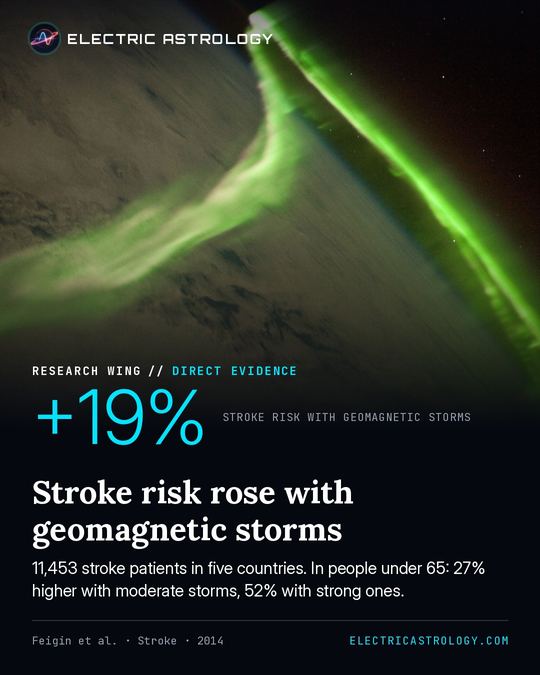 Stroke risk rose with geomagnetic stormsFeigin et al. · 2014 · Stroke
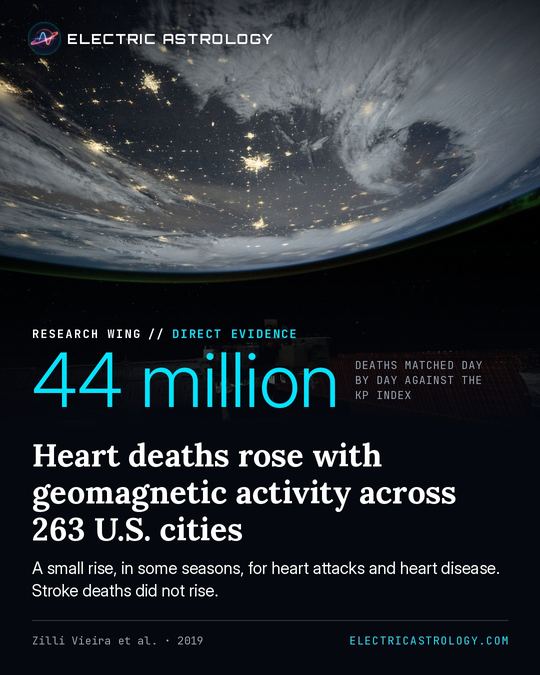 Heart deaths rose with geomagnetic activity across 263 U.S. citiesZilli Vieira et al. · 2019 · Environmental Health
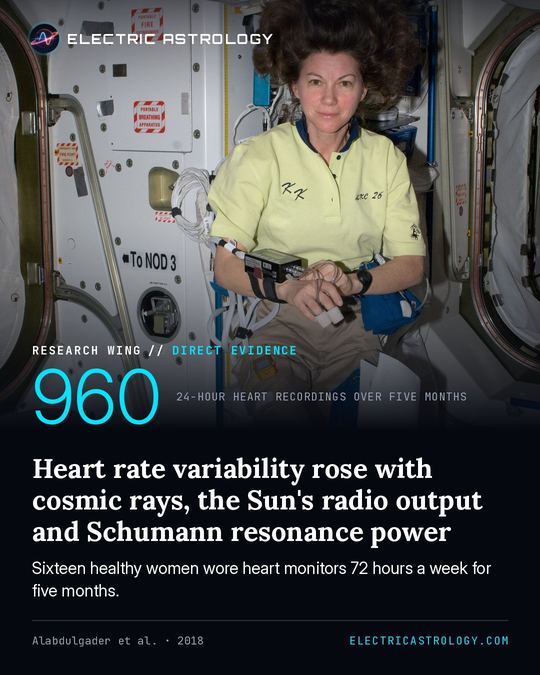 Heart rate variability rose with cosmic rays, the Sun's radio output and Schumann resonance powerAlabdulgader et al. · 2018 · Scientific Reports