Across 44 million deaths in 263 U.S. cities, heart deaths rose with geomagnetic activity
Matching daily deaths in 263 U.S. cities against the planetary Kp index, the authors found total, cardiovascular and heart-attack deaths rising with geomagnetic activity.
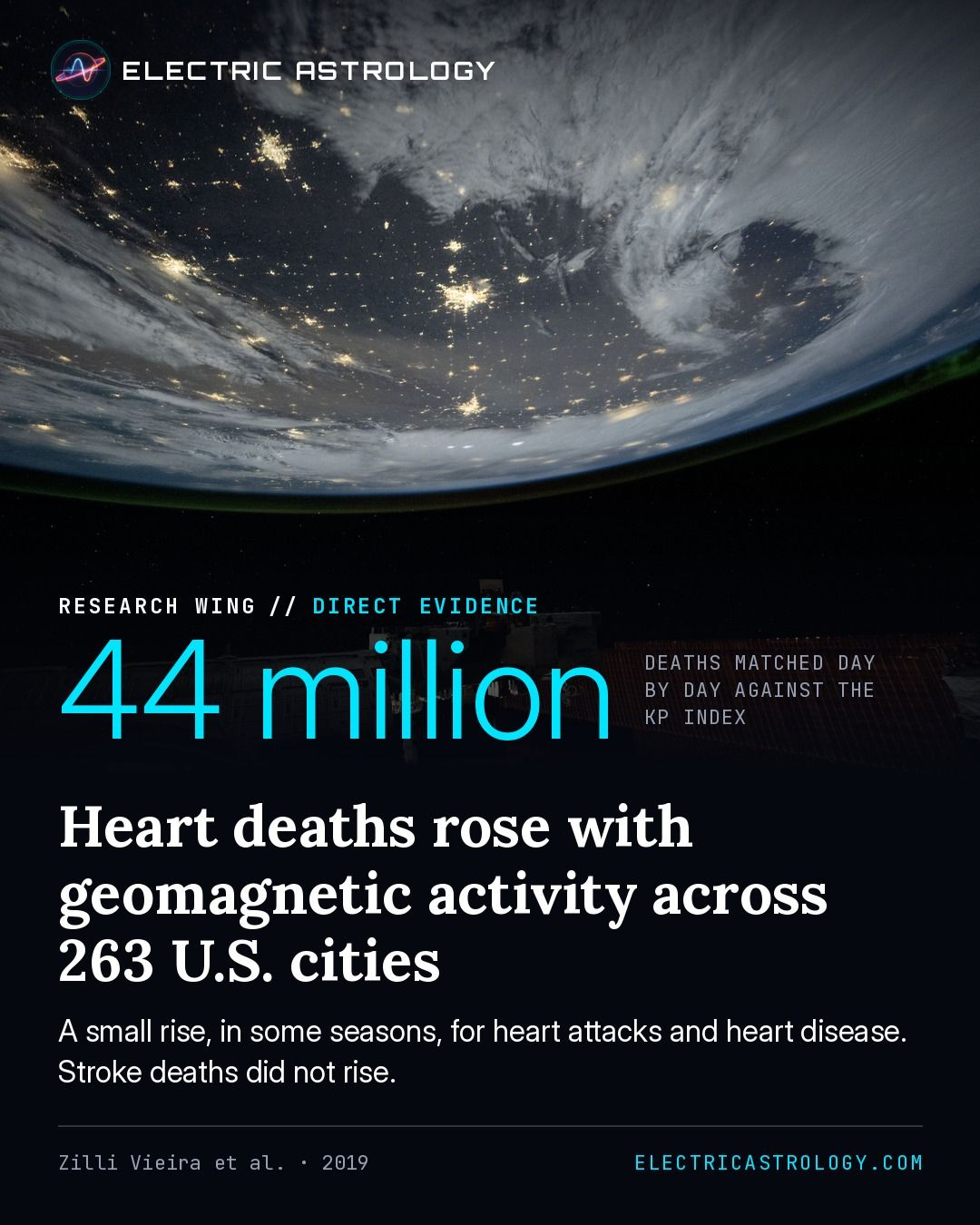
The short version
Researchers matched daily deaths in 263 U.S. cities, 44 million in all, against the Kp index of geomagnetic activity. Total deaths rose with Kp in every season; cardiovascular and heart-attack deaths rose with it in some seasons. The rises were small, fractions of a percent. Stroke deaths did not rise.
The authors call for clinical work to connect the pattern to what happens in the heart day to day.
+1.0%
Heart-attack deaths in winter for each one-standard-deviation rise in the Kp index, after adjusting for fine-particle air pollution (95% CI 0.4% to 1.62%).
The paper
Geomagnetic disturbances driven by solar activity enhance total and cardiovascular mortality risk in 263 U.S. cities
Zilli Vieira, C. L., Alvares, D., Blomberg, A., Schwartz, J., Coull, B., Huang, S., Koutrakis, P. (2019). Geomagnetic disturbances driven by solar activity enhance total and cardiovascular mortality risk in 263 U.S. cities. Environmental Health, 18(1), 83.
Checked against the paper’s full text on November 9, 2026.
What they measured
The study covers 44,220,261 deaths in 263 U.S. cities over about 30 years: 2,008,990 days of data from the National Center for Health Statistics and city health departments.
The exposure was the planetary Kp index, the standard measure of geomagnetic disturbance, from NASA Goddard. City by city and season by season, the authors modelled daily deaths against Kp, adjusting for day of year, temperature, humidity, day of week and year; a second set of models also adjusted for fine-particle air pollution (PM2.5). The city results were then combined in a meta-analysis.
What they found
Total deaths rose with Kp in every season: by 0.13% in winter, 0.31% in spring, 0.27% in summer and 0.31% in fall for each one-standard-deviation increase in the Kp index, all statistically significant.
Cardiovascular deaths rose 0.21% in spring and 0.34% in fall, and after the air-pollution adjustment 0.54% in winter and 0.46% in fall. Heart-attack (myocardial infarction) deaths rose 0.4% in spring and 0.7% in fall, and 1.0% in winter after the adjustment.
Stroke deaths did not rise with Kp. In winter and summer they were significantly lower on high-Kp days, and after the air-pollution adjustment there was no significant link.
How it bears on the hypothesis
Direct evidenceMeasures the body (or a living thing) changing with the Sun, the sky or Earth’s field.
Each percentage is small for a single day, but this is the whole population of 263 cities over three decades. The direction is the one the hypothesis predicts: when Earth’s magnetic field is disturbed, cardiovascular and heart-attack deaths rise.
The title names the chain the way Electric Astrology does: geomagnetic disturbances driven by solar activity, with the heart at the receiving end.
The authors’ own caution: The authors call for further work to connect this population pattern with day-to-day clinical observations of the heart.
On Electric Astrology
More on: Do geomagnetic storms affect the heart and circulation?
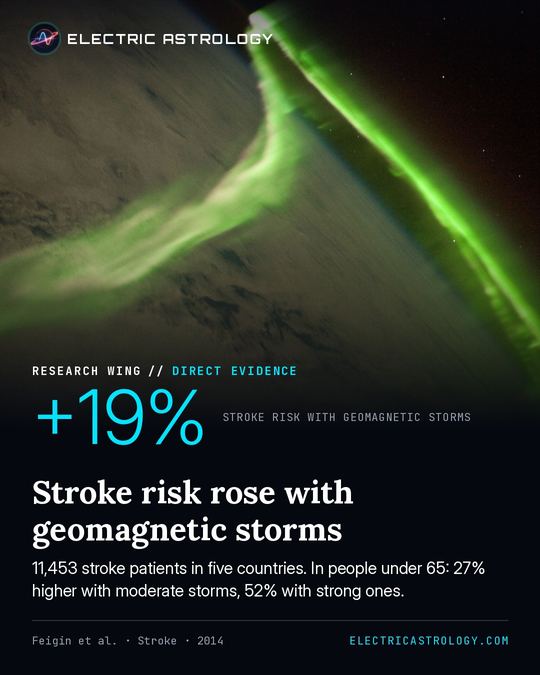 Stroke risk rose with geomagnetic stormsFeigin et al. · 2014 · Stroke
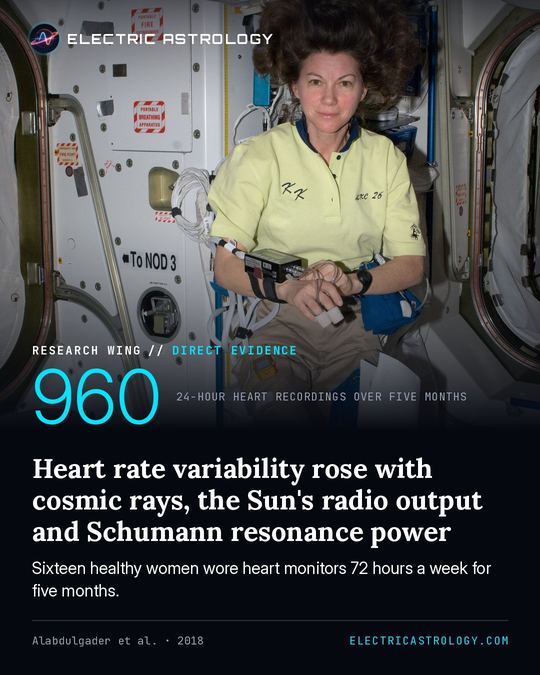 Heart rate variability rose with cosmic rays, the Sun's radio output and Schumann resonance powerAlabdulgader et al. · 2018 · Scientific Reports
 Nine people's heart rhythms rose and fell together during a month of space weatherMcCraty et al. · 2017 · International Journal of Environmental Research and Public Health