Geomagnetic storms went with a 19% higher stroke risk across five countries
Pooling six population-based stroke studies from five countries, the authors found strokes more likely with geomagnetic storms, and most of all in people under 65.
The short version
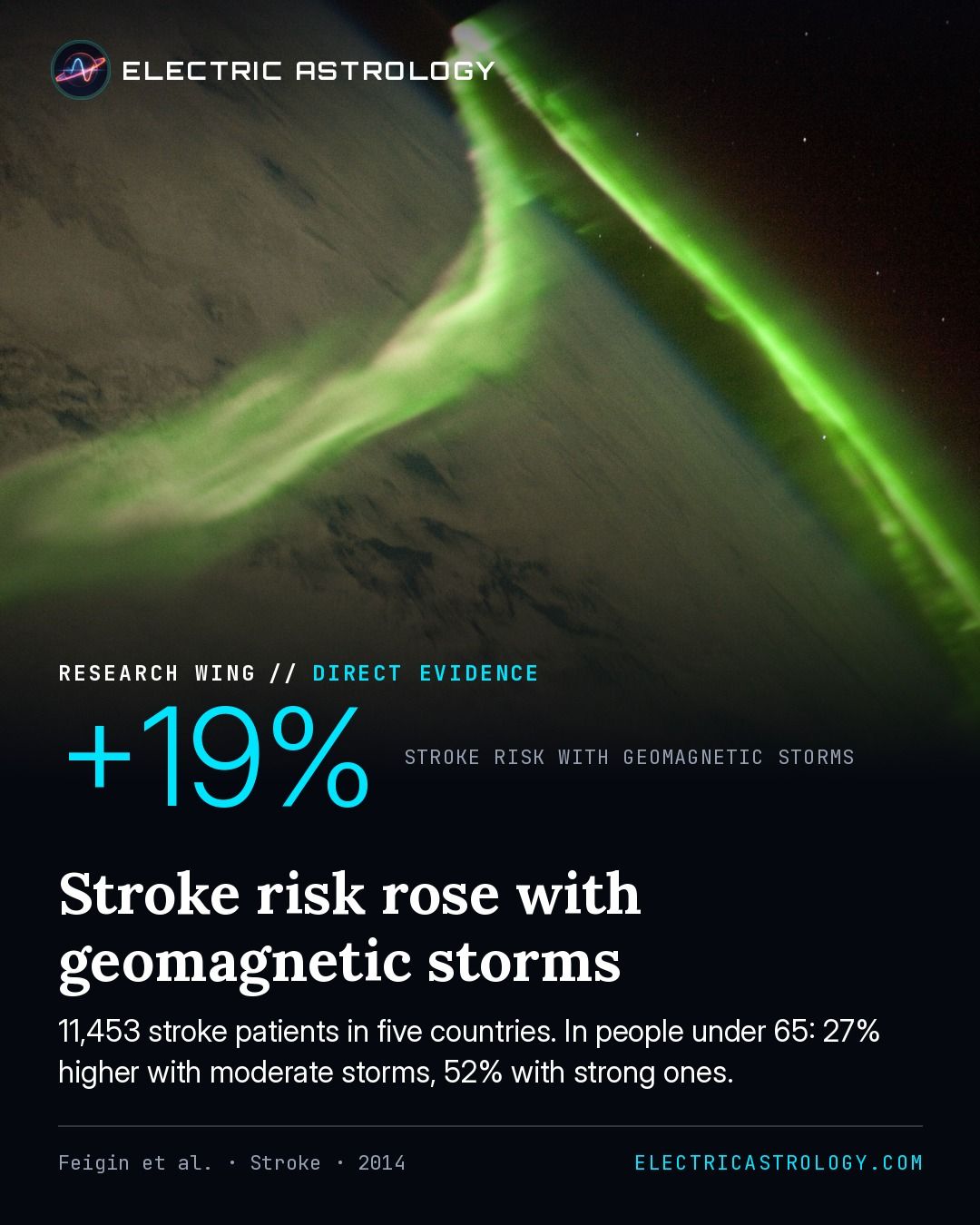
Researchers pooled six population-based stroke studies from New Zealand, Australia, the United Kingdom, France and Sweden: 11,453 stroke patients in all. Geomagnetic storms went with a 19% higher risk of stroke. In people under 65 the risk was 27% higher with moderate storms and 52% higher with strong ones.
The authors conclude that geomagnetic storms should be weighed alongside the established risk factors for stroke.
+19%
Stroke risk with geomagnetic storms (Ap index 60 or more). 95% confidence interval: 11% to 27%.
The paper
Geomagnetic storms can trigger stroke: evidence from 6 large population-based studies in Europe and Australasia
Feigin, V. L., Parmar, P. G., Barker-Collo, S., Bennett, D. A., Anderson, C. S., Thrift, A. G., et al. (2014). Geomagnetic storms can trigger stroke: evidence from 6 large population-based studies in Europe and Australasia. Stroke, 45(6), 1639–1645.
Checked against the paper’s abstract on November 9, 2026.
What they measured
The team pooled individual patient records from population-based stroke incidence studies in New Zealand, Australia, the United Kingdom, France and Sweden, run between 1981 and 2004: 11,453 stroke patients over 16,031,764 person-years of observation.
Each stroke was compared with daily geomagnetic activity, measured by the Ap index, in a time-stratified case-crossover design, in which each patient serves as their own control.
What they found
Geomagnetic storms (Ap index 60 or more) were associated with a 19% increase in the risk of stroke (95% confidence interval 11% to 27%).
In people under 65 the effect grew with the strength of the storm: 27% higher risk with moderate storms (Ap 60 to 99), 52% with strong storms (Ap 100 to 149) and 52% with severe or extreme storms (Ap 150 and above). The test for trend gave P < 2 × 10⁻¹⁶.
The authors conclude that geomagnetic storms should be considered along with the established risk factors for stroke.
How it bears on the hypothesis
Direct evidenceMeasures the body (or a living thing) changing with the Sun, the sky or Earth’s field.
Electric Astrology treats a geomagnetic storm as a load on the body’s circuit, not only on power grids and satellites. This is one of the largest tests of that idea: a hard medical outcome, stroke, rising with storms in five countries across Europe and Australasia.
In people under 65, stronger storms went with larger increases (27% for moderate storms, 52% for strong and severe ones): a dose-response, one of the classic signs that an association may be causal.
On Electric Astrology
More on: Do geomagnetic storms affect the heart and circulation?
 Heart deaths rose with geomagnetic activity across 263 U.S. citiesZilli Vieira et al. · 2019 · Environmental Health
 Heart rate variability rose with cosmic rays, the Sun's radio output and Schumann resonance powerAlabdulgader et al. · 2018 · Scientific Reports
 Nine people's heart rhythms rose and fell together during a month of space weatherMcCraty et al. · 2017 · International Journal of Environmental Research and Public Health