Men’s hospital admissions for bipolar depression rose 36.2% in the second week after geomagnetic storms
Comparing hospital admissions after geomagnetic storms with quiet periods, a psychiatrist in Falkirk, Scotland found a 36.2% rise in men admitted for the depressed phase of manic-depressive illness.
The short version
A psychiatrist in Falkirk, Scotland compared hospital admissions after geomagnetic storms with geomagnetically quiet periods. In the second week after a storm, men's admissions for the depressed phase of manic-depressive illness rose 36.2%. Women's admissions for depression rose too, by less, short of statistical significance.
Storm size did not predict how many men were admitted with psychotic depression, which he said fits a threshold event affecting people already predisposed.
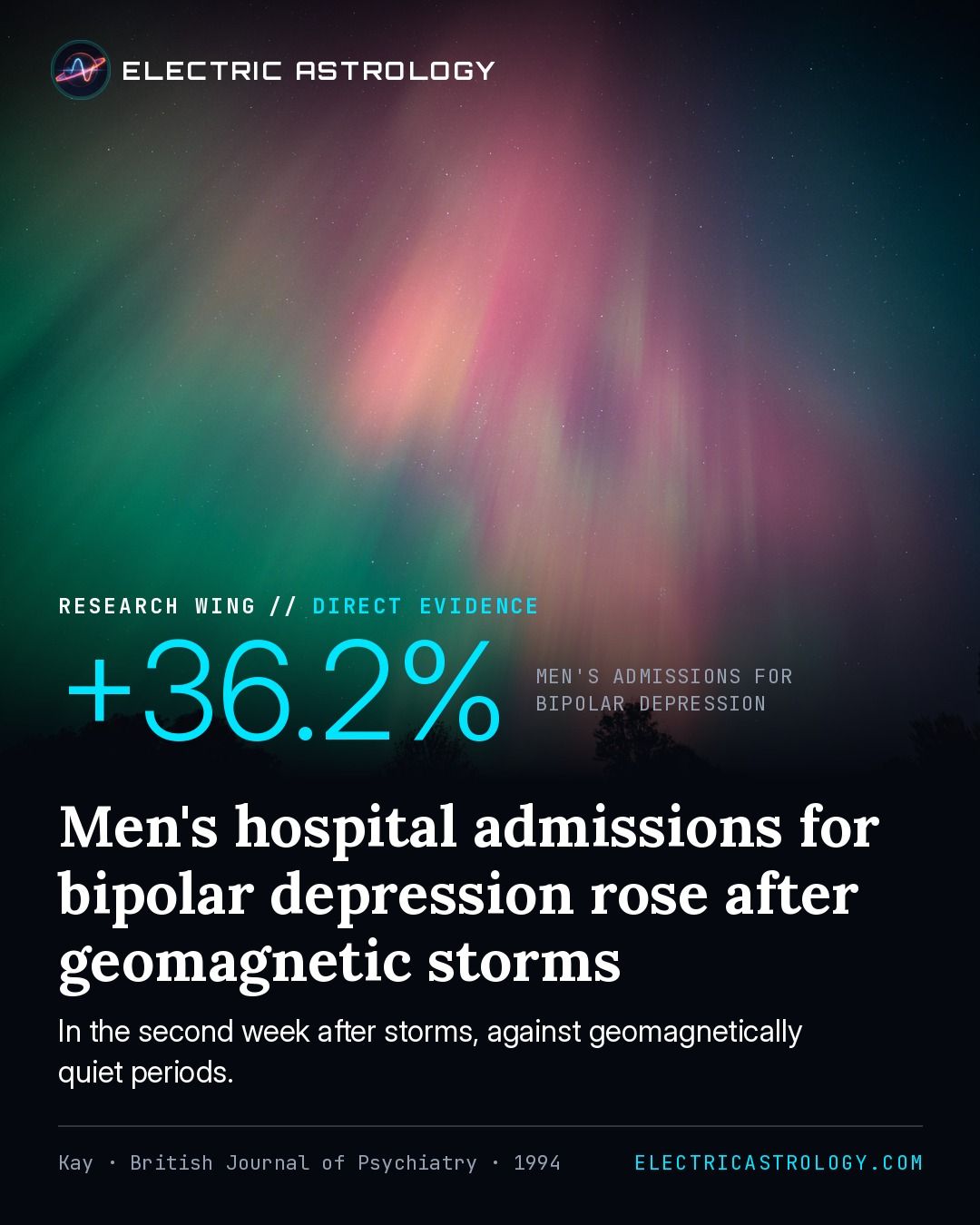
+36.2%
Men’s admissions for the depressed phase of manic-depressive illness in the second week after storms, against geomagnetically quiet periods.
The paper
Geomagnetic storms: association with incidence of depression as measured by hospital admission
Kay, R. W. (1994). Geomagnetic storms: association with incidence of depression as measured by hospital admission. British Journal of Psychiatry, 164(3), 403–409.
Checked against the paper’s abstract on November 9, 2026.
What they measured
Ronald Kay compared hospital admissions for depression in the second week after geomagnetic storms with admissions during geomagnetically quiet control periods, by diagnosis and by sex.
What they found
Men’s admissions with a diagnosis of the depressed phase of manic-depressive illness rose by a statistically significant 36.2% in the second week after storms.
Women’s admissions for psychotic and non-psychotic depression also rose after storms, by a smaller amount that did not reach statistical significance.
For men admitted with psychotic depression, the size of the storm did not predict the number of admissions. The author reads this as a threshold event that affects people already predisposed.
How it bears on the hypothesis
Direct evidenceMeasures the body (or a living thing) changing with the Sun, the sky or Earth’s field.
If the nervous system is part of the circuit, mood should show it too. The timing is telling: the significant rise came in the second week after the storm.
The author suggests a possible route: a phase advance in the pineal gland’s circadian rhythm of melatonin, the hormone that times the body’s night.