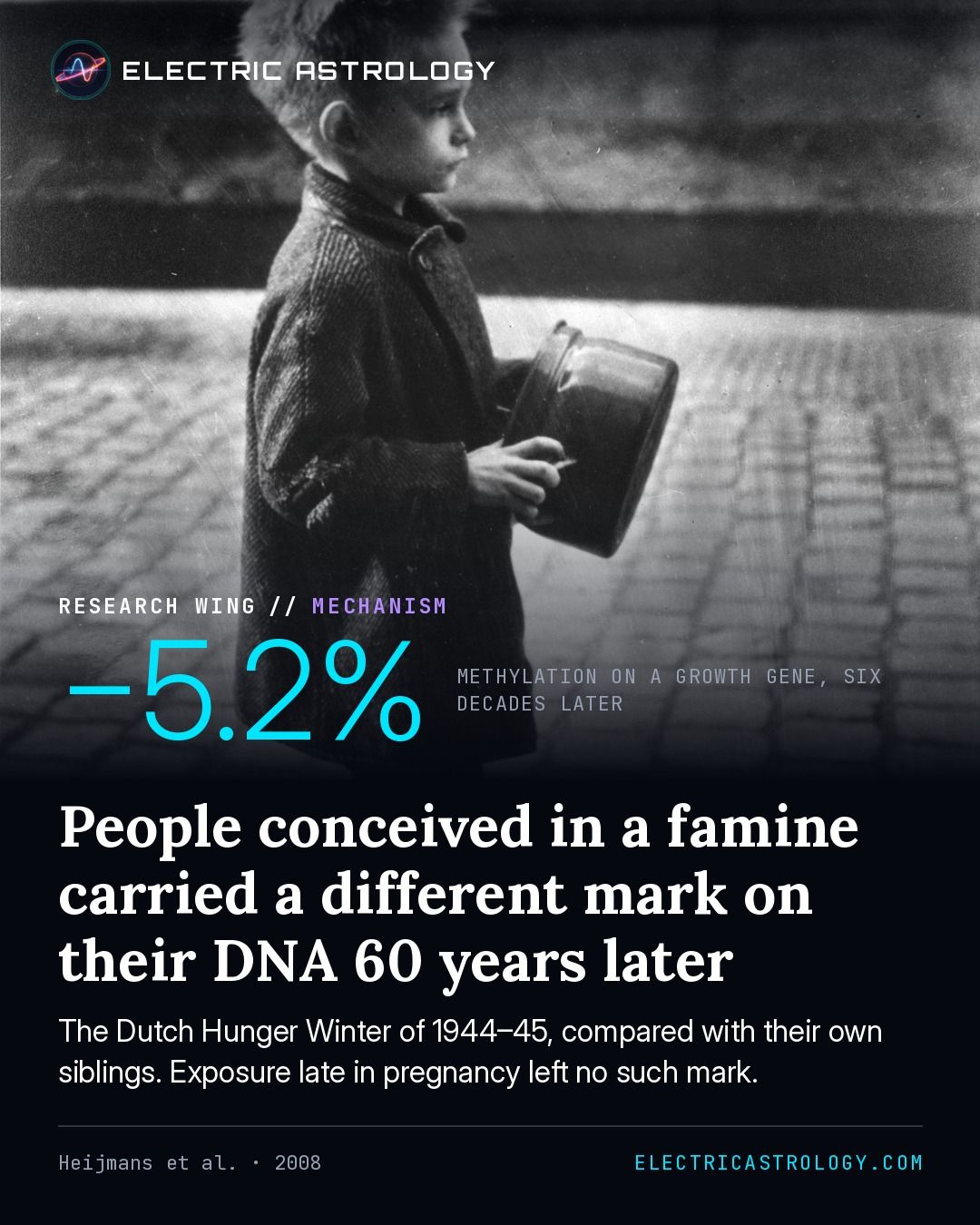
Six decades after the Dutch Hunger Winter, people conceived during it still carried a different mark on their DNA
Comparing people conceived during the Dutch famine of 1944–45 with their own brothers and sisters, the team found a lasting difference in a chemical mark on a growth gene.
The short version
Six decades after the Dutch famine of 1944–45, researchers compared 60 people conceived during it with a same-sex brother or sister. The famine-conceived siblings carried 5.2% less methylation, a chemical mark on DNA, on a regulatory stretch of the growth gene IGF2.
People who met the famine only late in their mother's pregnancy were born lighter, but carried no such difference. The timing around conception was what mattered.
−5.2%
Methylation of the IGF2 gene’s regulatory region in people conceived during the famine, against their same-sex siblings (P = 5.9 × 10⁻⁵).
The paper
Persistent epigenetic differences associated with prenatal exposure to famine in humans
Heijmans, B. T., Tobi, E. W., Stein, A. D., Putter, H., Blauw, G. J., Susser, E. S., et al. (2008). Persistent epigenetic differences associated with prenatal exposure to famine in humans. Proceedings of the National Academy of Sciences, 105(44), 17046–17049.
Checked against the paper’s full text on November 13, 2026.
What they measured
From the Hunger Winter Families Study, the team took 60 people whose mothers conceived them during the Dutch famine (last menstrual period between November 28, 1944 and May 15, 1945) and 62 people exposed late in gestation (born between January 28 and May 30, 1945). Each was compared with a same-sex sibling who was not exposed.
About six decades later, methylation at five CpG sites in a differentially methylated region of the IGF2 gene, for insulin-like growth factor II, was measured in DNA from whole blood with a mass-spectrometry method, each in triplicate.
What they found
People conceived during the famine had an average methylation fraction of 0.488 at the IGF2 region, against 0.515 in their siblings: 5.2% lower (P = 5.9 × 10⁻⁵). In 43 of the 60 families, the exposed person had the lowest methylation.
Average daily rations during the famine were 667 kilocalories.
People exposed only late in gestation showed no difference, though they were born 296 g lighter than reference births; those exposed around conception had normal birth weights but carried the change. The difference between the two timings was significant (P for interaction = 4.7 × 10⁻³).
The authors conclude these are the first data to support, in humans, the idea that early-life conditions can cause epigenetic changes that persist throughout life.
How it bears on the hypothesis
MechanismShows a working part of the circuit: a receiver in the body, a current in space, a field that couples them.
Electric Astrology holds that the conditions a person begins life in leave a lasting signature, the commissioning. This paper does not test the sky. It shows the kind of mechanism such a signature would need: conditions around conception and in early pregnancy, written into the chemistry of the DNA and still readable sixty years later.
Timing decided it. The same famine, met late in pregnancy, lowered birth weight but left this mark unchanged.
The authors’ own caution: The authors say other stresses of the time, such as cold and emotional stress, cannot be ruled out, that they studied blood only, and that how vulnerable other regions of the genome are remains to be established.