People born at solar maximum in historical Norway lived 5.2 years less on average
In two Norwegian parishes over two centuries, people born in years of high solar activity lived shorter lives, and girls born then had lower survival.
The short version
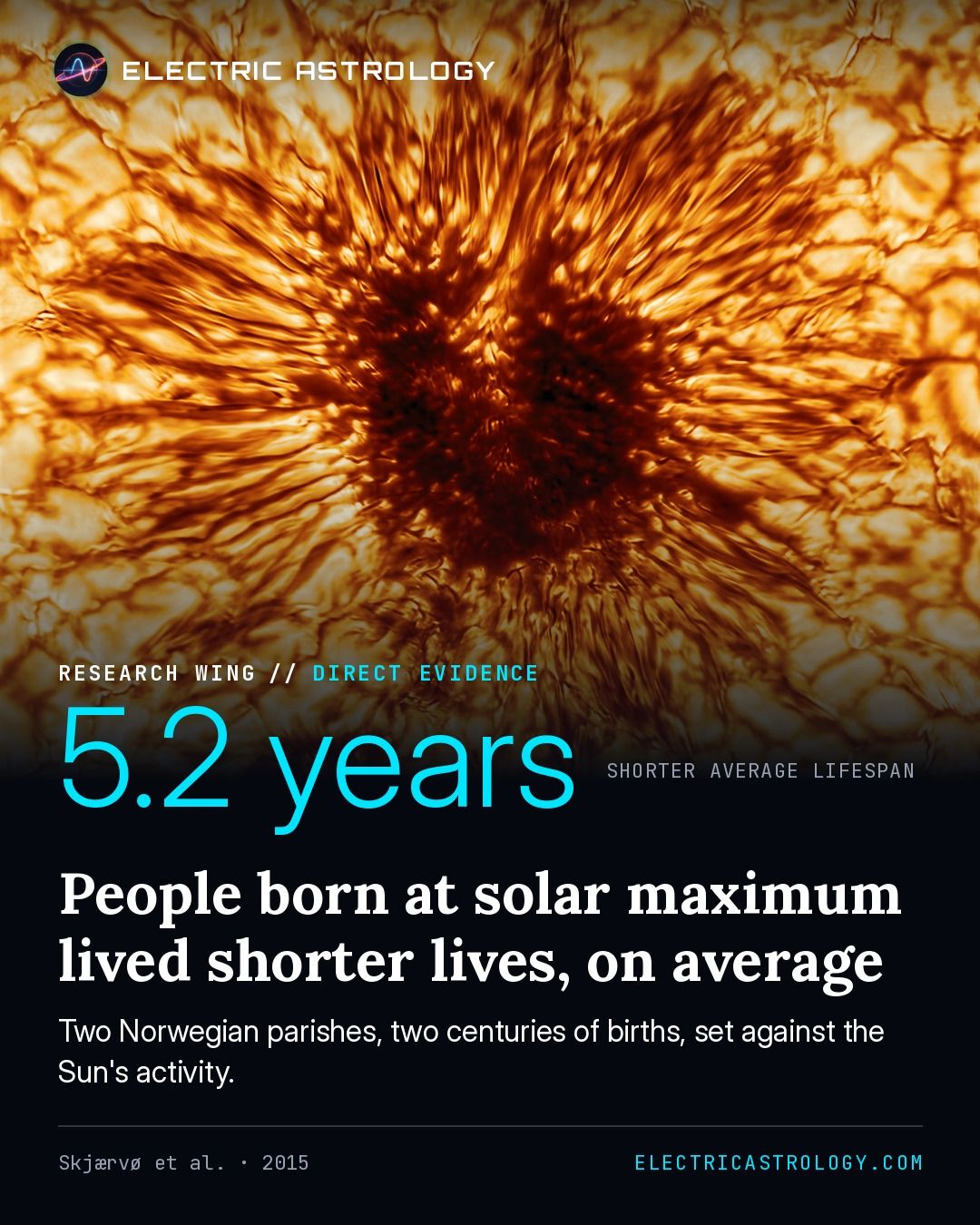
Researchers followed people in two Norwegian parishes across two centuries and compared their lives with the Sun's activity when they were born. People born in a solar maximum period lived 5.2 years less on average than those born at solar minimum. Girls born when the Sun was active were also less likely to survive to adulthood.
5.2 years
Shorter average lifespan for people born in a solar maximum period than for those born at solar minimum (5.1 years for women, 5.3 for men).
The paper
Solar activity at birth predicted infant survival and women’s fertility in historical Norway
Skjærvø, G. R., Fossøy, F., Røskaft, E. (2015). Solar activity at birth predicted infant survival and women’s fertility in historical Norway. Proceedings of the Royal Society B, 282(1801), 20142032.
Checked against the paper’s full text on November 9, 2026.
What they measured
The authors used church records from two parishes in mid-Norway at about 63°N, the coastal island of Smøla and inland Soknedal: 8,662 births between 1676 and 1878, with full life histories for 1,498 women and 1,623 men.
Each birth was placed in a solar maximum or solar minimum period using NOAA’s yearly sunspot numbers. Generalized linear mixed models controlled for the year of birth, alongside survival curves and Cox proportional hazards models.
What they found
On average, people born in a solar maximum period lived 5.2 years less than people born in a solar minimum period: 5.1 years less for women and 5.3 for men.
Solar activity at birth had a strong, significant effect on survival to adulthood (age 20) for girls (p = 0.012) and a weaker tendency for boys (p = 0.087).
High solar activity at birth significantly reduced fertility in low-status women (p = 0.027), but not in high-status women or in men.
How it bears on the hypothesis
Direct evidenceMeasures the body (or a living thing) changing with the Sun, the sky or Earth’s field.
Electric Astrology reads the birth chart as a commissioning: the conditions at the moment a life starts leave a mark on it. This study measured one of those conditions, the Sun’s activity around the birth, and found it tracking how long people lived.
The authors propose ultraviolet light as the route, through the breakdown of folate during pregnancy; they do not test an electric or magnetic effect. Either way, it is the Sun at birth leaving a measurable mark on a life.
The authors’ own caution: The authors note they lack the exact timing of each birth and cannot fully separate exposure before birth from exposure after it.