The human pineal gland grows tiny calcite crystals, found elsewhere in healthy tissue only in the inner ear
Isolating crystals from human pineal glands, a team led from Ben-Gurion University identified a second, distinct kind of mineral there: microcrystals of calcite.
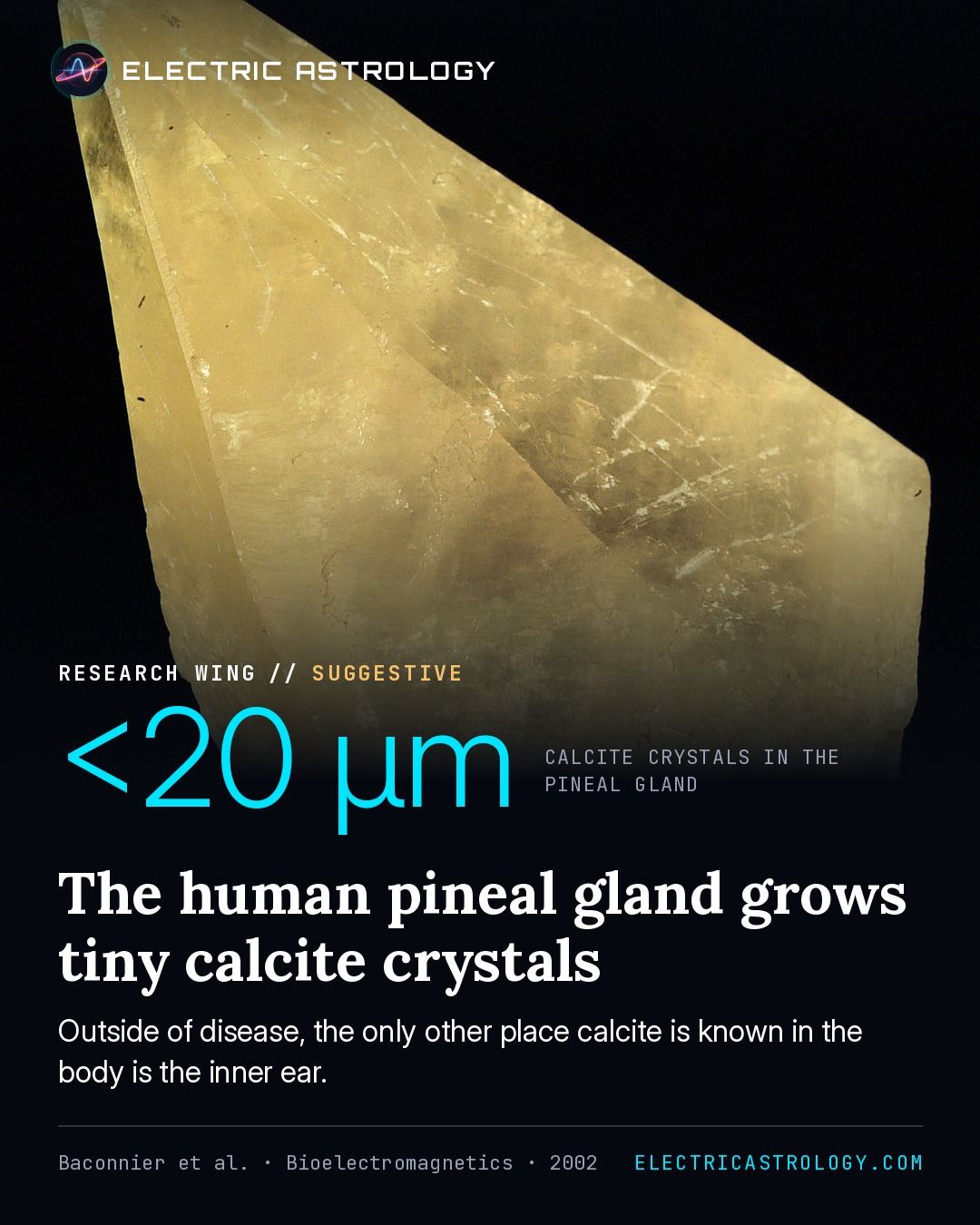
The short version
Researchers isolated crystals from human pineal glands and found a second kind, separate from the usual mineral deposits: calcite microcrystals less than 20 micrometres long, made only of calcium, carbon and oxygen.
Apart from the inner ear, it was the only known healthy occurrence of calcite in the body. The authors suggest the crystals may be piezoelectric, as the inner ear's are.
<20 µm
Length of the calcite microcrystals, distinct from the mulberry-shaped hydroxyapatite deposits often seen in the pineal.
The paper
Calcite microcrystals in the pineal gland of the human brain: First physical and chemical studies
Baconnier, S., Lang, S. B., Polomska, M., Hilczer, B., Berkovic, G., Meshulam, G. (2002). Calcite microcrystals in the pineal gland of the human brain: First physical and chemical studies. Bioelectromagnetics, 23(7), 488–495.
Checked against the paper’s abstract on November 13, 2026.
What they measured
The team developed a procedure to isolate crystals from the organic matter of the human pineal gland, the small gland deep in the brain that makes melatonin.
They examined the crystals by scanning electron microscopy, energy-dispersive spectroscopy, electron diffraction and near-infrared Raman spectroscopy.
What they found
The pineal holds small crystals less than 20 micrometres long, completely distinct from the often observed mulberry-type hydroxyapatite deposits. They were cubic, hexagonal and cylindrical, with sharp edges and very rough surfaces.
They contained only calcium, carbon and oxygen, and electron diffraction and Raman spectroscopy established that they were calcite.
Apart from the otoconia of the inner ear, this is the only known occurrence of calcite in the human body outside disease.
The authors say the crystals’ complex texture may make them piezoelectric, as otoconia are, and that two different crystals in the pineal suggest two different biological functions.
How it bears on the hypothesis
SuggestivePoints the same way, from a smaller study or a proposed mechanism still being tested.
The pineal times the body’s night, and it carries a crystal the body otherwise grows only in the inner ear’s balance organ. The authors list a possible interaction with external electromagnetic fields among the questions they were studying next.
In seven human brains measured later, the pineal also carried more than ten times the magnetic signal of the cortex (Gilder 2018, in this wing).
The authors’ own caution: The authors call piezoelectricity possible, not shown. They say studies of how the crystals form, what they do, and any interaction with external electromagnetic fields were still in progress.