Infrared light grew the exclusion zone, the particle-free layer of water at a gel surface, to six times its width
Gerald Pollack’s lab shone light on the exclusion zone, the layer of water next to a water-loving surface that pushes out microspheres, and found it grew, most of all under infrared.
The short version
Next to a water-loving surface, a layer of water pushes out suspended particles, clearing a zone about a quarter of a millimetre wide. Gerald Pollack calls this ordered layer water's fourth phase.
In his lab, five minutes of infrared light grew the zone to about three times its width, and an hour grew it six times, while the water warmed by only about one degree. Other labs have since seen the zone itself; as of a 2020 review, its growth under light still awaited an independent repeat.
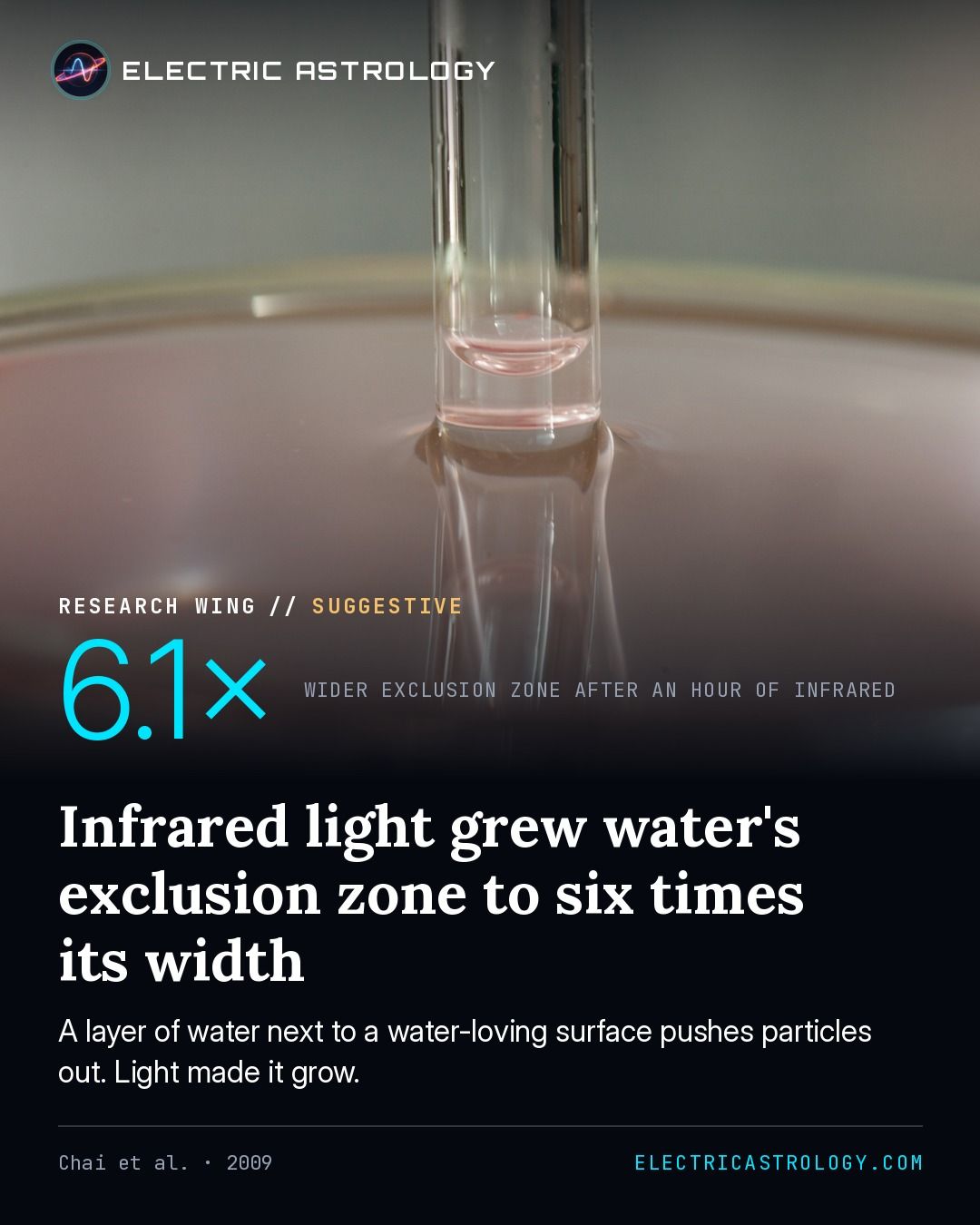
6.1×
Width of the exclusion zone after one hour of 3.1-micrometre infrared light, against its starting size. About 3× after five minutes.
The paper
Effect of Radiant Energy on Near-Surface Water
Chai, B., Yoo, H., Pollack, G. H. (2009). Effect of Radiant Energy on Near-Surface Water. The Journal of Physical Chemistry B, 113(42), 13953–13958.
Checked against the paper’s full text on November 13, 2026.
What they measured
Binghua Chai, Hyok Yoo and Gerald Pollack (University of Washington) set Nafion tubing, a water-loving polymer, in a suspension of 1-micrometre microspheres in a dark room at 22 to 23 °C. The exclusion zone is the region next to the surface from which the spheres are pushed out.
They shone light-emitting diodes on the zone, from ultraviolet through visible to infrared at 1.75, 2.0 and 3.1 micrometres; the 3.1-micrometre source put an estimated 2.4 nanowatts on the sample. They measured the zone’s width over time and checked the water’s temperature with a probe small enough to sit inside the zone.
What they found
Without extra light the zone extended 260 ± 13.3 micrometres from the surface (n = 5); restored under the microscope lamp, about 300 micrometres.
Five minutes of 3.1-micrometre infrared grew the zone to about three times its control width. With continued exposure the ratio rose to 3.7 at 10 minutes, 4.7 at 30 minutes and 6.1 ± 0.17 at one hour. The 3.1-micrometre light had the largest effect of all wavelengths, despite its lower power.
The water warmed by only about 1 °C, so the authors judge the effect nonthermal. After the light went off, the zone held its width for about 30 minutes, then shrank halfway back in about 15 minutes.
The authors suggest that a good fraction of the light energy water absorbs goes into building order and separating charge.
How it bears on the hypothesis
SuggestivePoints the same way, from a smaller study or a proposed mechanism still being tested.
Pollack calls this ordered, charged layer water’s “fourth phase”. This paper shows it responding to light: energy in, a wider zone out, with almost no heating.
A 2020 critical review (Elton et al.) found the exclusion zone itself has now been independently demonstrated by several groups. Its cause is still argued: Pollack proposes a distinct structure of water, others a diffusion effect at charged surfaces. The same review notes that the zone’s growth under light, this paper’s result, still needs to be repeated by independent groups.
The authors’ own caution: The authors note the infrared sources were far weaker than the ultraviolet and visible ones, that measurements beyond an hour were unreliable because of evaporation, and that the mechanism is not yet worked out.