A satellite mapped two rings of electric current flowing between space and Earth’s upper atmosphere
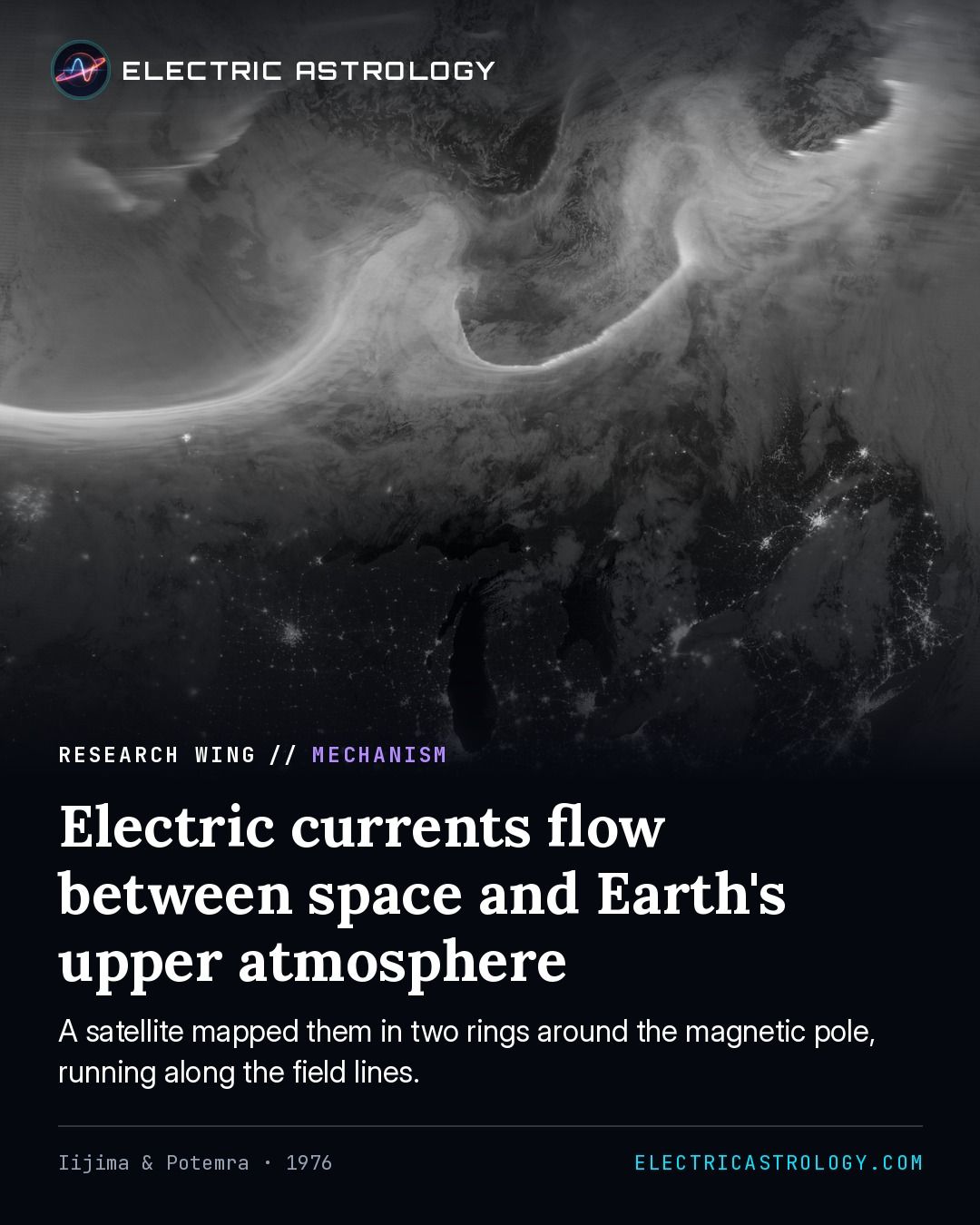
Magnetometer data from the Triad satellite showed large-scale electric currents flowing along Earth’s magnetic field lines, in two rings around the geomagnetic pole.
The short version
A 1976 study used magnetometer data from the Triad satellite to map large-scale electric currents flowing along Earth's magnetic field lines, into and out of the upper atmosphere. They run in two rings around the magnetic pole, and the ring nearer the pole persists, especially on the day side, even when geomagnetic activity is very low.
These field-aligned currents are known as Birkeland currents.
The paper
The amplitude distribution of field-aligned currents at northern high latitudes observed by Triad
Iijima, T., Potemra, T. A. (1976). The amplitude distribution of field-aligned currents at northern high latitudes observed by Triad. Journal of Geophysical Research, 81(13), 2165–2174.
Checked against the paper’s abstract on November 9, 2026.
What they measured
The Triad satellite carried a magnetometer across the high-latitude sky at 800 km altitude. Iijima and Potemra used its data, recorded at College, Alaska from July 1973 to October 1974, to map where electric currents flow along Earth’s magnetic field lines (field-aligned currents, also called Birkeland currents) and how strong they are.
What they found
Large-scale field-aligned currents are concentrated in two principal areas encircling the geomagnetic pole, which the authors call region 1 and region 2.
In region 1, under moderately disturbed conditions, the strongest currents flow into the ionosphere in the morning sector and out of it in the afternoon. Region 1 currents are statistically larger than region 2 currents at all local times except near midnight, and they persist, especially on the day side, even when geomagnetic activity is very low.
Region 2 currents are strongest on the night side, where the auroral electrojets are usually most active, and their strength tracks the westward and eastward electrojets.
How it bears on the hypothesis
MechanismShows a working part of the circuit: a receiver in the body, a current in space, a field that couples them.
Kristian Birkeland proposed more than a century ago that currents flowing along magnetic field lines power the aurora. Satellite maps like this one measured them. They are a working part of the circuit Electric Astrology describes: electric current joining near-Earth space to the planet’s upper atmosphere, not only during storms but even when geomagnetic activity is very low.