Galileo found that Ganymede makes its own magnetic field, a magnetosphere inside Jupiter’s
On two close flybys the Galileo spacecraft found Ganymede, Jupiter’s largest moon, with an internal magnetic field strong enough to carve out its own magnetosphere inside Jupiter’s.
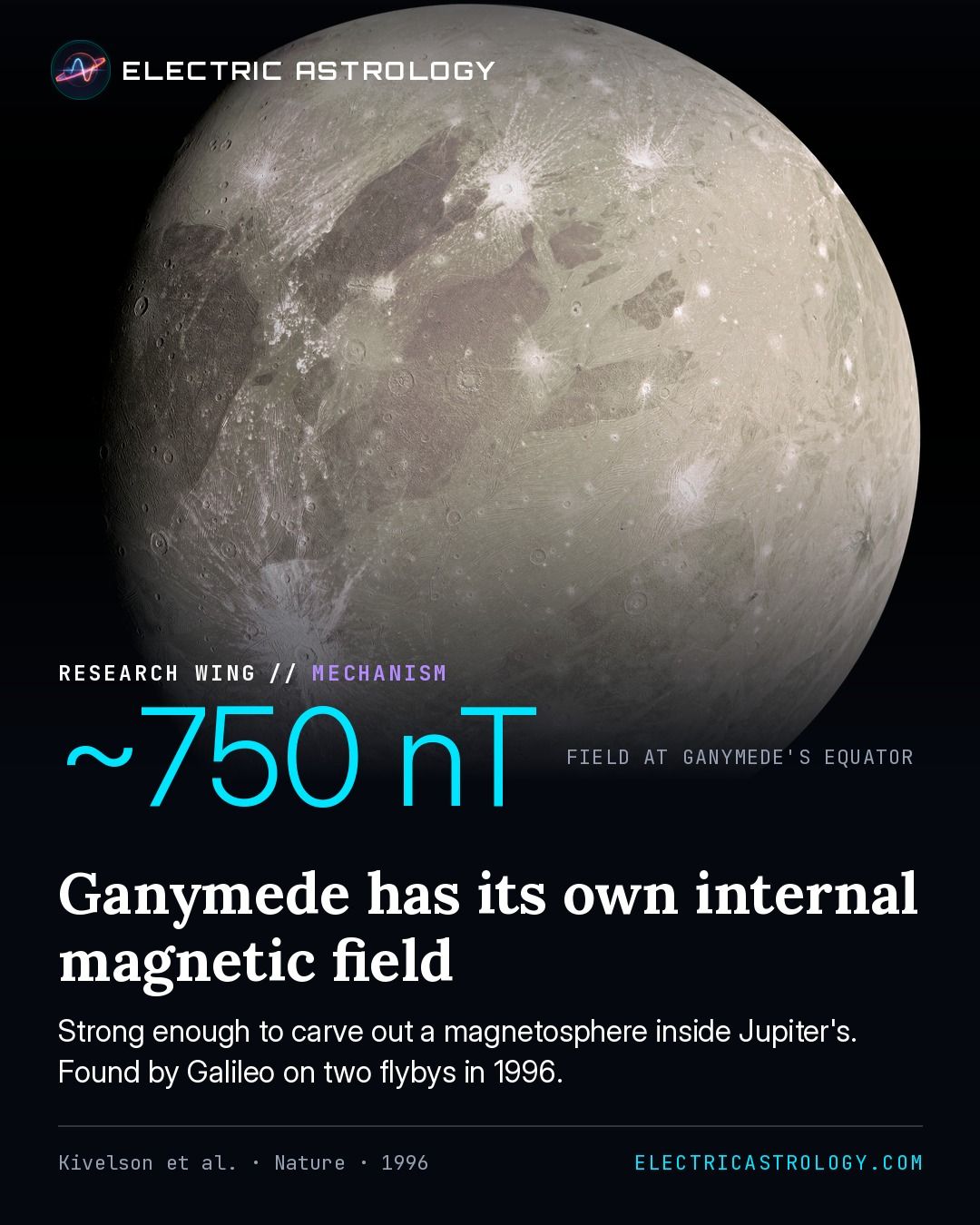
The short version
On two close flybys in 1996, the Galileo spacecraft found that Ganymede, Jupiter's largest moon, has an internal magnetic field strong enough to carve out a magnetosphere of its own inside Jupiter's.
The authors note that the only other solid bodies then known to have magnetic fields were Mercury, Earth and probably Io.
~750 nT
Ganymede’s equatorial surface field, from a dipole tilted about 10° to its spin axis.
The paper
Discovery of Ganymede’s magnetic field by the Galileo spacecraft
Kivelson, M. G., Khurana, K. K., Russell, C. T., Walker, R. J., Warnecke, J., Coroniti, F. V., et al. (1996). Discovery of Ganymede’s magnetic field by the Galileo spacecraft. Nature, 384(6609), 537–541.
Checked against the paper’s abstract on November 9, 2026.
What they measured
The Galileo spacecraft passed close to Ganymede twice, first at an altitude of 838 km and then at just 264 km.
What they found
The encounters revealed an internal magnetic field associated with Ganymede. Before this, the only other solid bodies in the solar system known to have magnetic fields were Mercury, Earth and probably Io.
The data fit a Ganymede-centred magnetic dipole tilted about 10° from the spin axis, with an equatorial surface field of about 750 nanotesla.
The field is strong enough to carve out a magnetosphere with clearly defined boundaries inside Jupiter’s magnetosphere.
How it bears on the hypothesis
MechanismShows a working part of the circuit: a receiver in the body, a current in space, a field that couples them.
Electric Astrology’s guide is named for Ganymede, and this is part of why the name fits: a moon that is its own magnetic system, nested inside the largest one around any planet. It is a small-scale picture of the hypothesis itself, a node with its own field, coupled to the larger circuit around it.
The authors’ own caution: The authors note that the observations require an internal field but do not show its source.