The Geometry of Frequencies · The film
Why do the angles between planets matter?
The short answer
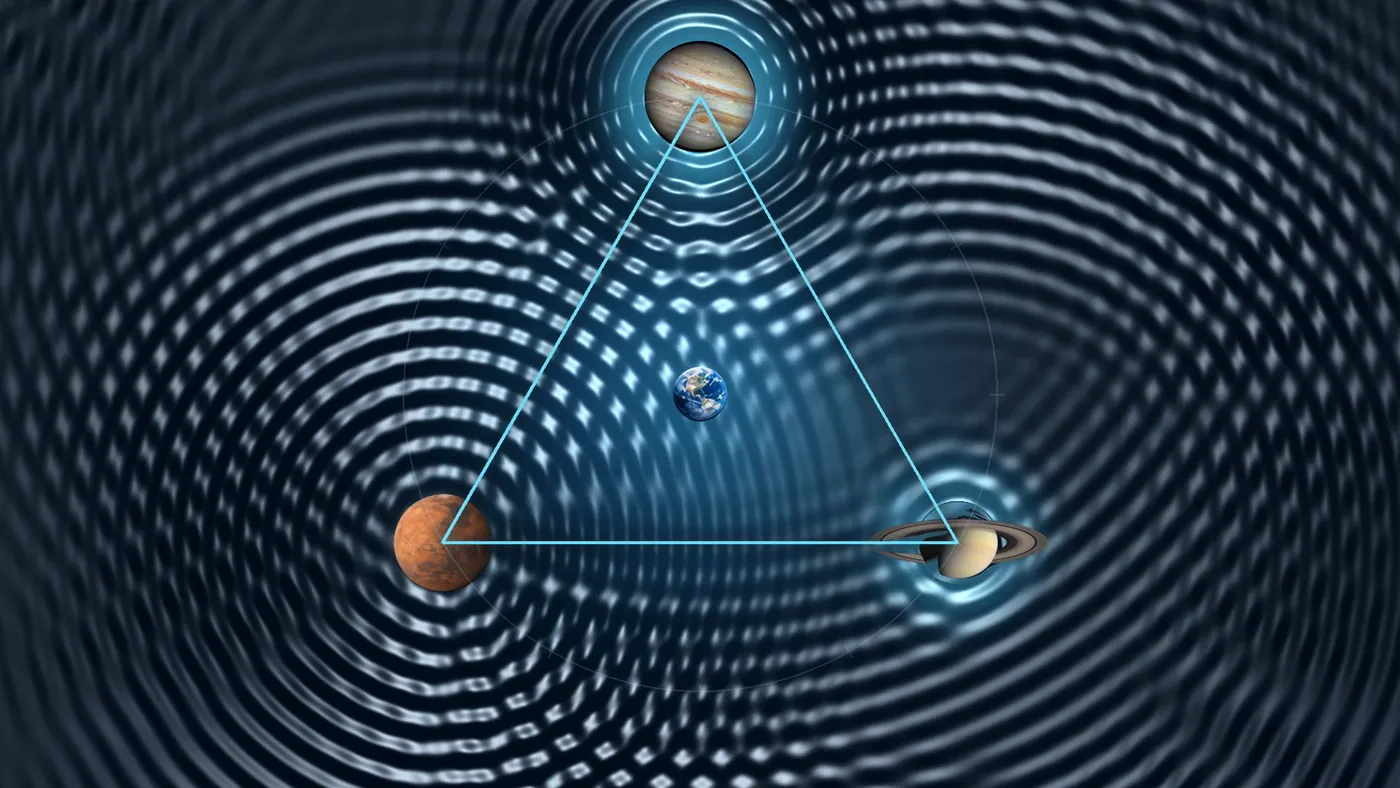
The solar system is wired with plasma, and the angles between the planets are the wiring diagram. Astrologers say a trine (120 degrees) flows, a square (90 degrees) grinds and an opposition (180 degrees) brings pressure. In a circuit, those are three different jobs.
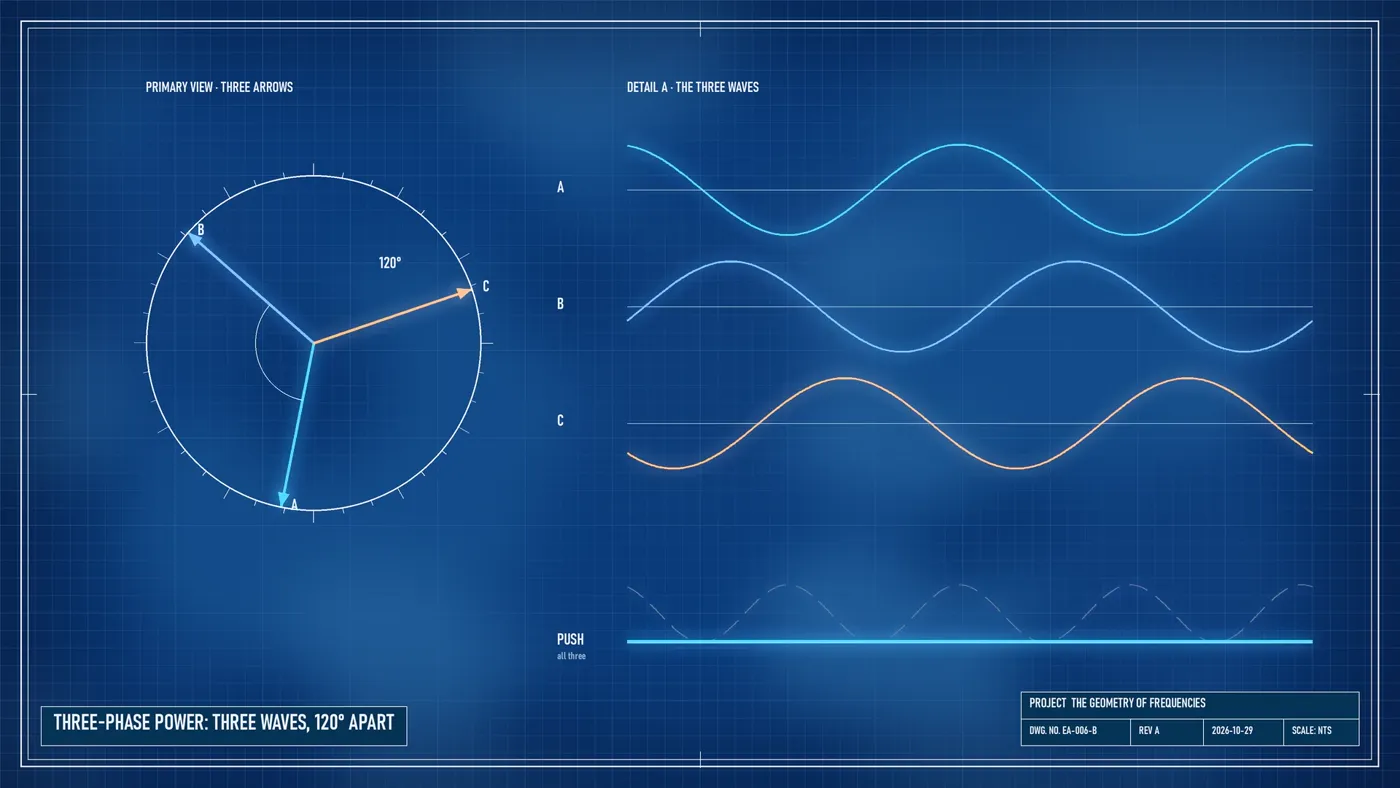
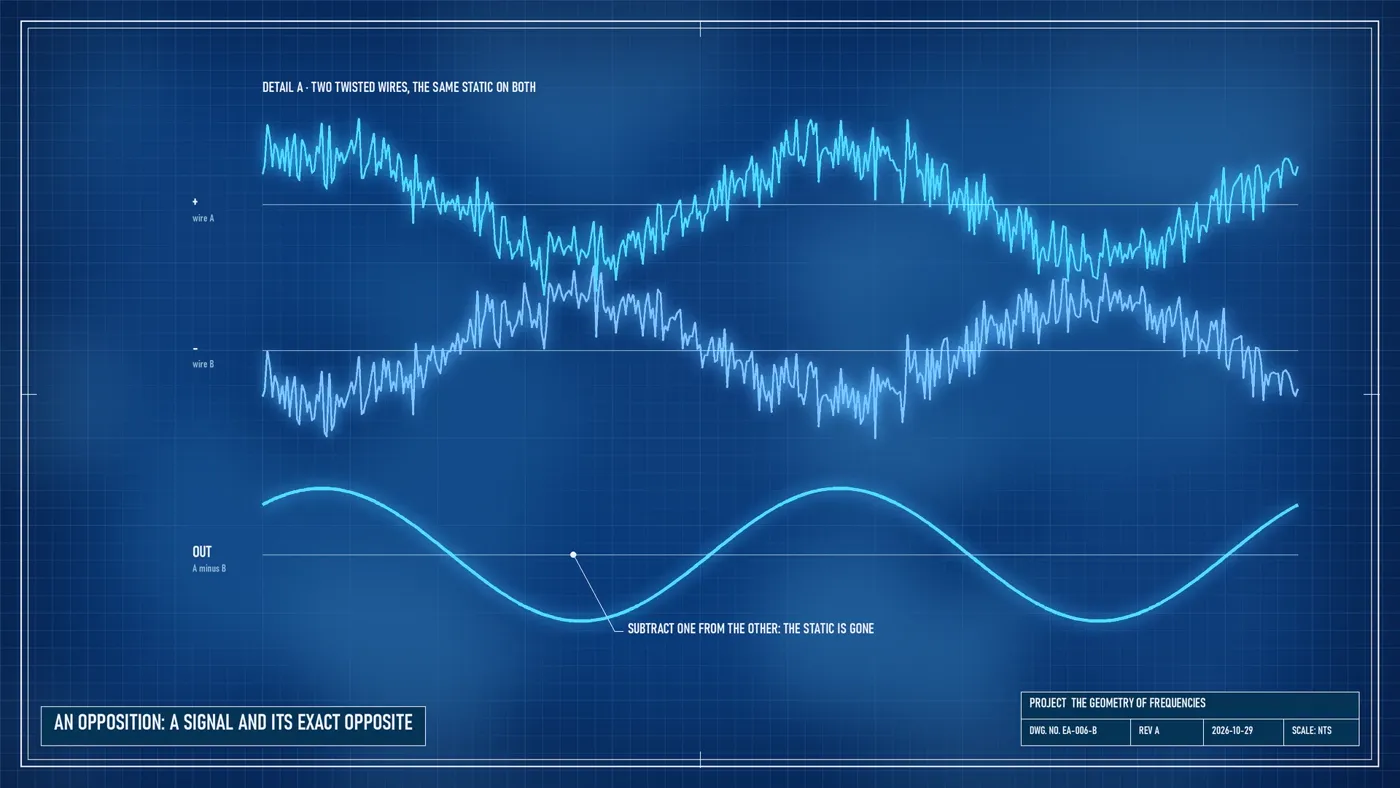
A trine is three-phase power: three waves a third of a turn apart, so the push never drops out[1]. A square is two waves out of step: the push and the flow a quarter of a turn apart, which makes the heat that makes the light. An opposition is two wires carrying opposite signals: it tunes out the static[2]. None of them is a bad part.
Three angles, three jobs
What do a trine, a square and an opposition actually do?
“I spent my career in the electrical trade,” says William Edwards, “and that’s where you learn that the shape of a wave decides whether a machine runs smooth or shakes itself to pieces.” A chart works the same way: three kinds of connection, each with its own job. Pick an angle.
△ Trine = Three-phase power
Astrologers say: Things flow.
Just as the first wave drops off, the second is rising to catch the load. Then the third. The push never drops out. It’s called three-phase power, and what it gives a motor is constant torque: a steady, even pull that never lets up.[1]
“A trine is three-phase power: it flows.”
The instrument · the Electric Astrology app
See the angles on your own chart.
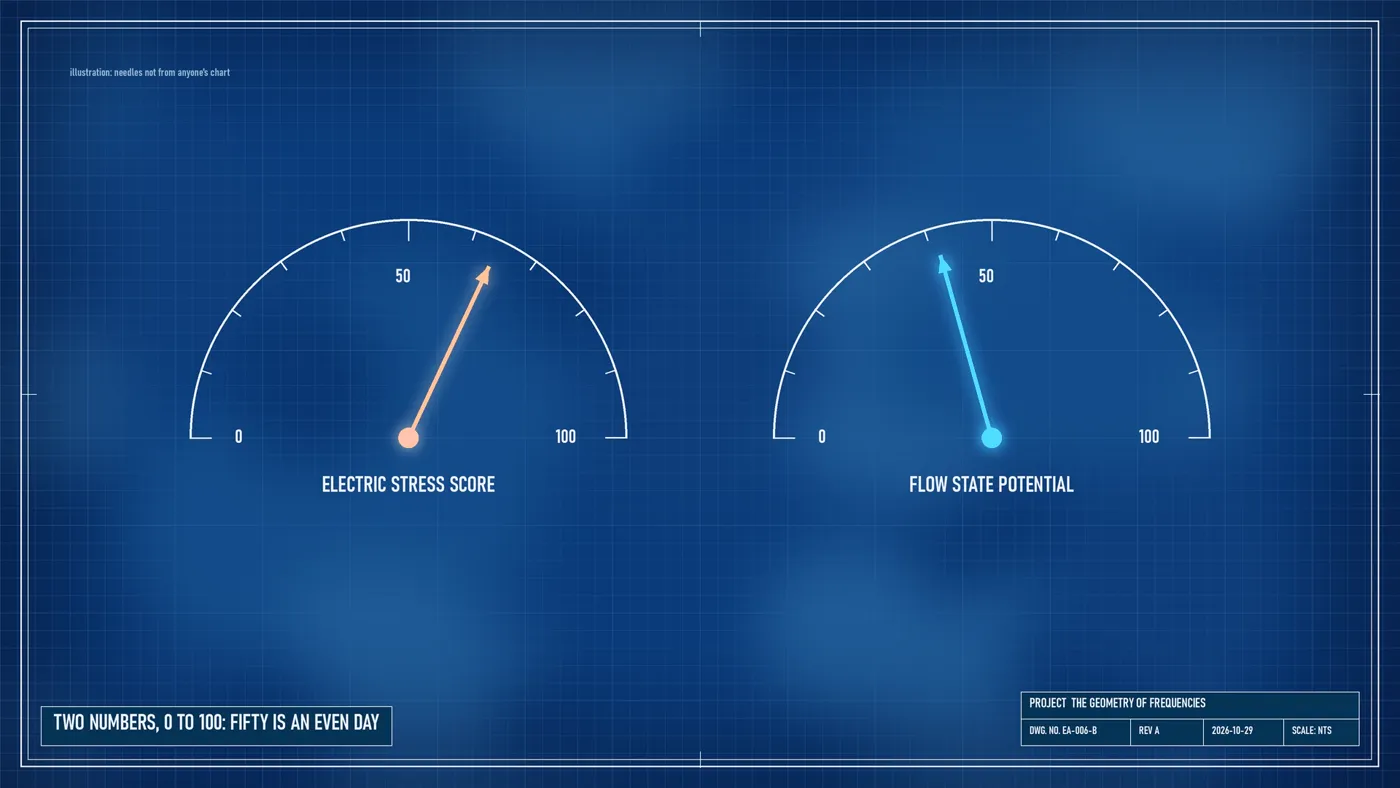
The Electric Astrology app takes every angle the planets are making to your birth chart today, adds the live space weather, and gives you two numbers from 0 to 100, with 50 as an even day: the Electric Stress Score and the Flow State Potential. Your natal schematic is free; the daily scores are part of the subscription.


The room
Why is a concert hall the best picture of astrology?
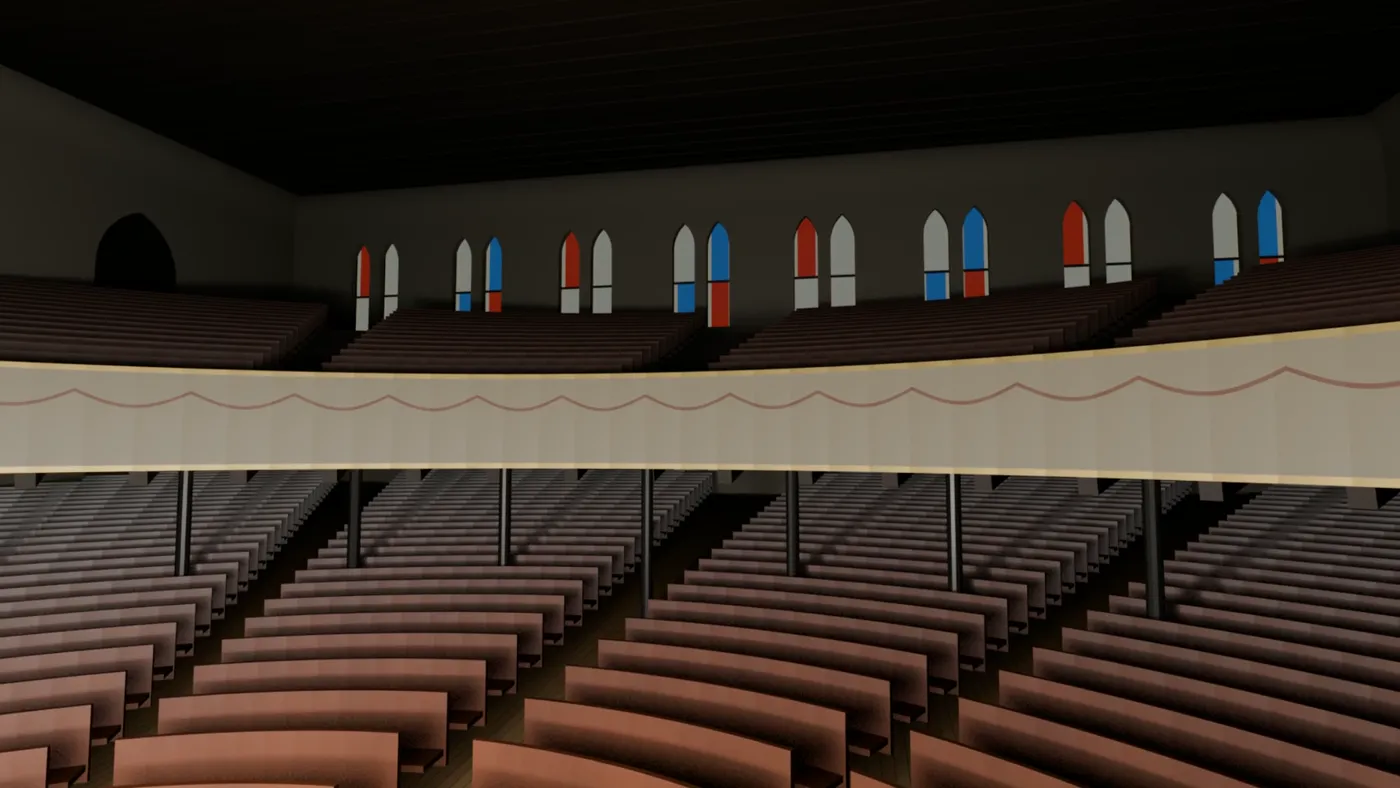
The Ryman Auditorium in Nashville opened in 1892[3], long before there was any such thing as a sound system, so the room itself had to carry a voice to the back row. So they curved it. The pews curve around the stage, the balcony curves above them. A note leaves the stage, hits every one of those surfaces and bounces back; where the copies meet in step, the note gets bigger, and where they meet out of step, it goes dead.
William Edwards was in those pews the night the band walked off and thousands of people beat their bare hands on the backs of them, hard enough to rattle the stained glass.
“We weren’t just making noise. We were playing the room.”
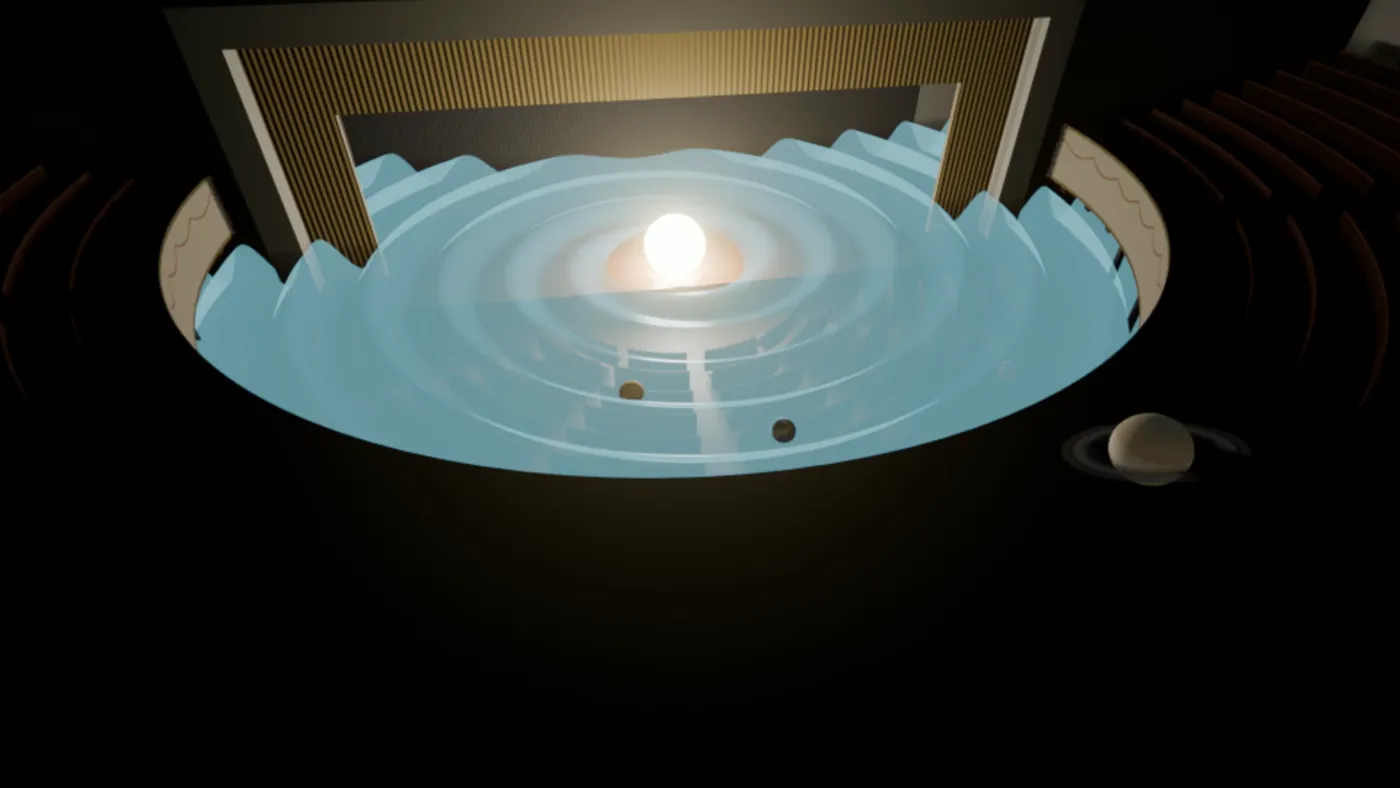
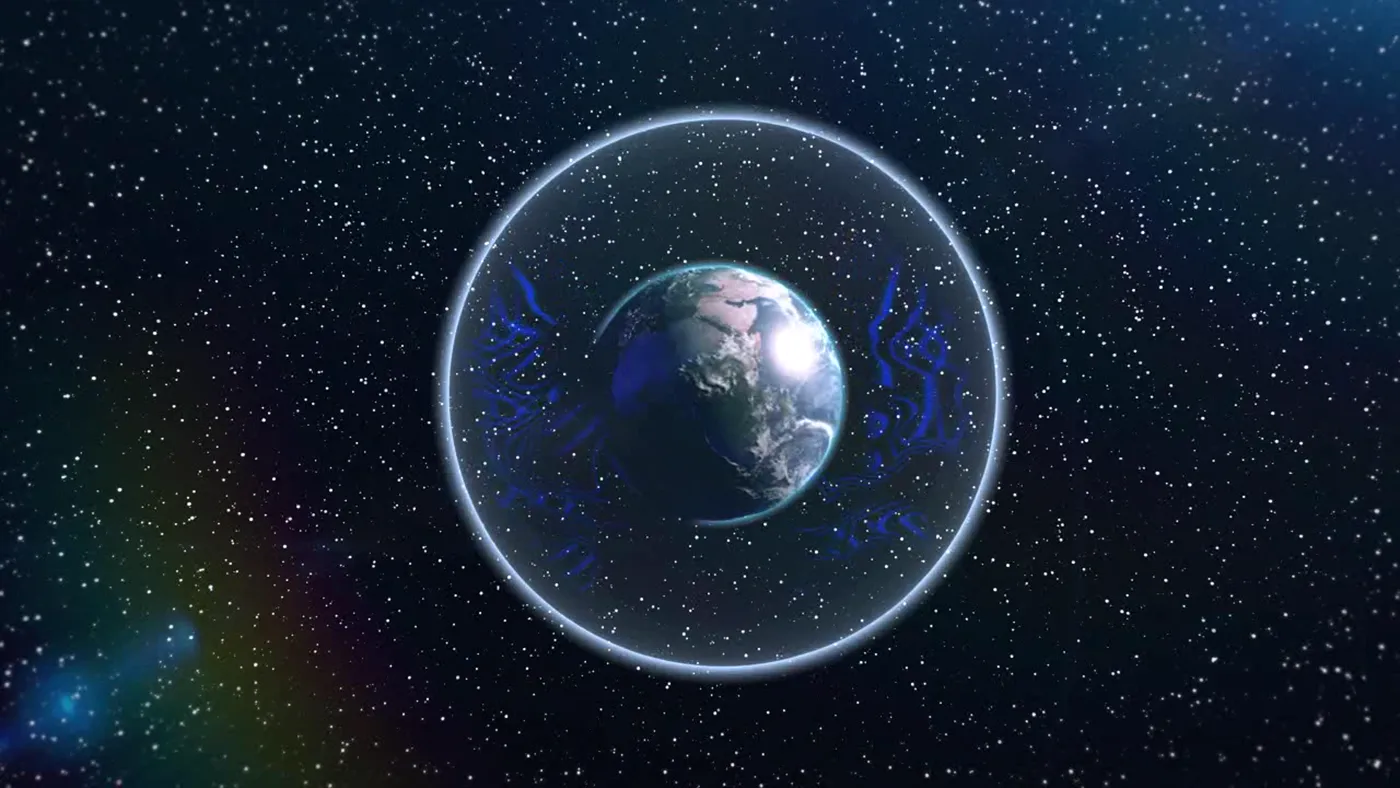
Straighten those pews out flat and that night goes dead. It was the curves that turned a sound into awe. The film’s claim is that the solar system is a room like that: the Sun on the stage, pumping out the solar wind; the heliosphere, the bubble that wind blows around the whole solar system, as the back wall[4]; and the planets as the pews, the geometry that shapes the signal.
In space there is no air to carry sound. What crosses it is electrical: the solar wind, and waves in the same family as light and radio. So we don’t hear a square. We feel tension. We don’t hear a trine. We feel flow.
The open question
How could the Earth know where a planet is?
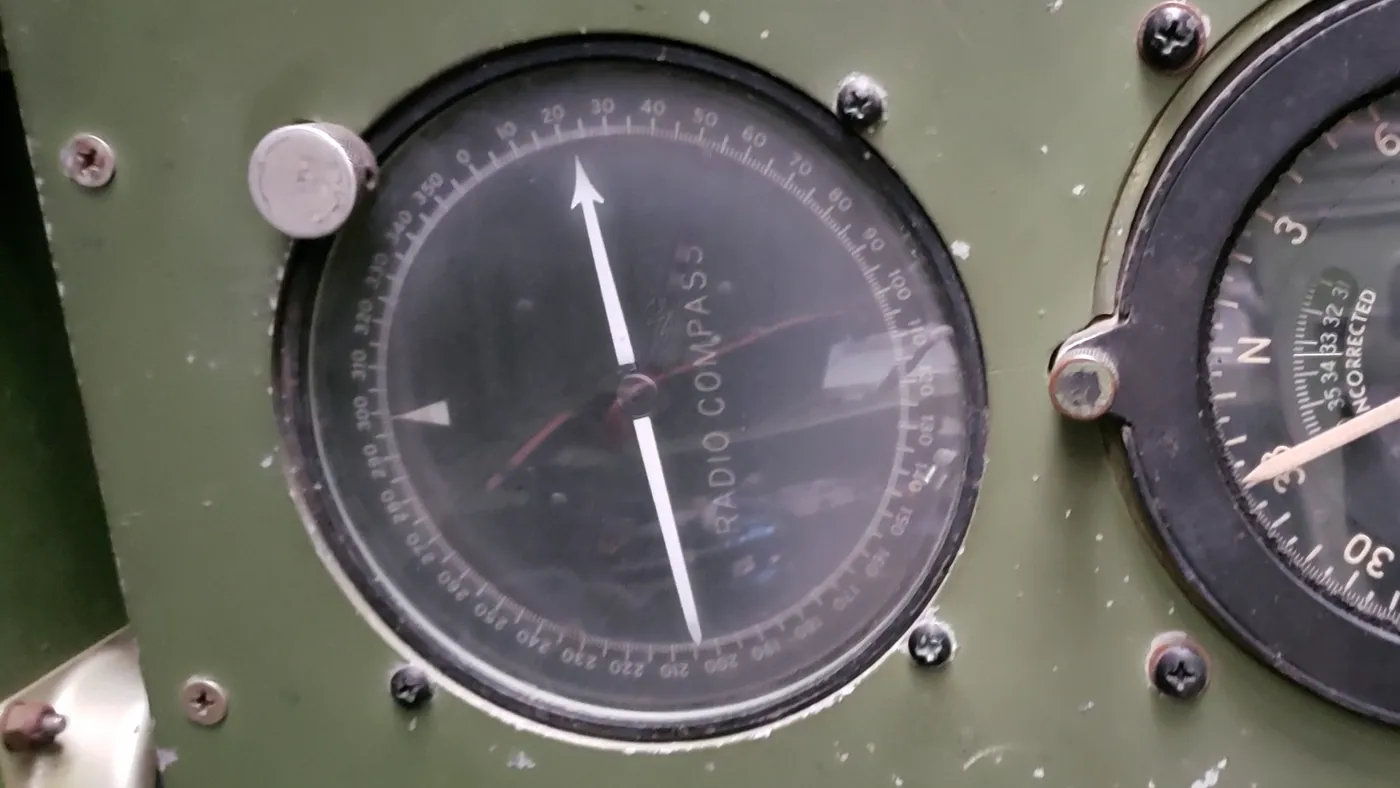
A helicopter’s automatic direction finder is a receiver: tune it to a station’s frequency and the needle points to where the signal is coming from. A crystal of galena, touched with a thin wire, pulls a radio station out of the air with no battery at all: a rock, working as a receiver. And the Earth’s crust is laden with crystals.
“If a rock can be a receiver, and a receiver tuned to the right frequency can tell which way a signal is coming from, then the Earth can sense where the planets’ signals are coming from. And we’re plugged into the Earth.”
That is William Edwards’s idea, offered as an idea. The film follows it to a birth chart read as commissioning: the reading a new machine takes of its conditions the first time it’s switched on, and locks in.
Keep following the wire
The films, live instruments and the book this one connects to.
Questions people ask
What are aspects in astrology?
The angles between two planets in the sky. Astrologers say the angle changes how you feel: a third of the way around the sky from each other (a trine, 120 degrees), and things flow; a quarter of the way (a square, 90 degrees), and everything grinds; straight across from each other (an opposition, 180 degrees), and you feel the pressure. In the film, William Edwards explains the three the way they work in a control panel: three kinds of connection, each with its own job, and none of them is a bad part.
What is a trine in astrology?
Two planets a third of the way around the sky from each other, 120 degrees apart. It is the same angle the power grid runs on: three-phase power, three waves each a third of a turn behind the last, so the push never drops out. A trine is like a superconductor, a wire with almost no resistance: the energy flows without friction. But with no heat, there is no urgency. The trine is your talent.
What does a square mean in astrology?
Two planets a quarter of the way around the sky from each other, 90 degrees apart. In the wiring, it is two waves a quarter of a turn apart: the push and the flow out of step, so the power sloshes back and forth without doing any work and comes off as heat. A square is like the heating element in a toaster: the difficult boss, the money crisis, the creative block. But heat is what makes light. A square is the engine of your ambition.
What is an opposition in astrology?
Two planets straight across the sky from each other, 180 degrees apart. Astrologers usually call it a tug-of-war. In the film it is two twisted wires, one carrying a signal and the other its exact opposite: the static hits both the same, the receiver subtracts one from the other, and the noise is gone. An opposition isn’t a war. It’s a filter. You aren’t being torn apart, you’re being tuned, the way the tension on a guitar string lets it hold a pitch.
Why would the angles between planets matter at all?
The film’s picture is a concert hall. The Sun is on the stage, pumping out the raw signal, the solar wind. That wind blows a bubble around the whole solar system, the heliosphere: the back wall. The planets are the pews, the geometry that shapes the signal. In space there is no air to carry sound; what crosses it is electrical, the solar wind and waves in the same family as light and radio. So we don’t hear a square, we feel tension. We don’t hear a trine, we feel flow.
Why is the Ryman Auditorium in a film about astrology?
Because it is an instrument. The Ryman opened in Nashville in 1892, long before there was any such thing as a sound system, so the room itself had to carry a voice to the back row: the pews curve around the stage and the balcony curves above them. William Edwards was in those pews the night thousands of people beat their hands on the backs of them: “We weren’t just making noise. We were playing the room.” Straighten the pews out flat and that night goes dead. It was the curves that turned a sound into awe, and the film argues the solar system is a room like that.
How could the Earth know where a planet is?
That is the film’s open question, and William Edwards gives his idea as an idea. A helicopter’s automatic direction finder, a receiver tuned to the right frequency, can tell which way a signal is coming from. A crystal of galena, touched with a thin wire, pulls a radio station out of the air with no battery: a rock working as a receiver. The Earth’s crust is laden with crystals. So, he says: if a rock can be a receiver, and a tuned receiver can tell which way a signal comes from, then the Earth can sense where the planets’ signals are coming from, and we’re plugged into the Earth.
What is a birth chart, in electrical terms?
In the film, a record of commissioning. When a factory starts up a new machine, the drive takes readings of the actual conditions and locks its settings to them. The moment you take your first breath, you’re on your own circuit for the first time, and your body takes a reading of that minute. That’s what a birth chart is: a record of the sky you were commissioned into.
Sources
- [1]Three-phase electric power: each phase is offset by 120 degrees from the others, which gives a more constant flow of power than single phase.
- [2]Differential signalling: a signal sent as two opposite copies on a pair of wires; noise that hits both the same is removed when one is subtracted from the other.
- [3]Ryman Auditorium, history: the Union Gospel Tabernacle opened with its first concert in May 1892.
- [4]NASA: the heliosphere, the bubble the solar wind blows around the solar system.
- [5]NobelPrize.org: Hannes Alfvén, Nobel Prize in Physics 1970, for his work in magnetohydrodynamics and plasma physics.
The angle drawings are illustrations in the film’s style, not a real date. Every image and clip in the film, with its author and license, is credited in the film’s pinned comment on YouTube.
The full transcript
The narration, chapter by chapter, as the film speaks it. Tap a time to play the film from that moment.
Why the angles between planets matter
Astrologers say the angle between two planets changes how you feel. A third of the way around the sky from each other, and things flow. A quarter of the way, and everything grinds. Straight across from each other, and you feel the pressure.
Which sounds crazy. How could an angle between two planets hundreds of millions of miles away do anything to you?
Listen, this is one chord.
Three of them, each a third of a turn behind the last.
A quarter turn. Opposite.
Same notes every time. The only thing I changed was the angle.
That first one isn’t just music. The power grid runs on three waves, a third of a turn apart. Engineers settled on it because the power never drops out. Astrologers had a name for that angle two thousand years before anybody strung a wire. The trine.
So if the angle can change a chord, what are the angles in the sky doing to the signal coming off the sun? And what’s that doing to us?
In your house, every part is tied to the next one with copper wire. Pull the cover off the panel, and you can follow every run.
In the solar system, there are no wires. There’s no copper cable stretching from the Moon to Mars.
So how does the energy get from one part to the next?
The solar system isn’t wired with metal. It’s wired with plasma.
Think of the inside of a lightning bolt, or the glow of the northern lights. Gas so charged that it carries electricity. And it flows a lot like water.
The physics of how it moves is called magnetohydrodynamics. It won a Swedish physicist named Hannes Alfvén the Nobel Prize.
The plasma is the wire. And the angles between the planets are the wiring diagram.
A night in the Ryman’s pews
Years ago, I was sitting in a pew at the Ryman Auditorium in Nashville, watching Alice in Chains play an acoustic set.
The sound didn’t hit me in the face, the way it does in an arena. It crawled inside my chest and my entire body.
The bass came up through the old wood of the pew and into my spine, until I couldn’t tell where my nervous system ended and the building began.
I wasn’t watching a band anymore. I was a single cell, vibrating inside a huge wooden lung.
Then the band walked off, and the lights stayed down. Nobody was ready to leave.
It started low, like a freight train a few miles off.
Thousands of people, beating their bare hands on the backs of those old pews. It rattled the stained glass.
We weren’t just making noise. We were playing the room.
It opened in 1892, long before there was any such thing as a sound system, so the room itself had to carry a voice to the back row.
So they curved it. The pews curve around the stage. The balcony curves above them. Row after row, all the way to the back wall.
A note leaves the stage and hits every one of those surfaces. It bounces back, and the copies cross in the air.
Where they meet in step, they add up and the note gets bigger. Where they meet out of step, they cancel, and the note goes dead.
They didn’t just build a room. They built an instrument.

The geometry of feeling
That night is the best way I know to show you something that’s usually invisible. I call it the geometry of feeling.
We treat our moods like random weather. They float in and out of our heads with no rhyme or reason.
But there’s no such thing as random. There’s only a signal, and the shape of the room that holds it.
Straighten the Ryman’s pews out flat, and that night goes dead. Drop a flat ceiling on it, and it turns to mud. It was the curves that turned a sound into awe.
I think this is exactly how astrology works.
The solar system is a room like that. The Sun is on the stage, pumping out the raw signal: a wind of that plasma that never stops blowing. It’s called the solar wind.
That wind blows a bubble around the whole solar system, called the heliosphere. That’s the back wall.
And the planets are the pews. They’re the geometry that shapes the signal.
But when Mars squares Saturn, we don’t hear it. There’s no loud noise in the sky.
Sound is air pushing on air, and space has no air. What crosses it is electrical: that wind, and waves in the same family as light and radio, which move at the speed of light, not the speed of sound. Two totally different things.
Four hundred years ago, Johannes Kepler, the man who worked out how the planets move, spent his life trying to prove that the planets make music. He gave us the notes. What he couldn’t see was the room they play in. He didn’t have the physics of electricity in space yet.
But our bodies are the pews. Our nervous systems are the old oak. We take in the vibration just as surely as I felt those hands on the pews that night.
We don’t hear a square. We feel tension. We don’t hear a trine. We feel flow. We don’t hear an opposition. We feel pressure.
For thousands of years, we’ve sat in this room, feeling anxiety, joy, aggression and peace wash over us, and we figured it all came from inside our own heads.
So what’s actually in the room with us?
The carrier and the ground
Every radio station you’ve ever tuned in sends out one steady wave, called the carrier. On its own, it’s just a hum. The music rides on it, as the station shapes that wave. That’s the modulation.
The Sun is the carrier. Raw power, all day, every day. If we only had the Sun, we’d have energy, but no information. We’d just be burning in the light.
The planets are the modulation. They take that raw power and shape it.
Mercury chops it into data. Venus smooths it into attraction. Mars spikes it into drive. Jupiter boosts it into expansion. Saturn limits it into form. Uranus disrupts it into genius. Neptune dissolves it into imagination. And Pluto compresses it into transformation.
And the planets don’t do it quietly. They put out radio of their own. NASA’s spacecraft have recorded it, and turned it into sound so our ears can take it in.
Jupiter roars like heavy metal static. Saturn hums, low and spooky.
And the Earth rings like a bell.
The bell is the space between the ground and the top of the sky, where the air turns electric. Lightning all over the world keeps it ringing, about seven point eight three times a second. It’s called the Schumann resonance.
Open any electrical panel, and the most important wire in it isn’t the one carrying the power. It’s the green one. The ground. It doesn’t feed anything. It gives everything else a reference point.
The Earth is the solar system’s ground wire, and that ring is its clock. And every one of us lives inside that bell.
Here’s what I believe. The Earth has been spinning and dancing with the Sun and these planets for billions of years. Through its magnetic field, the crystals under its crust, and the current running through it, it knows exactly where every one of them is, all the time.
And we’re little nodes inside that bell, wired into the Earth’s circuit, which is wired into the solar system’s.
How could the Earth know where a planet is?
So how could the Earth know where a planet is?
My friend Craig, the helicopter pilot from the last film, told me about an instrument in his cockpit.
You tune it to a radio station’s frequency, and the needle swings around and points to where the signal is coming from.
It’s called an automatic direction finder. A receiver, tuned to the right frequency, can tell which way a signal is coming from.
This is galena, a shiny gray crystal. Touch it with a thin wire, the cat’s whisker, wire in an antenna and a pair of headphones, and it pulls a radio station right out of the air.
There’s no battery in it. It runs on nothing but the signal it catches. It’s called a crystal radio. A rock, working as a receiver.
Now think about what the Earth is made of. The crust under your feet is laden with crystals, quartz running through the bedrock in veins. The whole planet is a giant electrical geode.
So here’s my idea. If a rock can be a receiver, and a receiver tuned to the right frequency can tell which way a signal is coming from, then the Earth can sense where the planets’ signals are coming from. And we’re plugged into the Earth.
Migrating birds carry tiny magnetic crystals in their bodies, and they find their way by the Earth’s magnetic field.
We grow those crystals too. It’s called biogenic magnetite.
When a factory starts up a new machine, nobody just flips it on. The drive runs a test, takes readings of the actual conditions, and locks its settings to them. That’s called commissioning.
You were commissioned too. The moment the cord is cut and you take your first breath, you’re on your own circuit for the first time. Those crystals take the full field of the sky, and they physically twist to line up with it.
Your body takes a reading of that minute, and it locks it in. That’s what a birth chart is: a record of the sky you were commissioned into.
From then on, the signal hits those crystals, pulses through the water in your body, and comes out as an emotion.
But why would a square come in as tension, and a trine as flow? For that, we have to leave the music and go to the wiring.
Three angles, three jobs
To a physicist, a wave is a wave. But I spent my career in the electrical trade, and that’s where you learn that the shape of a wave decides whether a machine runs smooth or shakes itself to pieces.
Open a control panel, and every part in it has a job. You wouldn’t build a toaster out of superconductors, because it wouldn’t make toast. And you wouldn’t build a power line out of resistors, because it would burn down the neighborhood.
A chart works the same way. There are three kinds of connection in it, each with its own job, and none of them is a bad part.
Start with the power in your wall outlet. It comes as one wave. It surges up, falls back to zero, swings the other way, and falls to zero again, sixty times every second.
Every time it passes through zero, for an instant, there’s no push at all. So a motor running on one wave gets its push in pulses.
Now picture that wave as a point going around a circle. One full turn of the circle is one full swing of the wave.
Add a second wave, a third of a turn behind the first. Then a third wave, a third of a turn behind that one. They’re 120 degrees apart.
Just as the first wave drops off, the second is rising to catch the load. Then the third. The push never drops out. It’s called three-phase power, and what it gives a motor is constant torque: a steady, even pull that never lets up.
So the power grid runs on it. Look up at the big lines on a pole, and you’ll often see three wires.
Now look at that circle again. A third of the way around. That’s a trine. The same 120 degrees the grid runs on, drawn between two planets in the sky.
A trine is like a superconductor, a wire with almost no resistance. The energy flows without friction. You don’t feel the work, and you don’t have to try. You just do.
But there’s a catch. With no heat, there’s no urgency. A superconductor is efficient, but it doesn’t glow.
A chart that runs on trines can settle into a comfortable loop and never build the muscle for a heavy load. The trine is your talent. But the square is the fuel.
Which brings us to the square.
In the wiring, it’s two waves a quarter of a turn apart: the push and the flow falling out of step. The voltage peaks just as the current hits zero, so the power can’t get delivered. It surges into the machine and straight back out. An electrician calls that a bad power factor.
That power sloshes back and forth without doing any work. But it still runs through the wires, and every wire has resistance, so it comes off as heat. The more resistance in the way, the more heat. That’s called Joule’s law.
A square is like the heating element in a toaster. It’s the difficult boss, the money crisis, the creative block. You feel the friction, and you feel the temperature rise.
But heat is what makes light. A light bulb is current forced through a resistor, and if the filament didn’t resist the flow, it wouldn’t glow. A square is the engine of your ambition.
Then there’s the opposition. Astrologers usually call it a tug-of-war, the planets pulling you in two directions.
Send a signal down a long wire, and the wire acts like an antenna. It picks up static from the radio, from solar storms, from the hum of the lights.
So you twist two wires together. One carries the signal, and the other carries its exact opposite.
The static hits both wires the same. At the other end, the receiver compares the two, subtracts one from the other, and the noise is gone. It’s called differential signaling. Noise-canceling headphones work the same way: they listen to the noise around you, play its exact opposite into your ear, and you get silence.
An opposition isn’t a war. It’s a filter. The tension between the two points is what creates the clarity.
You aren’t being torn apart. You’re being tuned. The tension on a guitar string isn’t there to break it. It’s there so it can hold a pitch.
So flow, heat and clarity each have a job. The trine runs the motor, the square makes the heat that makes the light, and the opposition tunes out the static.
You are the band
Now remember what happened in the Ryman when the music stopped.
We didn’t just sit there in the silence. We pounded on the pews. We sent a signal back.
You aren’t just a receiver. You’re a transceiver, like a walkie-talkie. A circuit goes both ways.
Think about the weather radar on the evening news. It shows you the storm before it gets to you, so you know whether to take an umbrella.
The Electric Astrology app works like that. It’s a weather radar for space, and the space weather it reads changes every single day.
There are three gauges worth watching. Picture a pressure gauge on a tank. As the pressure builds, the needle climbs. The Kp index is that gauge for the Earth’s magnetic field. Zero is calm. Nine is a severe storm.
When it spikes, the whole atmosphere turns into a pressurized vessel.
Then there’s the Earth’s bell, the Schumann resonance. Day to day, you can watch the background static rise and fall.
And there’s the solar wind. Some days it blows like a breeze, and some days it comes in like a wall of water, and hits the Earth’s magnetic shield like a tidal wave.
Put all of that together with the angles, and you get seasons on the grid. Seasons of high voltage, when the squares are on. Seasons of flow, when the trines are. And seasons of static, under the oppositions.
If you don’t have the map, you’re walking blind into a hurricane. You take a high Kp personally. You think you’re anxious, when really you’re vibrating in sympathy with the planet.
But when you have the map, you stop being a victim of the weather, and you start being an operator.
Say the Kp spikes and the squares are on. That’s not the day to run a marathon, or to force the flow. You insulate. You ground yourself. And you turn that heat into inner work, instead of burning out the people around you.
Now say the geometry lines up and the trines are on. The superconductor is live. Don’t waste that sitting on the couch. Open the throttle, and push that current into your biggest projects.
And none of these shapes last. When Mars squares Saturn, they’re doing a tango. The tension you feel is the torque of the turn, and the release comes when they step apart.
If the signal’s too loud, dampen it. If it’s too weak, amplify it. And if the rhythm’s chaotic, stomp your foot and set your own beat.
That night, the Ryman wasn’t just there to hold the sound. It was there to amplify us. The solar system is no different.
You aren’t the audience. You are the band.
There are no wires in space
There are no wires in space. The solar system is wired with plasma, and the angles between the planets are the wiring diagram.
The Sun is the carrier, the planets shape it, and the Earth is the ground we’re all wired into, from our first breath.
A trine is three-phase power: it flows, and it doesn’t glow. A square is two waves out of step: it makes the heat that makes the light. And an opposition is two wires carrying opposite signals: it tunes out the static.
The circle cut from the Ryman’s stage
Come back down to the front of the Ryman’s stage, to the spot where the singer stands.
Look at the floorboards. There’s a six-foot circle of lighter oak, let into the dark, stained wood.
That isn’t the original floor.
Years ago, the exact focal point of that room, the heart of the Mother Church, was cut out. They lifted it out of the building and carried it away.
Why would anyone cut the heart out of an instrument like that?
Because the Ryman was built to collect the signal, and collecting it wasn’t enough. We needed to broadcast it.
So that circle went into the Grand Ole Opry, wired up to something much louder than a wooden room.
That circle became the spot where a human voice is stepped up, electrified, and turned into a wave that travels at the speed of light.
Remember the pews answering back? This is the room itself doing it.
That’s the story of what happens when we stop listening and start screaming back. I told it in the Music City film.
A room that well-tuned had a heart at its focal point.
So do you.
See your own
The sky is the signal. You’re the sensor. And the Electric Astrology app is what lines the two up.
It takes every angle the planets are making to your own birth chart today, adds the live space weather, and weighs it all against your natal chart, because no two charts take the same weather the same way.
Out come two numbers, from zero to a hundred, with fifty as an even day: the Electric Stress Score and the Flow State Potential.
If you want to see your own, download the app and build your natal schematic. It’s your chart, drawn as a schematic, and it’s yours to keep. The daily scores are part of the subscription. The link’s on the screen.
One tap
Do you feel the trines, the squares and the oppositions?
Come along
The sky is the signal. You’re the sensor.
And the Electric Astrology app is what lines the two up: the angles the planets are making to your chart, the live space weather, and two numbers for the day. It’s on iPhone and Android, and the book is in there too.
Want the whole story on paper? Get the book →